Speech Given in the Trinity Debate on December 30, 2005 at the First Congergational Church in Riverside California
Throughout church history, the Christian Church has always maintained faith in the Doctrine of the Triune nature of Almighty God, affirming the essential Biblical truth that within the one true and living God exists three distinct persons: the Father, the Son and the Holy Spirit and that Jesus Christ preexisted before His incarnation.One of the egregious errors of the Unitarian position regarding the Trinity pertains to the Preexistence and deity of Jesus Christ.
By Pre-existence we mean, that the body of Jesus Christ, began with it's conception in the Womb, however, the mind and soul of Jesus existed before the conception of His earthly body. Jesus is unique in that He alone possesses a soul that pre-existed His conception in the womb of His mother. Whereas, all other humans begin to exist at conception, the Son of God pre-existed His entrance into the World. The Deity of Christ and eternal preexistence is openly denied by the Unitarians.The Unitarians believe that God is only one person and that Jesus Christ is not God, the second person of the Trinity who is co-equal with the Father and deny the personhood and deity of the Holy Spirit as well.
They argue that Christ did not actually physically exist as a person before the incarnation, rather he existed in the foreknowledge and plan of God. Anthony Buzzard, one of the leading modern Unitarian scholars argues in his book says that the Prexistence statements in the NT really have to do with predestination and foreordination and not that Christ pre-existed in eternity past.On Page 176 of this same work, Buzzard writes, the view of Jesus as uncreated" is not derived from scripture; rather, it has been handed down through post-biblical tradition." Again, on Page 181 and 182 Buzzard writes,"Talk of Jesus preexistence [in Scripture] ought probably in most, perhaps in all cases, to be understood, on the analogy of the preexistence of the Torah, to indicate the eternal divine purpose being achieved through him rather than preexistence of a fully personal kind. "
On Page 184 Buzzard quotes James Dunn in stating,"Outside of John's gospel, there is no doctrine of a literal preexistence."However, this Unitarian denial of the eternal pre-existence of the Lord Jesus Christ is easily refuted by Holy Scripture. The Bible is very clear that Jesus Christ is God and that he personally existed in eternity past before His Incarnation via the virgin Birth. It must be noted that the entire Unitarian line of argumentation against the doctrine of the Trinity and its denial of the deity and pre-existence of Christ can be demonstrated to be in absolute error if it can be shown from Scripture and the original languages of the Bible, that Jesus Christ personally existed at least one day before His incarnation. The following Scriptures clearly demonstrate that Jesus Christ did personally pre-exist before His incarnation and easily refute the heretical errors of Unitarianism argued for by own opponents in this debate.
Micah 5:2 2"But as for you, Bethlehem Ephrathah, Too little to be among the clans of Judah, From you One will go forth for Me to be ruler in Israel His goings forth are from long ago, From the days of eternity." German Old Testament scholars Kiel & Delitzsch in their 10 volume commentary on the OT clearly demonstrate that this passage, a prophecy concerning the Messiah refers to Jesus Christ’s pre-existence when they write, that: “the future Ruler of Israel, whose goings forth reach back into eternity, is to bring forth from the insignificant Bethlehem, like his ancestor David.
The descent of David from Bethlehem forms the substratum not only for the prophetic announcement of the fact that the Messiah would come forth this small town, but also for the divine appointment that Christ was born in Bethlehem, the city of David.” Dr. Thomas McComiskey, esteemed professor of OT & Semitic languages at Trinity Evangelical Divinity school states in the Expositor’s Bible commentary that the Hebrew grammar & syntax of Micah 5:2, in the terms “Old (qedem) & (yeme olam) denote great antiquity as well as eternity in the strictest sense. He argues that, Christ pre-existed in eternity past & only in Jesus Christ does this prophecy find fulfillment. (p427). Dr. Pocock, the highly respected English Arabic & Hebrew scholar, who occupied both the chairs of Arabic & Hebrew at Oxford argued that the term “of old, from everlasting” signals a description of Christ’s eternal generation, or His going forth as the Son of God, begotten of His father before all worlds” John 1:1-3 we find these Words,In the beginning was the Word, & the Word was with God, & the Word was God. He was in the beginning with God.
All things came into being through Him, & apart from Him nothing came into being that has come into being.This is a VERY simple statement of pure-and-simple plurality-in-unity.
John 1:14 the Apostle John writes, “& the Word became flesh & dwelt amongst us & we beheld His glory as the only begotten of the Father, full of grace & truth”I am well aware of the fact that Buzzard & the Unitarians argue that the Logos mentioned here by the Apostle John is not referring to a person, however, taken in context, when you view John 1:1-14 as a literary unit, the Logos can only refer to Jesus Christ who had a pre-existence & ultimately became flesh.If these verses do not refer to Jesus Christ who became flesh, what in the World does He mean when He says, “The Word became flesh & dwelt amongst us & we beheld His glory, the glory as the only begotten of the Father” who then, if not Jesus, is the Only begotten of the Father?
The context of these passages conclusively demonstrate that:
1. The Logos existed from the beginning with God.
2. The Logos is Himself God. The lit. Greek renders it ‘& God was the Word”
3. The Logos had preexistence as God.
4. All things came into being through the Logos.
5. The Logos became flesh.
6. The Logos is Himself Jesus Christ as evidenced by the fact that the Logos becomes flesh & is called the only begotten of the Father.It is clear from the writings of the Apostle John that the only begotten of the Father refers to Jesus.
John the Baptist argues for Christ’s preexistence when he says in John 1:15 “This was He of whom I said, ‘He who comes after me is preferred before me, for He was before me.” He even says it again in 1:27John wasn’t influenced so much by the Greek philosophers as our opponents might think, he was well schooled in the Targums of which we saw taught that the Meemra’, THE WORD was YHWH.John 8:58, Jesus Christ once again exerts His pre-existence when he stated, “Before Abraham was, I am” conclusively demonstrating that Jesus believed that He existed before Abraham.”Dr. AT Robertson, the most renowned Greek scholar & Grammarian of the 20th century makes some interesting points here:
1. Greek is clearly saying that "before Abraham came into existence or was born"2. Jesus is undoubtedly claiming, “eternal existence with the absolute phrase used of God.” ego eimi3. The contrast between genesthai, which is Abraham’s entrance into existence & eimi (Jesus as a timeless being) is complete.Did they not want to stone him because he was claiming to be deity? Well The "I am" phrase is how the OT Septuagint translators render the Hebrew "I AM" of Ex 3:14. This "I am" statement of Jesus is immediately understood by the Jews, who pick up stones to execute the proper sentence for blasphemy (Lev 24.16).
John 17:5, another devastating verse against the Unitarian argument against the Pre-existence of Christ, Jesus said,5"Now, Father, glorify Me together with Yourself, with the glory which I had with You before the world was.Hey here is a question for you, how can Jesus have glory with the Father before the world began if he didn’t pre-exist?It is clear from that Jesus pre-existed before His incarnation & claimed that He enjoyed fellowship with the Father before the foundation of the world.
Again Dr. A.T. Robertson writing on the Greek Grammatical construction writes,“Jesus prays for full restoration to the pre-incarnate glory & fellowship (cf. Mat 1:1) enjoyed before the Incarnation (John 1:14). This is not just ideal pre-existence, but actual & conscious existence at the Father's side…It is small wonder that those who deny or reject the deity of Jesus Christ have trouble with the Johannine authorship of this book & with the genuineness of these words. But even Harnack admits that the words here and in verse John 24 are "undoubtedly the reflection of the certainty with which Jesus himself spoke" (What Is Christianity, Engl. Tr., p. 132).
But Paul, as clearly as John, believes in the actual pre-existence and deity of Jesus Christ (Phil 2:5-11).The Apostle Paul in Colossians 1:15-16 also clearly argues for the Pre-existence of Jesus Christ, when he writes,15He is the image of the invisible God, the firstborn of all creation. For by Him all things were created, both in the heavens & on earth, visible & invisible, whether thrones or dominions or rulers or authorities--all things have been created through Him & for Him. 17He is before all things, & in Him all things hold together.When looking at the prepositions used in the Greek en-in; dia-through, & eis, scholars point out that these not only prove supreme deity but also his preexistence. It is absolutely obvious & inescapable from that Jesus Christ is God & that He preexisted before the world, evidenced by the fact Paul says here that Christ is before all things & in Him all things are held together.
No amount of Iesegesis & grammatical gymnastics can allow the Unitarians to escape from the obvious fact that Paul believed Jesus Christ pre-existed before His virgin Birth, to say otherwise is to go against the grammatical construction of the text & to lapse into a Presuppositional bias against Christ’s pre-existence based on previously held views against the Deity of Christ & the Trinity.Lastly Hebrews 1:1-3 clearly demonstrates that Jesus has preexistence before His physical birth in this world, when the author of Hebrews states;
1. God, after He spoke long ago to the fathers in the prophets in many portions & in many ways,
2. In these last days has spoken to us in His Son, whom He appointed heir of all things, through whom also He made the world.
3. And He is the radiance of His glory and the exact representation of His nature, and upholds all things by the word of His power When He had made purification of sins, He sat down at the right hand of the Majesty on high.Verse two clearly states that God the Father made the world through Jesus Christ.
A.T. Robertson writes,“Through whom The Son as Heir is also the Intermediate Agent (dia) in the work of creation as we have it in Col 1:16; John 1:3….the Scriptural evidence for the Pre-existence of Jesus Christ, conclusively demonstrating His deity is abundant, to argue otherwise is to go against the context of these verses, to lapse into esiegeis and a Presuppositional bias against the Trinity, not because the Scriptures actually teach your Unitarian position.”In verse 3 the literal Greek reads that the Son is the exact character & nature of God. The word for character or representation when used in extra biblical literature refers to an exact copy, like an impression in clay or a stamping on a coin. Jesus nature is an exact copy of the nature of the Father.But this is what Trinitarians expect…and what Unitarians have problems with.
Monday, May 29, 2006
What I Said at the Debate
(The Following is My Prepared Text for Last Friday's Debate with Dan Mages Held on May 26th 2006)
Good evening, I am grateful to Almighty God to be here tonight in order to defend the Deity of the Lord Jesus Christ.
For the record, we are orthodox, historical and Biblical Evangelical Christians and we believe that Jesus Christ is fully God and fully man.
We believe that God the Father sent God the Son through the power and agency of God the Holy Spirit into the world to die on the cross for our sins And rise again from the dead in order to give all those who sincerely repent and believe in Christ the hope of eternal life.
Throughout the annals of human history a tremendous debate has raged over the true identity of Jesus Christ of Nazareth. While the Historic Christian Church has always affirmed the Doctrine of the Trinity and affirmed that Jesus Christ is God the Son, the Second person of the eternal Godhead, there have been many heretical opponents of historic Christianity.
Over the centuries of church history. there have been many heretical and aberrant views of the person of Jesus Christ.
The heretical group known as the “Gnostics” argued for a Docetic view of Christ and said, that Jesus Christ only “appeared” to take on human flesh and that Jesus Christ never shared both human and divine natures as the Chalcedonian Creedal formulation on the Hypostatic Union Affirms.
The Arians of the Fourth Century argue that Jesus Christ was not God, but rather was a created being that did not possess the same nature as God the Father.
The Modalists of Sabbelians, early opponents of Biblical Christianity likewise denied the Doctrine of the Trinity and argued that only one person exists in the godhead, who takes on different modes of being, some times manifesting Himself as the Father, other times as the Son and then at times as the Holy Spirit.
Sabbellianism is very closely associated with the ancient heresy known as Patripassianism, the belief that God the Father and Son are simply different aspects of God. The implication of this belief is that God the Father suffered on the cross.
Another heretical view concerning the godhead that the historic Christian Church rejects is Tritheism, the belief that there are three equally powerful gods who form a triad. The gods are envisaged as having separate powers and separate supreme beings or spheres of influence but working together.
Still another heretical view concerning the nature of God is the Unitarian view, argued for by my opponent this evening Dan Mages.
Historic Unitarianism afirms the notion of Unitary monotheism and believes in the oneness of God as opposed to traditional Christian belief in the Trinity that affirms that there are three distinct persons in the godhead. Historic Unitarians believe in the moral authority, but not the deity, of Jesus.
Oxford Trained and Leading Unitarian scholar Dr. Anthony Buzzard who I had the chance to speak with on Wednesday, argues in his book entitled, “The Doctrine of the Trinity” Christianity’s Self Inflicted wound” that in no place in the Bible does the Scriptures ever teach that Jesus Christ is God, rather Jesus is merely a human messiah who carried out the will of God the Father.
Dr. Buzzard says on page 335 of his book that contemporary othodox belief in the divine and human Christ is in all actuality a crypto-gnostic element that has been handed down to us in Trinitarian Christology.
On Page 275, in his chapter in that same book entitled, “The Challenge Facing Trinitarianism Today” Buzzard argues that nowhere in the New Testament is Jesus Christ called God.
Buzzard writes “God in the New Testament almost invariably means the Father of Jesus and never three persons”
However, despite Dr. Buzzard, Dan and the Biblical Unitarian oppostion to the view that Jesus Christ is God, there is nothing in their argument that gives us any reason to abandon the biblical and historic view concerning the Trinity and Deity of Christ. For we the historic and Biblical Church have always believed in the doctrine of the Trinity.
The Historic Christian Doctrine of the Trinity believed by all true Christians since the inception of the Church some two millennia ago states unequivocally the doctrine of Trinitarian Monotheism, in that, Almighty God is a singular being who exists simultaneously and eternally as a communion of three distinct and co-eternal persons, God the Father, God the Son and God the Holy Spirit who share a single divine essence.
We, the true and historic orthodox Christian Church, believe that there exists only one true and living God and in God exists three distinct persons who share the same essence or nature of being, the Father, the Son and the Holy Spirit.
We, the historic Christian Church reject the cultic doctrine of the Unitarian position on the nature of God for many irrefutable reasons.
First of all there is nothing in Dan Mages unbiblical and hermeneutically suspect presentation that persuades us to abandon the Biblical and historic doctrine of the Trinity.
His thesis and that of leading Unitarian teacher Anthony Buzzard is guilty of forced exegesis that does not do justice to abundant Scriptural evidence that the Bible clearly teaches the doctrine of the Trinity and in particular the Deity of Christ, our specific focus this evening. We want to state for the record that we reject the notion implied by Dan and the Unitarians that we are somehow affirming Tritheism; rather, we are strict monotheists.
The historic Christian Church has always believed that there is one true and living God. We affirm the Shema’s declaration in Deuteronomy 6:4 that states, “O hear oh Israel, the Lord Your God is one Lord”
We affirm Isaiah 43:10 which reads,
"You are my witnesses," declares the LORD,"and my servant whom I have chosen, that you may know and believe me and understand that I am he.
Before me no god was formed, nor shall there be any after me.
Yet, we believe in the historic doctrine of the Trinity affirming Trinitarian Monotheism. That in the one true and living God exists three distinct persons who share the same essence and divine nature.
The Bible clearly teaches there is one true God, yet it also teaches that those three distinct persons exist within the Godhead.
The Bible clearly calls the Father God, the Son God and the Holy Spirit God.
The Bible explicitly teaches and celebrates that Jesus Christ is God the Son.
The Old Testament clearly teaches the Divinity of the Messiah,
Isaiah 9:6-7 says,
For to us a child is born, to us a son is given; and the government shall be upon his shoulder, and his name shall be called Wonderful Counselor, Mighty God, Everlasting Father, Prince of Peace
My question for Dan regarding Isaiah 9:6 is why is Jesus Christ called “Mighty God if He is not divine?”
Micah 5:2 says,
But you, O Bethlehem Ephrathah, who are too little to be among the clans of Judah, from you shall come forth for me one who is to be ruler in Israel, whose origin is from of old, from ancient days.
Dr. Thomas McComiskey, esteemed professor of OT & Semitic languages at Trinity Evangelical Divinity school states in the Expositor’s Bible commentary that the Hebrew grammar & syntax of Micah 5:2, in the terms “Old (qedem) & (yeme olam) denote great antiquity as well as eternity in the strictest sense. He argues that, Christ pre-existed in eternity past & only in Jesus Christ does this prophecy find fulfillment. (p427). Dr. Pocock, the late and highly respected English Arabic & Hebrew scholar, who occupied both the chairs of Arabic & Hebrew at Oxford argued that the term “of old, from everlasting” signals a description of Christ’s eternal generation, or His going forth as the Son of God, begotten of His father before all worlds”
In the New Testament there are very clear and unambiguous passages that teach that Jesus Christ is God.
Matthew 28:19-20
“Go therefore and make disciples of all nations, baptizing them in the name of the Father and of the Son and of the Holy Spirit”
The Trinitarian language of Matthew 28:19-20 is reminiscent of that which Paul used in 2 Corinthians 13:14:
“The grace of the Lord Jesus Christ and the love of God and the fellowship of the Holy Spirit be with you all”
My question for Dan is why is Jesus Christ included in the Triadic formulations if He is not God and equal with the Father. Why do we baptize in the name of Christ if He is not equal with the Father. Why does it say baptize in the name of the Father, Son and Holy Spirit if only the Father is God, why is Jesus and the Holy Spirit included in the “name” in that Greek Grammatical construction? Why is the singular Greek term (onoma) used here and not a plural form?
John 1:1-3
In the beginning was the Word, and the Word was with God, and the Word was God. He was in the beginning with God. All things were made through him, and without him was not any thing made that was made.
And John 1:14 says,
And the Word became flesh and dwelt among us, and we have seen his glory, glory as of the only Son from the Father, full of grace and truth.
John 1:14 the Apostle John writes, “& the Word became flesh & dwelt amongst us & we beheld His glory as the only begotten of the Father, full of grace & truth”I am well aware of the fact that Buzzard & the Unitarians argue that the Logos mentioned here by the Apostle John is not referring to a person, however, taken in context, when you view John 1:1-14 as a literary unit, the Logos can only refer to Jesus Christ who had a pre-existence & ultimately became flesh.If these verses do not refer to Jesus Christ who became flesh, what in the World does He mean when He says, “The Word became flesh & dwelt amongst us & we beheld His glory, the glory as the only begotten of the Father” who then, if not Jesus, is the Only begotten of the Father? The context of these passages conclusively demonstrate that:1. The Logos existed from the beginning with God.2. The Logos is Himself God. The lit. Greek renders it ‘& God was the Word”3. The Logos had preexistence as God.4. All things came into being through the Logos.5. The Logos became flesh.6. The Logos is Himself Jesus Christ as evidenced by the fact that the Logos becomes flesh & is called the only begotten of the Father.It is clear from the writings of the Apostle John that the only begotten of the Father refers to Jesus.
John the Baptist also argues for Christ’s divine preexistence when he says in John 1:15 “This was He of whom I said, ‘He who comes after me is preferred before me, for He was before me.” He even says it again in 1:27
John 1:18 says,
No one has ever seen God; the only God, who is at the Father's side, he has made him known.
But the best old Greek manuscripts (Aleph B C L) read monogenhß qeoß (God only begotten) which is undoubtedly the true text.
John 5:17-18
But Jesus answered them, "My Father is working until now, and I am working." This was why the Jews were seeking all the more to kill him, because not only was he breaking the Sabbath, but he was even calling God his own Father, making himself equal with God.
John 8:24,
I told you that you would die in your sins, for unless you believe that I am he you will die in your sins."
John 8:58
Jesus said to them, "Truly, truly, I say to you, before Abraham was, I am."
John 10:30-33 Jesus said,
I and the Father are one."
The Jews picked up stones again to stone him. Jesus answered them, "I have shown you many good works from the Father; for which of them are you going to stone me?" The Jews answered him, "It is not for a good work that we are going to stone you but for blasphemy, because you, being a man, make yourself God."
John 14:5-10
Thomas said to him, "Lord, we do not know where you are going. How can we know the way?" Jesus said to him, "I am the way, and the truth, and the life. No one comes to the Father except through me. If you had known me, you would have known my Father also. From now on you do know him and have seen him."
Philip said to him, "Lord, show us the Father, and it is enough for us." Jesus said to him, "Have I been with you so long, and you still do not know me, Philip? Whoever has seen me has seen the Father.
In John 17:5
And now, Father, glorify me in your own presence with the glory that I had with you before the world existed
John 20:28
Then he said to Thomas, "Put your finger here, and see my hands; and put out your hand, and place it in my side. Do not disbelieve, but believe." Thomas answered him, "My Lord and my God!" Jesus said to him, "Have you believed because you have seen me? Blessed are those who have not seen and yet have believed."
Acts 20:28
Pay careful attention to yourselves and to all the flock, in which the Holy Spirit has made you overseers, to care for the church of God, which he obtained with his own blood.
Romans 9:5
To them belong the patriarchs, and from their race, according to the flesh, is the Christ who is God over all, blessed forever. Amen.
Philippians 2:5-11
Have this mind among yourselves, which is yours in Christ Jesus, who, though he was in the form of God, did not count equality with God a thing to be grasped, but made himself nothing, taking the form of a servant, being born in the likeness of men. And being found in human form, he humbled himself by becoming obedient to the point of death, even death on a cross. Therefore God has highly exalted him and bestowed on him the name that is above every name, so that at the name of Jesus every knee should bow, in heaven and on earth and under the earth, and every tongue confess that Jesus Christ is Lord, to the glory of God the Father.
Colossians 1:13-19 says,
He has delivered us from the domain of darkness and transferred us to the kingdom of his beloved Son, in whom we have redemption, the forgiveness of sins. He is the image of the invisible God, the firstborn of all creation. For by him all things were created, in heaven and on earth, visible and invisible, whether thrones or dominions or rulers or authorities--all things were created through him and for him. And he is before all things, and in him all things hold together. And he is the head of the body, the church. He is the beginning, the firstborn from the dead, that in everything he might be preeminent. For in him all the fullness of God was pleased to dwell, and through him to reconcile to himself all things, whether on earth or in heaven, making peace by the blood of his cross.
Colossians 2:8-10
See to it that no one takes you captive by philosophy and empty deceit, according to human tradition, according to the elemental spirits of the world, and not according to Christ. For in him the whole fullness of deity dwells bodily, and you have been filled in him, who is the head of all rule and authority.
Hebrews 1:1-8
Long ago, at many times and in many ways, God spoke to our fathers by the prophets, but in these last days he has spoken to us by his Son, whom he appointed the heir of all things, through whom also he created the world. He is the radiance of the glory of God and the exact imprint of his nature, and he upholds the universe by the word of his power. After making purification for sins, he sat down at the right hand of the Majesty on high, having become as much superior to angels as the name he has inherited is more excellent than theirs.
For to which of the angels did God ever say, "You are my Son, today I have begotten you"?
Or again, "I will be to him a father, and he shall be to me a son"?
And again, when he brings the firstborn into the world, he says, "Let all God's angels worship him."
Of the angels he says, "He makes his angels winds, and his ministers a flame of fire."
But of the Son he says, "Your throne, O God, is forever and ever, the scepter of uprightness is the scepter of your kingdom.
Now the two primary lines of New Testament Argumentation that demonstrates the Deity of Jesus Christ from the Bible pertain to the Doxologies to Christ and the Pre-existence of Jesus Christ.
A Doxology is a Word said or sung in praise of the Holy Trinity demonstrating God’s worthiness of being venerated.
Usually a doxology is an expression of praise to God, especially a short hymn sung as part of a Christian worship service.
It is important to understand that doxologies of worship in the Bible are only directed towards God.
The fact that there are doxologies in the Bible to Jesus Christ demonstrates that His disciples in the New Testament viewed Him to be more than a mere man, but in all actuality God Himself.
If Jesus Christ is not God, then why then, did the disciples worship and pray to Jesus? Why then did the disciples direct their prayers to Christ?
If Christ is not God, then the disciples, who were strict Jewish monotheists engaged in the highest form of blasphemy by praying and worshipping Jesus as though He were God.
In John 9:35-39, the blind man who was healed worshipped Jesus as God, if Jesus was not God He would have rebuked the formerly blind man for blasphemy just as the Apostle John was rebuked by an Angel in Revelation 22, when John tried to worship the Angel
Please follow the contrast between John 9:35-39 and Revelation 22:8-9
John 9:35-39 says,
Jesus heard that they had cast him out, and having found him he said, "Do you believe in the Son of Man?"He answered, "And who is he, sir, that I may believe in him?" Jesus said to him, "You have seen him, and it is he who is speaking to you." He said, "Lord, I believe," and he worshiped him. Jesus said, "For judgment I came into this world, that those who do not see may see, and those who see may become blind."
Acts 7:59-60
And they stoned Stephen, calling upon God, and saying, Lord Jesus, receive my spirit. And he kneeled down, and cried with a loud voice, Lord, lay not this sin to their charge. And when he had said this, he fell asleep.
Steven’s calling upon Christ, which is a prayer demonstrates that Peter believed that Jesus was God.
Revelation 22:8-9 says,
I, John, am the one who heard and saw these things. And when I heard and saw them, I fell down to worship at the feet of the angel who showed them to me, but he said to me, "You must not do that! I am a fellow servant with you and your brothers the prophets, and with those who keep the words of this book. Worship God."
Revelation 1:5-7 contains a doxology to Jesus Christ,
Grace to you and peace from him who is and who was and who is to come, and from the seven spirits who are before his throne, and from Jesus Christ the faithful witness, the firstborn of the dead, and the ruler of kings on earth.
To him who loves us and has freed us from our sins by his blood and made us a kingdom, priests to his God and Father, to him be glory and dominion forever and ever. Amen. Behold, he is coming with the clouds, and every eye will see him, even those who pierced him, and all tribes of the earth will wail[c] on account of him. Even so. Amen.
In Revelation 5: 8-14 we read about another glorious doxology to Jesus Christ
And between the throne and the four living creatures and among the elders I saw a Lamb standing, as though it had been slain, with seven horns and with seven eyes, which are the seven spirits of God sent out into all the earth. And he went and took the scroll from the right hand of him who was seated on the throne. And when he had taken the scroll, the four living creatures and the twenty-four elders fell down before the Lamb, each holding a harp, and golden bowls full of incense, which are the prayers of the saints. And they sang a new song, saying, "Worthy are you to take the scroll and to open its seals, for you were slain, and by your blood you ransomed people for God from every tribe and language and people and nation, and you have made them a kingdom and priests to our God, and they shall reign on the earth."
Then I looked, and I heard around the throne and the living creatures and the elders the voice of many angels, numbering myriads of myriads and thousands of thousands, saying with a loud voice, "Worthy is the Lamb who was slain, to receive power and wealth and wisdom and might and honor and glory and blessing!" And I heard every creature in heaven and on earth and under the earth and in the sea, and all that is in them, saying, "To him who sits on the throne and to the Lamb be blessing and honor and glory and might forever and ever!" And the four living creatures said, "Amen!" and the elders fell down and worshiped.
In Revelation 7: 9-12
After this I looked, and behold, a great multitude that no one could number, from every nation, from all tribes and peoples and languages, standing before the throne and before the Lamb, clothed in white robes, with palm branches in their hands, and crying out with a loud voice, "Salvation belongs to our God who sits on the throne, and to the Lamb!" And all the angels were standing around the throne and around the elders and the four living creatures, and they fell on their faces before the throne and worshiped God, saying, "Amen! Blessing and glory and wisdom and thanksgiving and honor and power and might be to our God forever and ever! Amen."
It is clear that this great multitude worshiped God the Father and the Lamb who is Jesus Christ simultaneously.
As Dr. Morey states in his excellent book on the Trinity, that Christ is not only the direct object of worship in the Book of Revelation, but He is also pictured as receiving equal worship with the Father. (Page 383).
Hebrews 13:21 also is another clear example of a doxology to Jesus,
“Equip you with everything good that you may do his will, working in us that which is pleasing in his sight, through Jesus Christ, to whom be glory forever and ever. Amen”
2 Peter 4:11 contains a doxology to Christ as well.
whoever speaks, as one who speaks oracles of God; whoever serves, as one who serves by the strength that God supplies--in order that in everything God may be glorified through Jesus Christ. To him belong glory and dominion forever and ever. Amen.
Good evening, I am grateful to Almighty God to be here tonight in order to defend the Deity of the Lord Jesus Christ.
For the record, we are orthodox, historical and Biblical Evangelical Christians and we believe that Jesus Christ is fully God and fully man.
We believe that God the Father sent God the Son through the power and agency of God the Holy Spirit into the world to die on the cross for our sins And rise again from the dead in order to give all those who sincerely repent and believe in Christ the hope of eternal life.
Throughout the annals of human history a tremendous debate has raged over the true identity of Jesus Christ of Nazareth. While the Historic Christian Church has always affirmed the Doctrine of the Trinity and affirmed that Jesus Christ is God the Son, the Second person of the eternal Godhead, there have been many heretical opponents of historic Christianity.
Over the centuries of church history. there have been many heretical and aberrant views of the person of Jesus Christ.
The heretical group known as the “Gnostics” argued for a Docetic view of Christ and said, that Jesus Christ only “appeared” to take on human flesh and that Jesus Christ never shared both human and divine natures as the Chalcedonian Creedal formulation on the Hypostatic Union Affirms.
The Arians of the Fourth Century argue that Jesus Christ was not God, but rather was a created being that did not possess the same nature as God the Father.
The Modalists of Sabbelians, early opponents of Biblical Christianity likewise denied the Doctrine of the Trinity and argued that only one person exists in the godhead, who takes on different modes of being, some times manifesting Himself as the Father, other times as the Son and then at times as the Holy Spirit.
Sabbellianism is very closely associated with the ancient heresy known as Patripassianism, the belief that God the Father and Son are simply different aspects of God. The implication of this belief is that God the Father suffered on the cross.
Another heretical view concerning the godhead that the historic Christian Church rejects is Tritheism, the belief that there are three equally powerful gods who form a triad. The gods are envisaged as having separate powers and separate supreme beings or spheres of influence but working together.
Still another heretical view concerning the nature of God is the Unitarian view, argued for by my opponent this evening Dan Mages.
Historic Unitarianism afirms the notion of Unitary monotheism and believes in the oneness of God as opposed to traditional Christian belief in the Trinity that affirms that there are three distinct persons in the godhead. Historic Unitarians believe in the moral authority, but not the deity, of Jesus.
Oxford Trained and Leading Unitarian scholar Dr. Anthony Buzzard who I had the chance to speak with on Wednesday, argues in his book entitled, “The Doctrine of the Trinity” Christianity’s Self Inflicted wound” that in no place in the Bible does the Scriptures ever teach that Jesus Christ is God, rather Jesus is merely a human messiah who carried out the will of God the Father.
Dr. Buzzard says on page 335 of his book that contemporary othodox belief in the divine and human Christ is in all actuality a crypto-gnostic element that has been handed down to us in Trinitarian Christology.
On Page 275, in his chapter in that same book entitled, “The Challenge Facing Trinitarianism Today” Buzzard argues that nowhere in the New Testament is Jesus Christ called God.
Buzzard writes “God in the New Testament almost invariably means the Father of Jesus and never three persons”
However, despite Dr. Buzzard, Dan and the Biblical Unitarian oppostion to the view that Jesus Christ is God, there is nothing in their argument that gives us any reason to abandon the biblical and historic view concerning the Trinity and Deity of Christ. For we the historic and Biblical Church have always believed in the doctrine of the Trinity.
The Historic Christian Doctrine of the Trinity believed by all true Christians since the inception of the Church some two millennia ago states unequivocally the doctrine of Trinitarian Monotheism, in that, Almighty God is a singular being who exists simultaneously and eternally as a communion of three distinct and co-eternal persons, God the Father, God the Son and God the Holy Spirit who share a single divine essence.
We, the true and historic orthodox Christian Church, believe that there exists only one true and living God and in God exists three distinct persons who share the same essence or nature of being, the Father, the Son and the Holy Spirit.
We, the historic Christian Church reject the cultic doctrine of the Unitarian position on the nature of God for many irrefutable reasons.
First of all there is nothing in Dan Mages unbiblical and hermeneutically suspect presentation that persuades us to abandon the Biblical and historic doctrine of the Trinity.
His thesis and that of leading Unitarian teacher Anthony Buzzard is guilty of forced exegesis that does not do justice to abundant Scriptural evidence that the Bible clearly teaches the doctrine of the Trinity and in particular the Deity of Christ, our specific focus this evening. We want to state for the record that we reject the notion implied by Dan and the Unitarians that we are somehow affirming Tritheism; rather, we are strict monotheists.
The historic Christian Church has always believed that there is one true and living God. We affirm the Shema’s declaration in Deuteronomy 6:4 that states, “O hear oh Israel, the Lord Your God is one Lord”
We affirm Isaiah 43:10 which reads,
"You are my witnesses," declares the LORD,"and my servant whom I have chosen, that you may know and believe me and understand that I am he.
Before me no god was formed, nor shall there be any after me.
Yet, we believe in the historic doctrine of the Trinity affirming Trinitarian Monotheism. That in the one true and living God exists three distinct persons who share the same essence and divine nature.
The Bible clearly teaches there is one true God, yet it also teaches that those three distinct persons exist within the Godhead.
The Bible clearly calls the Father God, the Son God and the Holy Spirit God.
The Bible explicitly teaches and celebrates that Jesus Christ is God the Son.
The Old Testament clearly teaches the Divinity of the Messiah,
Isaiah 9:6-7 says,
For to us a child is born, to us a son is given; and the government shall be upon his shoulder, and his name shall be called Wonderful Counselor, Mighty God, Everlasting Father, Prince of Peace
My question for Dan regarding Isaiah 9:6 is why is Jesus Christ called “Mighty God if He is not divine?”
Micah 5:2 says,
But you, O Bethlehem Ephrathah, who are too little to be among the clans of Judah, from you shall come forth for me one who is to be ruler in Israel, whose origin is from of old, from ancient days.
Dr. Thomas McComiskey, esteemed professor of OT & Semitic languages at Trinity Evangelical Divinity school states in the Expositor’s Bible commentary that the Hebrew grammar & syntax of Micah 5:2, in the terms “Old (qedem) & (yeme olam) denote great antiquity as well as eternity in the strictest sense. He argues that, Christ pre-existed in eternity past & only in Jesus Christ does this prophecy find fulfillment. (p427). Dr. Pocock, the late and highly respected English Arabic & Hebrew scholar, who occupied both the chairs of Arabic & Hebrew at Oxford argued that the term “of old, from everlasting” signals a description of Christ’s eternal generation, or His going forth as the Son of God, begotten of His father before all worlds”
In the New Testament there are very clear and unambiguous passages that teach that Jesus Christ is God.
Matthew 28:19-20
“Go therefore and make disciples of all nations, baptizing them in the name of the Father and of the Son and of the Holy Spirit”
The Trinitarian language of Matthew 28:19-20 is reminiscent of that which Paul used in 2 Corinthians 13:14:
“The grace of the Lord Jesus Christ and the love of God and the fellowship of the Holy Spirit be with you all”
My question for Dan is why is Jesus Christ included in the Triadic formulations if He is not God and equal with the Father. Why do we baptize in the name of Christ if He is not equal with the Father. Why does it say baptize in the name of the Father, Son and Holy Spirit if only the Father is God, why is Jesus and the Holy Spirit included in the “name” in that Greek Grammatical construction? Why is the singular Greek term (onoma) used here and not a plural form?
John 1:1-3
In the beginning was the Word, and the Word was with God, and the Word was God. He was in the beginning with God. All things were made through him, and without him was not any thing made that was made.
And John 1:14 says,
And the Word became flesh and dwelt among us, and we have seen his glory, glory as of the only Son from the Father, full of grace and truth.
John 1:14 the Apostle John writes, “& the Word became flesh & dwelt amongst us & we beheld His glory as the only begotten of the Father, full of grace & truth”I am well aware of the fact that Buzzard & the Unitarians argue that the Logos mentioned here by the Apostle John is not referring to a person, however, taken in context, when you view John 1:1-14 as a literary unit, the Logos can only refer to Jesus Christ who had a pre-existence & ultimately became flesh.If these verses do not refer to Jesus Christ who became flesh, what in the World does He mean when He says, “The Word became flesh & dwelt amongst us & we beheld His glory, the glory as the only begotten of the Father” who then, if not Jesus, is the Only begotten of the Father? The context of these passages conclusively demonstrate that:1. The Logos existed from the beginning with God.2. The Logos is Himself God. The lit. Greek renders it ‘& God was the Word”3. The Logos had preexistence as God.4. All things came into being through the Logos.5. The Logos became flesh.6. The Logos is Himself Jesus Christ as evidenced by the fact that the Logos becomes flesh & is called the only begotten of the Father.It is clear from the writings of the Apostle John that the only begotten of the Father refers to Jesus.
John the Baptist also argues for Christ’s divine preexistence when he says in John 1:15 “This was He of whom I said, ‘He who comes after me is preferred before me, for He was before me.” He even says it again in 1:27
John 1:18 says,
No one has ever seen God; the only God, who is at the Father's side, he has made him known.
But the best old Greek manuscripts (Aleph B C L) read monogenhß qeoß (God only begotten) which is undoubtedly the true text.
John 5:17-18
But Jesus answered them, "My Father is working until now, and I am working." This was why the Jews were seeking all the more to kill him, because not only was he breaking the Sabbath, but he was even calling God his own Father, making himself equal with God.
John 8:24,
I told you that you would die in your sins, for unless you believe that I am he you will die in your sins."
John 8:58
Jesus said to them, "Truly, truly, I say to you, before Abraham was, I am."
John 10:30-33 Jesus said,
I and the Father are one."
The Jews picked up stones again to stone him. Jesus answered them, "I have shown you many good works from the Father; for which of them are you going to stone me?" The Jews answered him, "It is not for a good work that we are going to stone you but for blasphemy, because you, being a man, make yourself God."
John 14:5-10
Thomas said to him, "Lord, we do not know where you are going. How can we know the way?" Jesus said to him, "I am the way, and the truth, and the life. No one comes to the Father except through me. If you had known me, you would have known my Father also. From now on you do know him and have seen him."
Philip said to him, "Lord, show us the Father, and it is enough for us." Jesus said to him, "Have I been with you so long, and you still do not know me, Philip? Whoever has seen me has seen the Father.
In John 17:5
And now, Father, glorify me in your own presence with the glory that I had with you before the world existed
John 20:28
Then he said to Thomas, "Put your finger here, and see my hands; and put out your hand, and place it in my side. Do not disbelieve, but believe." Thomas answered him, "My Lord and my God!" Jesus said to him, "Have you believed because you have seen me? Blessed are those who have not seen and yet have believed."
Acts 20:28
Pay careful attention to yourselves and to all the flock, in which the Holy Spirit has made you overseers, to care for the church of God, which he obtained with his own blood.
Romans 9:5
To them belong the patriarchs, and from their race, according to the flesh, is the Christ who is God over all, blessed forever. Amen.
Philippians 2:5-11
Have this mind among yourselves, which is yours in Christ Jesus, who, though he was in the form of God, did not count equality with God a thing to be grasped, but made himself nothing, taking the form of a servant, being born in the likeness of men. And being found in human form, he humbled himself by becoming obedient to the point of death, even death on a cross. Therefore God has highly exalted him and bestowed on him the name that is above every name, so that at the name of Jesus every knee should bow, in heaven and on earth and under the earth, and every tongue confess that Jesus Christ is Lord, to the glory of God the Father.
Colossians 1:13-19 says,
He has delivered us from the domain of darkness and transferred us to the kingdom of his beloved Son, in whom we have redemption, the forgiveness of sins. He is the image of the invisible God, the firstborn of all creation. For by him all things were created, in heaven and on earth, visible and invisible, whether thrones or dominions or rulers or authorities--all things were created through him and for him. And he is before all things, and in him all things hold together. And he is the head of the body, the church. He is the beginning, the firstborn from the dead, that in everything he might be preeminent. For in him all the fullness of God was pleased to dwell, and through him to reconcile to himself all things, whether on earth or in heaven, making peace by the blood of his cross.
Colossians 2:8-10
See to it that no one takes you captive by philosophy and empty deceit, according to human tradition, according to the elemental spirits of the world, and not according to Christ. For in him the whole fullness of deity dwells bodily, and you have been filled in him, who is the head of all rule and authority.
Hebrews 1:1-8
Long ago, at many times and in many ways, God spoke to our fathers by the prophets, but in these last days he has spoken to us by his Son, whom he appointed the heir of all things, through whom also he created the world. He is the radiance of the glory of God and the exact imprint of his nature, and he upholds the universe by the word of his power. After making purification for sins, he sat down at the right hand of the Majesty on high, having become as much superior to angels as the name he has inherited is more excellent than theirs.
For to which of the angels did God ever say, "You are my Son, today I have begotten you"?
Or again, "I will be to him a father, and he shall be to me a son"?
And again, when he brings the firstborn into the world, he says, "Let all God's angels worship him."
Of the angels he says, "He makes his angels winds, and his ministers a flame of fire."
But of the Son he says, "Your throne, O God, is forever and ever, the scepter of uprightness is the scepter of your kingdom.
Now the two primary lines of New Testament Argumentation that demonstrates the Deity of Jesus Christ from the Bible pertain to the Doxologies to Christ and the Pre-existence of Jesus Christ.
A Doxology is a Word said or sung in praise of the Holy Trinity demonstrating God’s worthiness of being venerated.
Usually a doxology is an expression of praise to God, especially a short hymn sung as part of a Christian worship service.
It is important to understand that doxologies of worship in the Bible are only directed towards God.
The fact that there are doxologies in the Bible to Jesus Christ demonstrates that His disciples in the New Testament viewed Him to be more than a mere man, but in all actuality God Himself.
If Jesus Christ is not God, then why then, did the disciples worship and pray to Jesus? Why then did the disciples direct their prayers to Christ?
If Christ is not God, then the disciples, who were strict Jewish monotheists engaged in the highest form of blasphemy by praying and worshipping Jesus as though He were God.
In John 9:35-39, the blind man who was healed worshipped Jesus as God, if Jesus was not God He would have rebuked the formerly blind man for blasphemy just as the Apostle John was rebuked by an Angel in Revelation 22, when John tried to worship the Angel
Please follow the contrast between John 9:35-39 and Revelation 22:8-9
John 9:35-39 says,
Jesus heard that they had cast him out, and having found him he said, "Do you believe in the Son of Man?"He answered, "And who is he, sir, that I may believe in him?" Jesus said to him, "You have seen him, and it is he who is speaking to you." He said, "Lord, I believe," and he worshiped him. Jesus said, "For judgment I came into this world, that those who do not see may see, and those who see may become blind."
Acts 7:59-60
And they stoned Stephen, calling upon God, and saying, Lord Jesus, receive my spirit. And he kneeled down, and cried with a loud voice, Lord, lay not this sin to their charge. And when he had said this, he fell asleep.
Steven’s calling upon Christ, which is a prayer demonstrates that Peter believed that Jesus was God.
Revelation 22:8-9 says,
I, John, am the one who heard and saw these things. And when I heard and saw them, I fell down to worship at the feet of the angel who showed them to me, but he said to me, "You must not do that! I am a fellow servant with you and your brothers the prophets, and with those who keep the words of this book. Worship God."
Revelation 1:5-7 contains a doxology to Jesus Christ,
Grace to you and peace from him who is and who was and who is to come, and from the seven spirits who are before his throne, and from Jesus Christ the faithful witness, the firstborn of the dead, and the ruler of kings on earth.
To him who loves us and has freed us from our sins by his blood and made us a kingdom, priests to his God and Father, to him be glory and dominion forever and ever. Amen. Behold, he is coming with the clouds, and every eye will see him, even those who pierced him, and all tribes of the earth will wail[c] on account of him. Even so. Amen.
In Revelation 5: 8-14 we read about another glorious doxology to Jesus Christ
And between the throne and the four living creatures and among the elders I saw a Lamb standing, as though it had been slain, with seven horns and with seven eyes, which are the seven spirits of God sent out into all the earth. And he went and took the scroll from the right hand of him who was seated on the throne. And when he had taken the scroll, the four living creatures and the twenty-four elders fell down before the Lamb, each holding a harp, and golden bowls full of incense, which are the prayers of the saints. And they sang a new song, saying, "Worthy are you to take the scroll and to open its seals, for you were slain, and by your blood you ransomed people for God from every tribe and language and people and nation, and you have made them a kingdom and priests to our God, and they shall reign on the earth."
Then I looked, and I heard around the throne and the living creatures and the elders the voice of many angels, numbering myriads of myriads and thousands of thousands, saying with a loud voice, "Worthy is the Lamb who was slain, to receive power and wealth and wisdom and might and honor and glory and blessing!" And I heard every creature in heaven and on earth and under the earth and in the sea, and all that is in them, saying, "To him who sits on the throne and to the Lamb be blessing and honor and glory and might forever and ever!" And the four living creatures said, "Amen!" and the elders fell down and worshiped.
In Revelation 7: 9-12
After this I looked, and behold, a great multitude that no one could number, from every nation, from all tribes and peoples and languages, standing before the throne and before the Lamb, clothed in white robes, with palm branches in their hands, and crying out with a loud voice, "Salvation belongs to our God who sits on the throne, and to the Lamb!" And all the angels were standing around the throne and around the elders and the four living creatures, and they fell on their faces before the throne and worshiped God, saying, "Amen! Blessing and glory and wisdom and thanksgiving and honor and power and might be to our God forever and ever! Amen."
It is clear that this great multitude worshiped God the Father and the Lamb who is Jesus Christ simultaneously.
As Dr. Morey states in his excellent book on the Trinity, that Christ is not only the direct object of worship in the Book of Revelation, but He is also pictured as receiving equal worship with the Father. (Page 383).
Hebrews 13:21 also is another clear example of a doxology to Jesus,
“Equip you with everything good that you may do his will, working in us that which is pleasing in his sight, through Jesus Christ, to whom be glory forever and ever. Amen”
2 Peter 4:11 contains a doxology to Christ as well.
whoever speaks, as one who speaks oracles of God; whoever serves, as one who serves by the strength that God supplies--in order that in everything God may be glorified through Jesus Christ. To him belong glory and dominion forever and ever. Amen.

Reflections on Last Friday's Trinity Debate
No man has seen God at any time, but the only begotten God, who was in the bosom of Father He has declared Him" (John 1:18).
Now that my debate with Dan Mages on the Deity of Christ has come and gone, I have had a few days to reflect on the event. First of all, I want to thank every one that came out last Friday, it was an awesome time and I am confident that the Lord was glorified.
I have received an enormous amount of positive feed back on the event and also some criticism, so I want to deal with the negative comments first.
I know that in putting on an event like this, I cannot please everyone. Some people thought I was too friendly to Dan Mages, others feel I was too harsh, others feel I preached the Gospel too much throughout the debate, others did not like the fact that I had one of our worship leaders play a few songs before the event.
Some people felt that I did wrong in not bring up any Greek exegesis arguments in defending the Deity of Christ. One fellow, was even bold enough to tell me that "If I knew any Greek I would have defeated Him better!"
The list of criticisms about such an event can be discouraging, but I appreciate these comments because they only work to help me improve in putting together better debates in the future.
While, I know that I will never be able to please everyone all the time in conducting these debates, I will honestly take these concerns and issues before the Lord and attempt to adjust and modify things as the Lord leads.
It is important that people know that there is more to organizing a debate then just studying for the debate and then showing up. There are an enormous amount of unseen variables involved in orchestrating such an event. Hundreds of hours of organizing are put forth in attempting to put together the best event possible.
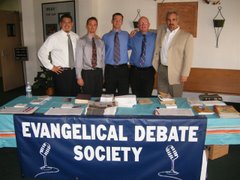
In founding the Evangelical Debate Society, I have learned that to have a successful debate ministry one needs to be flexible and work together with people.
In being the chairman of this ministry, I have to wear many hats and juggle many responsibilities behind the scenes.
First of all you have to work together with your debating opponent and his organization. You have to make sure that he feels that his views and organizing issues are being met. So, there are weeks, of back and forth discussion on what the debate proposition and timing ans structure of the debate will look like.
Secondly, I have to find time to study for the event, despite the massive amount of time needed to publicize and promote the event as well as working together will office staff, graphic designers, donars, pastors, the moderator and many other people.
All of this is time consuming and not seen by the average person that comes to watch the debate, yet I rejoice that such a ministry is possible and I have grown to love putting together all these details to put forward the best debate possible.
In the future, I plan on holding many, many other debates and I am learning crucial lessons of organizational leadership in the process, so I want to thank everyone for their constructive comments!
Now, regarding the debate itself. Dan Mages was a very formidable opponent and I enjoyed the lively exchange of ideas that we discussed.
I feel that the strongest arguments that I raised in the debate concerned the Prayers and worship of Jesus Christ. Dan did not seem to have a good answer in why the disciples in the NT prayed and worshiped Jesus and what the significance of the cross is to the Unitarians if Jesus Christ is not in fact God.
I am still greatly perplexed as to why Jesus' death matters at all if Christ is not in fact God. What is the purpose of the atonement? How can a mere man's death have universal salvific-soteriological implications if He is not God? Why is Christ's death any different than another man's, if Christ is not in fact God?
If Jesus Christ is not God, then why does His death upon the cross have any greater significance than any other death of other mortals?
I believe by declaring that Jesus Christ is not God, this then automatically robs and jettisons the cross of its soteriological gravity and significance, since it essentially says that Jesus' death is similar to that of any other man who lived and died.
Another issue that was raised concerns the sinlessness of Christ. If Jesus is not God as Dan Mages and the Biblical Unitarians suggest, how is it possible that Jesus remains without sin? How does Jesus remain impeccable if He is robbed of His Deity?
Dan argued that while Jesus Christ is not God, He is greater somehow than the average man. So, somehow Jesus is not God, but He is kind of an in-between, "Demi-god" like being that should be esteemed higher than the average person for some inexplicable reason.
Dan argued that people in the NT prayed and worshiped Jesus Christ somehow in some lesser capacity then God. I do not see how this is possible when in some passages of Scripture (Revelation 1, 5 and 7), the Father and Jesus are worshiped as God and the worshipers simutaneously worship Jesus and the Father at the same time without any distinction being made.
Now that my debate with Dan Mages on the Deity of Christ has come and gone, I have had a few days to reflect on the event. First of all, I want to thank every one that came out last Friday, it was an awesome time and I am confident that the Lord was glorified.
I have received an enormous amount of positive feed back on the event and also some criticism, so I want to deal with the negative comments first.
I know that in putting on an event like this, I cannot please everyone. Some people thought I was too friendly to Dan Mages, others feel I was too harsh, others feel I preached the Gospel too much throughout the debate, others did not like the fact that I had one of our worship leaders play a few songs before the event.
Some people felt that I did wrong in not bring up any Greek exegesis arguments in defending the Deity of Christ. One fellow, was even bold enough to tell me that "If I knew any Greek I would have defeated Him better!"
The list of criticisms about such an event can be discouraging, but I appreciate these comments because they only work to help me improve in putting together better debates in the future.
While, I know that I will never be able to please everyone all the time in conducting these debates, I will honestly take these concerns and issues before the Lord and attempt to adjust and modify things as the Lord leads.
It is important that people know that there is more to organizing a debate then just studying for the debate and then showing up. There are an enormous amount of unseen variables involved in orchestrating such an event. Hundreds of hours of organizing are put forth in attempting to put together the best event possible.
In founding the Evangelical Debate Society, I have learned that to have a successful debate ministry one needs to be flexible and work together with people.
In being the chairman of this ministry, I have to wear many hats and juggle many responsibilities behind the scenes.
First of all you have to work together with your debating opponent and his organization. You have to make sure that he feels that his views and organizing issues are being met. So, there are weeks, of back and forth discussion on what the debate proposition and timing ans structure of the debate will look like.
Secondly, I have to find time to study for the event, despite the massive amount of time needed to publicize and promote the event as well as working together will office staff, graphic designers, donars, pastors, the moderator and many other people.
All of this is time consuming and not seen by the average person that comes to watch the debate, yet I rejoice that such a ministry is possible and I have grown to love putting together all these details to put forward the best debate possible.
In the future, I plan on holding many, many other debates and I am learning crucial lessons of organizational leadership in the process, so I want to thank everyone for their constructive comments!
Now, regarding the debate itself. Dan Mages was a very formidable opponent and I enjoyed the lively exchange of ideas that we discussed.
I feel that the strongest arguments that I raised in the debate concerned the Prayers and worship of Jesus Christ. Dan did not seem to have a good answer in why the disciples in the NT prayed and worshiped Jesus and what the significance of the cross is to the Unitarians if Jesus Christ is not in fact God.
I am still greatly perplexed as to why Jesus' death matters at all if Christ is not in fact God. What is the purpose of the atonement? How can a mere man's death have universal salvific-soteriological implications if He is not God? Why is Christ's death any different than another man's, if Christ is not in fact God?
If Jesus Christ is not God, then why does His death upon the cross have any greater significance than any other death of other mortals?
I believe by declaring that Jesus Christ is not God, this then automatically robs and jettisons the cross of its soteriological gravity and significance, since it essentially says that Jesus' death is similar to that of any other man who lived and died.
Another issue that was raised concerns the sinlessness of Christ. If Jesus is not God as Dan Mages and the Biblical Unitarians suggest, how is it possible that Jesus remains without sin? How does Jesus remain impeccable if He is robbed of His Deity?
Dan argued that while Jesus Christ is not God, He is greater somehow than the average man. So, somehow Jesus is not God, but He is kind of an in-between, "Demi-god" like being that should be esteemed higher than the average person for some inexplicable reason.
Dan argued that people in the NT prayed and worshiped Jesus Christ somehow in some lesser capacity then God. I do not see how this is possible when in some passages of Scripture (Revelation 1, 5 and 7), the Father and Jesus are worshiped as God and the worshipers simutaneously worship Jesus and the Father at the same time without any distinction being made.
Wednesday, April 19, 2006
The Dangers of the Emergent and Liturgical Church Movements
The Assimilated Nation
How Postmodern Relativism is Deconstructing Contemporary Evangelicalism and Hijacking the American Church
By Lee Edward Enochs
The Evangelical Debate Society
“My people are destroyed for lack of knowledge”
(Hosea 4:6).
“Behold, the days are coming," declares the Lord GOD, "when I will send a famine on the land--not a famine of bread, nor a thirst for water, but of hearing the words of the LORD”
(Amos 8:11).
“For my people have committed two evils:they have forsaken me, the fountain of living waters,and hewed out cisterns for themselves, broken cisterns that can hold no water”
(Jeremiah 2:13).
In our fast paced, technological and entertainment driven superficial Western culture where stylistic sound- bites and digitally enhanced imagery takes precedent over substance and clearly delineated thought, American Evangelicals often do not have time or conscience desire to soberly and critically analyze the secular and ecclesiastical framework in which we live and move and have our being (Acts 17:28).
Yet, make no mistake about it, there are currently ominously powerful sociological and ideological forces at work throughout Western Civilization that are working overtime to shape both the secular culture and Christian Church along postmodern lines and disseminate a secularist worldview that is bent on eviscerating the validity of the Church and is diametrically opposed to the historic Evangelical Christian faith and societal mission of world evangelization.
While most American Evangelicals are busy being lulled to sleep and unwittingly conformed into submission to secularist and Anti-Christian forces by ever improving technology and round the clock entertainment choices that communicate evil and abominable messages that are entirely antithetical to the teachings and Lordship of Jesus Christ, the devil is actively energizing the postmodern and secularist ideological forces to completely subjugate American civilization and suppress the mission of the Evangelical Church.
Bible believing Christians across America are now indulging themselves with the creature comforts of the world and are being lulled asleep by the call of the abjectly materialistic “American Dream” in pursuit of perpetual comfort and domestic ease through the quest for bigger and better material possessions.
The American Church has largely bought into the insidious lie that the essence of human existence is materialism and image and the most important goal in life is to acquire bigger and better things, be it, houses, cars, boats, vacation homes and a litany of other materialistic and entertainment driven venues.
We are told by secular forces that what matters most in life is to look good, to feel good and to live in optimum comfort for the indulgence of the self. American Evangelicals do not know they have actually bought into the philosophy of narcissism, an excessive preoccupation with self indulgence and one’s own personal importance, or with achieving one’s own chosen goals rather than bonding with others, or with associating only with others whom one chooses.
Like the fictious technological parasites known as the Borg, who incessantly and unquestionably assimilate all life-forms into their ominous robotic collective, made famous in the Star Trek: the Next Generation television series, American Evangelicals are being lulled asleep by postmodern relativism, narcissist and entertainment driven self- indulgence and are being unwittingly culturally assimilated and rendered absolutely irrelevant and ineffective agents of Gospel Change by the seductive sirens of secularism.
Contemporarily, many American Evangelicals have currently rejected the traditional Reformation emphasis on the centrality of the Bible, forensic justification and the person and redemptive work of Jesus Christ and his Cross and in turn, have adopted grotesquely unbiblical patterns of belief and worship, as the mass Evangelical rush towards the Emergent and Liturgical Church movements conclusively demonstrate.
The emerging church or emergent church is a diverse movement according to a great article on the free encyclopedia, Wikipedia: within the American Christian Church that arose in the late 20th century as a reaction to the influence of modernism in Western Christianity. The movement is usually called a "conversation" by its proponents to emphasize its diffuse nature with contributions from many people and no explicitly defined leadership or direction. The emerging church seeks to deconstruct and reconstruct Christianity as its mainly Western members live in a postmodern culture. While practices and even core doctrine vary, most emergents can be recognized by the following values:
Missional living - Christians go out into the world to serve God rather than isolate themselves within communities of like-minded individuals.
Narrative theology - Teaching focuses on narrative presentations of faith and the Bible rather than systematic theology or biblical reductionism
Christ-likeness - While not neglecting the study of scripture or the love of the church, Christians focus their lives on the worship and emulation of the person of Jesus Christ
Authenticity - People in the postmodern culture seek real and authentic experiences in preference over scripted or superficial experiences. Emerging churches strive to be relevant to today's culture and daily life, whether it be through worship or service opportunities. The core Christian message is unchanged but emerging churches attempt, as the church has throughout the centuries, to find ways to reach God's people where they are to hear God's message of unconditional love.
Emergent Christians are predominantly found in Western Europe, North America and the South Pacific. Some attend local independent churches that specifically identify themselves as being "emergent", while many others contribute to the conversation from within existing mainline denominations.
The Emergent Church movement has unwisely and unbiblically adopted the existential and ideological cultural hermeneutic of Postmodernism, the relativistic world-view that postulates that there are no ethical and propositional absolutes and seeks to deconstruct and overthrow traditional Western Christian doctrines and morals.
In the Emergent Church movement the doctrines of the Reformation argued for by Martin Luther and John Calvin are unhealthy and unnecessary relics of a semi-modernist and medieval ethos that has been obliterated by postmodernist and postmodern influenced Biblical Scholarship such as the New Perspective and anti-reformation proponents such as New Testament scholars as E.P. Sanders, James Dunn and NT Wright.
We are told by proponents of the Emergent Church movement that traditional Evangelical doctrine divides and that the contemporary Evangelical Christian Church movement within Western Civilization must immediately discard and instantaneously jettison the undue perceived dogmas of the Protestant Reformation and embrace traditionally divergent and diametrically opposed ecclesiastical movements such as Roman Catholicism and Eastern Orthodoxy under the banner of one big relativistic conglomerate/ synthesis and smorgasbord of “Christian spirituality.”
We are told by the postmodern driven Emergent Church proponents that traditional Evangelical doctrine is divisive and dogmatic and hence must be avoided at all costs, to be replaced by a more tolerant and inclusive “Christian spirituality” that embraces all ecclesiastical traditions that have functioned historically under the umbrella of historic Christendom.
Essentially, the Emergent Church movement leaders and ethos are arguing that the Reformation was unnecessary and the quintessential doctrines of the Protestant Reformation such as the doctrine of the authority of the Bible alone and justification by grace alone through faith alone in Jesus Christ alone is wrong, irrelevant and unnecessarily obstructionist towards the Emerging Church goal of uniting all professing Christians into one united church irrespective of heresy and unbiblical teaching and practices.
The Emergent Church movement is forcefully and openly proclaiming that the traditional doctrinal differences that have historically divided Evangelical Protestants, Roman Catholics and adherents of Eastern Orthodoxy are ill-founded and unnecessary. This is why many Evangelicals are now openly incorporating aspects of Roman Catholic spirituality and teaching into the spiritual disciplines and doctrinal instruction within their respective local churches. Since doctrine no longer matters to most contemporary Evangelicals and historic Reformation teaching is always anathema to many Evangelical Pastors, we are told we should openly embrace the Catholic Church and Eastern Orthodox teaching and practice into our fellowships.
We are also informed by many Emergent Church leaders that the traditional Evangelical opposition towards female pastors, elders and leadership in the local church are equally archaic and fallacious and that we must openly embrace the overt femmization of Christianity and allow women to lead men in the local Church despite the fact the Bible teaches that women are never to lead men in the context of the local church (1 Timothy 2).
Likewise, many within the Emergent Church movement are calling the Church to embrace homosexuality as viable lifestyle and similarly adopt pluralism, the acceptance of all religions and life-styles as being equally valid as being true.
However, despite this Postmodern and Emergent Church call to discard traditional and conservative Evangelical Doctrine and Practice, I believe this call towards complete assimilation into the postmodern ethos and the embracing of all varieties of spirituality and lifestyle _expression is unwarranted and self-defeating since the Postmodern world-view is so easily demonstrated to be illogical and self-refuting.
Just as relativism can be demonstrated to be false and self-defeating based on the fact that this view in denying there are concrete and real absolutes at once, borrows from the traditional Christian absolutist world-view and deems the traditional Evangelical view to be wrong, all the while proclaiming there are no propositional truths, thus operating in a vicious and self-defeating circle of nonsensical language.
Despite the Postmodernist Emergent Church call to disregard and discard the traditional and conservative Evangelical-Protestant doctrinal positions that clearly divided Evangelicalism from divergent forms of Ecclesiastical spirituality, doctrine, practice and engagement with secular culture, Postmodernity and the Emerging Church is self-defeating and offers the Christian Church in Western Civilization absolutely no concrete reason why we should not abandon Christianity altogether.
In counter distinction to this ill-advised and destructive pathway charted out by many Postmodern and Emerging Evangelicals, there is a better and wiser course of action: embracing the doctrines of the Historic Evangelical Church for these teachings are founded on the authority of infallible Scripture and will never fade away.
Like Martin Luther of the Protestant Reformation, American Evangelicals must stand for the authority of the Bible alone, and the essential teachings of the Christian faith that has made Conservative Evangelicalism what it is, the most powerful force of Biblical change on the face of the Earth.
No, Emerging Church enthusiasts and Postmodernists, American Evangelicals should not abandon the traditions of our Protestant Fathers, to do so would be to go against the clear authority of Holy Scripture and to effect mutiny against Almighty God who sent His Son Jesus Christ to be both Savior and Lord of the earth. Evangelical Church, here we stand before Almighty God, we can no other!
“Thus says the LORD: “ Stand in the ways and see, And ask for the old paths, where the good way is, And walk in it; Then you will find rest for your souls. But they said, ‘We will not walk in it.’
Jeremiah 6:16
How Postmodern Relativism is Deconstructing Contemporary Evangelicalism and Hijacking the American Church
By Lee Edward Enochs
The Evangelical Debate Society
“My people are destroyed for lack of knowledge”
(Hosea 4:6).
“Behold, the days are coming," declares the Lord GOD, "when I will send a famine on the land--not a famine of bread, nor a thirst for water, but of hearing the words of the LORD”
(Amos 8:11).
“For my people have committed two evils:they have forsaken me, the fountain of living waters,and hewed out cisterns for themselves, broken cisterns that can hold no water”
(Jeremiah 2:13).
In our fast paced, technological and entertainment driven superficial Western culture where stylistic sound- bites and digitally enhanced imagery takes precedent over substance and clearly delineated thought, American Evangelicals often do not have time or conscience desire to soberly and critically analyze the secular and ecclesiastical framework in which we live and move and have our being (Acts 17:28).
Yet, make no mistake about it, there are currently ominously powerful sociological and ideological forces at work throughout Western Civilization that are working overtime to shape both the secular culture and Christian Church along postmodern lines and disseminate a secularist worldview that is bent on eviscerating the validity of the Church and is diametrically opposed to the historic Evangelical Christian faith and societal mission of world evangelization.
While most American Evangelicals are busy being lulled to sleep and unwittingly conformed into submission to secularist and Anti-Christian forces by ever improving technology and round the clock entertainment choices that communicate evil and abominable messages that are entirely antithetical to the teachings and Lordship of Jesus Christ, the devil is actively energizing the postmodern and secularist ideological forces to completely subjugate American civilization and suppress the mission of the Evangelical Church.
Bible believing Christians across America are now indulging themselves with the creature comforts of the world and are being lulled asleep by the call of the abjectly materialistic “American Dream” in pursuit of perpetual comfort and domestic ease through the quest for bigger and better material possessions.
The American Church has largely bought into the insidious lie that the essence of human existence is materialism and image and the most important goal in life is to acquire bigger and better things, be it, houses, cars, boats, vacation homes and a litany of other materialistic and entertainment driven venues.
We are told by secular forces that what matters most in life is to look good, to feel good and to live in optimum comfort for the indulgence of the self. American Evangelicals do not know they have actually bought into the philosophy of narcissism, an excessive preoccupation with self indulgence and one’s own personal importance, or with achieving one’s own chosen goals rather than bonding with others, or with associating only with others whom one chooses.
Like the fictious technological parasites known as the Borg, who incessantly and unquestionably assimilate all life-forms into their ominous robotic collective, made famous in the Star Trek: the Next Generation television series, American Evangelicals are being lulled asleep by postmodern relativism, narcissist and entertainment driven self- indulgence and are being unwittingly culturally assimilated and rendered absolutely irrelevant and ineffective agents of Gospel Change by the seductive sirens of secularism.
Contemporarily, many American Evangelicals have currently rejected the traditional Reformation emphasis on the centrality of the Bible, forensic justification and the person and redemptive work of Jesus Christ and his Cross and in turn, have adopted grotesquely unbiblical patterns of belief and worship, as the mass Evangelical rush towards the Emergent and Liturgical Church movements conclusively demonstrate.
The emerging church or emergent church is a diverse movement according to a great article on the free encyclopedia, Wikipedia: within the American Christian Church that arose in the late 20th century as a reaction to the influence of modernism in Western Christianity. The movement is usually called a "conversation" by its proponents to emphasize its diffuse nature with contributions from many people and no explicitly defined leadership or direction. The emerging church seeks to deconstruct and reconstruct Christianity as its mainly Western members live in a postmodern culture. While practices and even core doctrine vary, most emergents can be recognized by the following values:
Missional living - Christians go out into the world to serve God rather than isolate themselves within communities of like-minded individuals.
Narrative theology - Teaching focuses on narrative presentations of faith and the Bible rather than systematic theology or biblical reductionism
Christ-likeness - While not neglecting the study of scripture or the love of the church, Christians focus their lives on the worship and emulation of the person of Jesus Christ
Authenticity - People in the postmodern culture seek real and authentic experiences in preference over scripted or superficial experiences. Emerging churches strive to be relevant to today's culture and daily life, whether it be through worship or service opportunities. The core Christian message is unchanged but emerging churches attempt, as the church has throughout the centuries, to find ways to reach God's people where they are to hear God's message of unconditional love.
Emergent Christians are predominantly found in Western Europe, North America and the South Pacific. Some attend local independent churches that specifically identify themselves as being "emergent", while many others contribute to the conversation from within existing mainline denominations.
The Emergent Church movement has unwisely and unbiblically adopted the existential and ideological cultural hermeneutic of Postmodernism, the relativistic world-view that postulates that there are no ethical and propositional absolutes and seeks to deconstruct and overthrow traditional Western Christian doctrines and morals.
In the Emergent Church movement the doctrines of the Reformation argued for by Martin Luther and John Calvin are unhealthy and unnecessary relics of a semi-modernist and medieval ethos that has been obliterated by postmodernist and postmodern influenced Biblical Scholarship such as the New Perspective and anti-reformation proponents such as New Testament scholars as E.P. Sanders, James Dunn and NT Wright.
We are told by proponents of the Emergent Church movement that traditional Evangelical doctrine divides and that the contemporary Evangelical Christian Church movement within Western Civilization must immediately discard and instantaneously jettison the undue perceived dogmas of the Protestant Reformation and embrace traditionally divergent and diametrically opposed ecclesiastical movements such as Roman Catholicism and Eastern Orthodoxy under the banner of one big relativistic conglomerate/ synthesis and smorgasbord of “Christian spirituality.”
We are told by the postmodern driven Emergent Church proponents that traditional Evangelical doctrine is divisive and dogmatic and hence must be avoided at all costs, to be replaced by a more tolerant and inclusive “Christian spirituality” that embraces all ecclesiastical traditions that have functioned historically under the umbrella of historic Christendom.
Essentially, the Emergent Church movement leaders and ethos are arguing that the Reformation was unnecessary and the quintessential doctrines of the Protestant Reformation such as the doctrine of the authority of the Bible alone and justification by grace alone through faith alone in Jesus Christ alone is wrong, irrelevant and unnecessarily obstructionist towards the Emerging Church goal of uniting all professing Christians into one united church irrespective of heresy and unbiblical teaching and practices.
The Emergent Church movement is forcefully and openly proclaiming that the traditional doctrinal differences that have historically divided Evangelical Protestants, Roman Catholics and adherents of Eastern Orthodoxy are ill-founded and unnecessary. This is why many Evangelicals are now openly incorporating aspects of Roman Catholic spirituality and teaching into the spiritual disciplines and doctrinal instruction within their respective local churches. Since doctrine no longer matters to most contemporary Evangelicals and historic Reformation teaching is always anathema to many Evangelical Pastors, we are told we should openly embrace the Catholic Church and Eastern Orthodox teaching and practice into our fellowships.
We are also informed by many Emergent Church leaders that the traditional Evangelical opposition towards female pastors, elders and leadership in the local church are equally archaic and fallacious and that we must openly embrace the overt femmization of Christianity and allow women to lead men in the local Church despite the fact the Bible teaches that women are never to lead men in the context of the local church (1 Timothy 2).
Likewise, many within the Emergent Church movement are calling the Church to embrace homosexuality as viable lifestyle and similarly adopt pluralism, the acceptance of all religions and life-styles as being equally valid as being true.
However, despite this Postmodern and Emergent Church call to discard traditional and conservative Evangelical Doctrine and Practice, I believe this call towards complete assimilation into the postmodern ethos and the embracing of all varieties of spirituality and lifestyle _expression is unwarranted and self-defeating since the Postmodern world-view is so easily demonstrated to be illogical and self-refuting.
Just as relativism can be demonstrated to be false and self-defeating based on the fact that this view in denying there are concrete and real absolutes at once, borrows from the traditional Christian absolutist world-view and deems the traditional Evangelical view to be wrong, all the while proclaiming there are no propositional truths, thus operating in a vicious and self-defeating circle of nonsensical language.
Despite the Postmodernist Emergent Church call to disregard and discard the traditional and conservative Evangelical-Protestant doctrinal positions that clearly divided Evangelicalism from divergent forms of Ecclesiastical spirituality, doctrine, practice and engagement with secular culture, Postmodernity and the Emerging Church is self-defeating and offers the Christian Church in Western Civilization absolutely no concrete reason why we should not abandon Christianity altogether.
In counter distinction to this ill-advised and destructive pathway charted out by many Postmodern and Emerging Evangelicals, there is a better and wiser course of action: embracing the doctrines of the Historic Evangelical Church for these teachings are founded on the authority of infallible Scripture and will never fade away.
Like Martin Luther of the Protestant Reformation, American Evangelicals must stand for the authority of the Bible alone, and the essential teachings of the Christian faith that has made Conservative Evangelicalism what it is, the most powerful force of Biblical change on the face of the Earth.
No, Emerging Church enthusiasts and Postmodernists, American Evangelicals should not abandon the traditions of our Protestant Fathers, to do so would be to go against the clear authority of Holy Scripture and to effect mutiny against Almighty God who sent His Son Jesus Christ to be both Savior and Lord of the earth. Evangelical Church, here we stand before Almighty God, we can no other!
“Thus says the LORD: “ Stand in the ways and see, And ask for the old paths, where the good way is, And walk in it; Then you will find rest for your souls. But they said, ‘We will not walk in it.’
Jeremiah 6:16
Saturday, April 15, 2006
On the Reality of Circles and Squares
(Thoughts about God on a Rainy Day)
by Lee Edward Enochs"
The heavens declare the glory of God; the skies proclaim the work of his hands. Day after day they pour forth speech; night after night they display knowledge" (Psalm 19:1-2).
On a particular dreadful and rainy day my thoughts were about God and I wondered...Why is a circle a circle and a square a square?
Why is an apple not an orange or a banana a pear?
Why does gravity pull an apple down and not up?
Why does a dog drink from a bowl and not a cup?
Why do fish swim upward and not backward in a lake?
Why is Martha in prison and not on TV baking a cake?
Is it because her entire media empire is a fake?
Do we know the shape of objects from the womb?
Or do we learn their identity from observing a room?
Why do poor kids in the hood steal cars and get shot?
While equally bad rich kids in the suburbs do not?
Is reality inherent or through experience observed?
This is what has my mind particularly perturbed...Aristotle, Plato, Socrates, Kant, Hume and Hegelphilosophers have all tried to solve this puzzle,
Are things a priori knowable without appeal to particular experience?
Like Descartes, do we "think therefore I am?" or like Popeye the Sailor Man, is it "I am that I am?"
Or are things a posteriori comprehended throughexperience in the process of reasoning from facts orparticulars to general principles or from effects to causes; inductive; empirical?
John Locke(1632-1704) , the British Philosopher said that the mind is "tabula rasa" or a "blank slate", before it receives the impressions gained from experience. In his "An Essay Concerning Human Understanding" (1690), the culmination of twenty years of reflection on the origins of human knowledge. According to Locke, what we know is always properly understood as the relation between ideas, and he devoted much of the Essay to an extended argument that all of our ideas—simple or complex—are ultimately derived from experience.
However, in counter distinction to Locke the German philosopher Immanuel Kant (1724-1804), argued that there are some things known epistemologically through a priori knowledge or experience.In the realm of Christian apologetics there are some apologists such as Aquinas, Tenant, Butler and Montgomery, that borrow from the thought of Locke and say that Christianity is "known to be true" by individuals by sense experience and probability.
They say that the historical and philosophical evidence for the existence of God and the veracity of the Christian faith is probably true based on the empirical evidence.on the other hand there are "revelational" apologists in Church history like Calvin, Van Til and Bahnsen that argue that the Bible teaches in Romans 1:18-32 that all people inherently know God in their hearts and minds through conscience and creation, but they suppress the truth of God's existence due to the depravity of their sin.
This inherent knowledge of God is deemed the "sensus divinitatis" or divine sense.
However, there are some apologists of the Christian faith that argue that Christianity is known to be true exclusively on the basis of subjective experience and that empirical evidence is unnecessary in determining whether or not Christianity is true.So which is it? Do we know that Christianity is true based on empirical evidence, "sensus divinitatis", or subjective experience?I tend to believe in the "sensus divinitatis" view, but then again, I could be wrong.
I can see where it is possible that all three views, can be simultaneously true at once and that we know that Christianity is true through a variety of means, through the historical evidence such as the resurrection of Jesus Christ and His fulfilled prophecies (1 Corinthians 15:1-11), the knowledge of God that is within us all (Psalm 19, Romans 1:18-32 and Romans 2).I also believe that Christianity is known to be true through the inward witness of the Holy Spirit (John 14:26, 15:26, 16:13, Romans 8:9, Galatians 4:6, 1 John 5:10).The reason why I have included poetic discussion regarding the shapes of apples and things is that I believe that without the existence of the God of Christianity as the precondition of all rational thought, reality itself would be rendered nonsensical.
Why then is a circle a circle and a square a square?And why is an apple not an orange or a banana a pear?I believe it is because God made them that way...
"The fool says in his heart, "There is no God." (Psalm 14:1)
“For God so loved the world that he gave his one and only Son, that whoever believes in him shall not perish but have eternal life. For God did not send his Son into the world to condemn the world, but to save the world through him. Whoever believes in him is not condemned, but whoever does not believe stands condemned already because he has not believed in the name of God's one and only Son. This is the verdict: Light has come into the world, but men loved darkness instead of light because their deeds were evil. Everyone who does evil hates the light, and will not come into the light for fear that his deeds will be exposed. But whoever lives by the truth comes into the light, so that it may be seen plainly that what he has done has been done through God.” (John 3:16-21)
by Lee Edward Enochs"
The heavens declare the glory of God; the skies proclaim the work of his hands. Day after day they pour forth speech; night after night they display knowledge" (Psalm 19:1-2).
On a particular dreadful and rainy day my thoughts were about God and I wondered...Why is a circle a circle and a square a square?
Why is an apple not an orange or a banana a pear?
Why does gravity pull an apple down and not up?
Why does a dog drink from a bowl and not a cup?
Why do fish swim upward and not backward in a lake?
Why is Martha in prison and not on TV baking a cake?
Is it because her entire media empire is a fake?
Do we know the shape of objects from the womb?
Or do we learn their identity from observing a room?
Why do poor kids in the hood steal cars and get shot?
While equally bad rich kids in the suburbs do not?
Is reality inherent or through experience observed?
This is what has my mind particularly perturbed...Aristotle, Plato, Socrates, Kant, Hume and Hegelphilosophers have all tried to solve this puzzle,
Are things a priori knowable without appeal to particular experience?
Like Descartes, do we "think therefore I am?" or like Popeye the Sailor Man, is it "I am that I am?"
Or are things a posteriori comprehended throughexperience in the process of reasoning from facts orparticulars to general principles or from effects to causes; inductive; empirical?
John Locke(1632-1704) , the British Philosopher said that the mind is "tabula rasa" or a "blank slate", before it receives the impressions gained from experience. In his "An Essay Concerning Human Understanding" (1690), the culmination of twenty years of reflection on the origins of human knowledge. According to Locke, what we know is always properly understood as the relation between ideas, and he devoted much of the Essay to an extended argument that all of our ideas—simple or complex—are ultimately derived from experience.
However, in counter distinction to Locke the German philosopher Immanuel Kant (1724-1804), argued that there are some things known epistemologically through a priori knowledge or experience.In the realm of Christian apologetics there are some apologists such as Aquinas, Tenant, Butler and Montgomery, that borrow from the thought of Locke and say that Christianity is "known to be true" by individuals by sense experience and probability.
They say that the historical and philosophical evidence for the existence of God and the veracity of the Christian faith is probably true based on the empirical evidence.on the other hand there are "revelational" apologists in Church history like Calvin, Van Til and Bahnsen that argue that the Bible teaches in Romans 1:18-32 that all people inherently know God in their hearts and minds through conscience and creation, but they suppress the truth of God's existence due to the depravity of their sin.
This inherent knowledge of God is deemed the "sensus divinitatis" or divine sense.
However, there are some apologists of the Christian faith that argue that Christianity is known to be true exclusively on the basis of subjective experience and that empirical evidence is unnecessary in determining whether or not Christianity is true.So which is it? Do we know that Christianity is true based on empirical evidence, "sensus divinitatis", or subjective experience?I tend to believe in the "sensus divinitatis" view, but then again, I could be wrong.
I can see where it is possible that all three views, can be simultaneously true at once and that we know that Christianity is true through a variety of means, through the historical evidence such as the resurrection of Jesus Christ and His fulfilled prophecies (1 Corinthians 15:1-11), the knowledge of God that is within us all (Psalm 19, Romans 1:18-32 and Romans 2).I also believe that Christianity is known to be true through the inward witness of the Holy Spirit (John 14:26, 15:26, 16:13, Romans 8:9, Galatians 4:6, 1 John 5:10).The reason why I have included poetic discussion regarding the shapes of apples and things is that I believe that without the existence of the God of Christianity as the precondition of all rational thought, reality itself would be rendered nonsensical.
Why then is a circle a circle and a square a square?And why is an apple not an orange or a banana a pear?I believe it is because God made them that way...
"The fool says in his heart, "There is no God." (Psalm 14:1)
“For God so loved the world that he gave his one and only Son, that whoever believes in him shall not perish but have eternal life. For God did not send his Son into the world to condemn the world, but to save the world through him. Whoever believes in him is not condemned, but whoever does not believe stands condemned already because he has not believed in the name of God's one and only Son. This is the verdict: Light has come into the world, but men loved darkness instead of light because their deeds were evil. Everyone who does evil hates the light, and will not come into the light for fear that his deeds will be exposed. But whoever lives by the truth comes into the light, so that it may be seen plainly that what he has done has been done through God.” (John 3:16-21)
Friday, March 31, 2006
Christ the Lord is Risen Today!
(Celebrating the Glory of Easter)
The Good News of the Gospel is for all will trust Christ today!
By Ed Enochs,
The Evangelical Debate Society
"For I delivered to you as of first importance what I also received: that Christ died for our sins in accordance with the Scriptures, that he was buried, that he was raised on the third day in accordance with the Scriptures, and that he appeared to Cephas, then to the twelve. Then he appeared to more than five hundred brothers at one time, most of whom are still alive, though some have fallen asleep"
1 Corinthians 15:3-6
"Jesus said to her, "I am the resurrection and the life.Whoever believes in me, though he die, yet shall he live, and everyone who lives and believes in me shall never die. Do you believe this?" She said to him, "Yes, Lord; I believe that you are the Christ, the Son of God, who is coming into the world."
John 11:25-27
Jesus Christ is alive! He is the Son of God who died on the cross for the sins of the world and rose again from the dead! The Good News is that we can have eternal life if we acknowledge we have sinned by breaking God's Holy Commandments, repent of our sins and place our faith in Jesus Christ by calling upon the name of the Lord. This is the good news of Almighty God, that men and women can be saved from hell and have access to God the Father and the glory of eternal life through personal faith in Jesus Christ. Have you trusted in Jesus Christ today? Have you repented of your sins today?
Throughout the years, as I have actively shared my faith on various University and College campuses across the United States and I have often been asked by students and college professors why it is I believe in the exclusivity of the Christian Faith over all other religions and ideological truth claims.
For the public record, I am an Evangelical Christian and have believed in the Lord Jesus Christ since 1986, when as a teenager, I came to saving faith in Christ after reading books on Apologetics by Josh McDowell and CS Lewis.
Over the last two decades, I have pondered greatly and studied much on the question of whether or not Christianity is true. In the inner most recesses of my mind and heart I have greatly probed the depths of my conscience and heart and have attempted to introspectively analyze why it is that I believe in Jesus Christ.
I have asked myself if there were external determining sociological and psychological reasons why I became a Christian and not a member of another religion such as Islam, Buddhism, Hinduism, Judaism, Mormonism or Jehovah’s Witnesses. Upon carefully thinking through the evidence, I can honestly say that I became a Christian based solely on the fact that I have looked at the evidence for Christianity and have found the historic Christian faith to be true.
After studying apologetics and theology for literally thousands of hours over the last twenty years, my faith in Jesus Christ of Nazareth is stronger than ever before and I believe in every tenet of the historic Christian faith with absolute full and unwavering conviction. I believe in the historic doctrine of the Trinity, that in the one true and living God exists three distinct persons who share the same substance and essence of being, God the Father, God the Son, God the Holy Spirit, the Holy Trinity of Almighty God, omnipotent, omnipresent, omniscient, transcendent, indivisible, immutable, incomprehensible and unfathomably majestic and perfect in every conceivable respect.
I believe in and affirm every doctrinal tenet espoused in the Historic Christian Creeds. I believe in Jesus Christ, that He is God the Son, the Second person of the divine Trinity. I believe Jesus Christ is fully God and fully man as the historic Christian doctrine of the hypostatic union doctrine asserted at the Fourth Ecumenical Council at Chalcedon held in 451 AD. I believe that Jesus Christ was born of a virgin, lived a perfect and sinless life, healed the sick, raised the dead, performed amazing miracles, died on the cross for the sins of the world, rose again from the dead and ascended gloriously to heaven. I believe the Bible alone is the inspired, inerrant, infallible, and exclusively authoritative Word of God. I believe that we obtain justification before Almighty God exclusively on the basis of God’s free and unmerited gift of grace alone through our faith in Jesus Christ alone.
I believe that Christianity alone is true, all other religious views and non-Christian ideologies and philosophical systems to be false, erroneous, damnable and misleading.
I believe Christianity is true because of the impossibility of the contrary. That is, I believe the historic Christian faith and the entire Biblical theistic worldview is postulates must be presupposed and pre-asserted as the precondition and foundational basis of all cognitive and coherent rationality. For without Christ and the Bible there can be found no absolute standard of ethical morality, no conceivable standard of reality itself, no absolute standard of religious and ideological belief, no absolute standard of law and legal jurisprudence and no standard for anything at all.
Almighty God has spoken and revealed the glorious knowledge of Himself through His Word. He has established the veracity of His existence and truthfully differentiated Himself from all other rival religious and ideological truth claims via certain invincible evidences found in the inspired Holy Scriptures such as fulfilled prophecies and the resurrection of Jesus Christ.
All non-Christian religions and truth claims will break down and prove to be refutable, internally incoherent, inconsistent, self-contradictory and self-defeating. Christianity on the other hand, has hundreds of Biblical prophecies and the evidence for the resurrection of Jesus Christ.
Christianity is true because Jesus Christ is and His infallible Word is true. Christ demonstrated to all that He is indeed the Son of God and Savior of the world by fulfilling over 300 specific prophecies and by ultimately rising again from the dead after being crucified on a Roman Cross and being laid bloody and broken in a borrowed Tomb.
The good news is that Jesus Christ and His cross is true. Jesus Christ is the only hope and only avenue to eternal life. Mankind can now escape the coming judgement of God by repenting of their sins and believing in Jesus Christ who is the Son of God who died on the cross and rose again from the dead. Have you repented of your sins and placed your faith in Jesus Christ. Do so today and you receive eternal life. Reject Jesus and suffer the eternal wrath of Almighty God which awaits all unblievers who reject Christ. However, the good news is that you can have eternal life through faith in Christ if you would only repent and trust Him today.
Verses for us to consider this Easter
"For God so loved the world that He gave His only begotten Son, that whoever believes in Him should not perish but have everlasting life. "(John 3:16)
"But these are written that you may believe that Jesus is the Christ, the Son of God, and that believing you may have life in His name" (John 20:31).
"Nor is there salvation in any other, for there is no other name under heaven given among men by which we must be saved" (Acts 4:12).
"Believe on the Lord Jesus Christ, and you will be saved, you and your household" (Acts 4:12).
"Truly, these times of ignorance God overlooked, but now commands all men everywhere to repent" (Acts 17:30).
"For all have sinned and fallen short of the glory of God" (Romans 3:23).
"For the wages of sin is death, but the free gift of God is eternal life through Christ Jesus our Lord" (Romans 6:23).
"That if you confess with your mouth the Lord Jesus and believe in your heart that God has raised Him from the dead, you will be saved" (Romans 10:9)
"For "whoever calls on the name of the Lord shall be saved (Romans 10:13).
The Good News of the Gospel is for all will trust Christ today!
By Ed Enochs,
The Evangelical Debate Society
"For I delivered to you as of first importance what I also received: that Christ died for our sins in accordance with the Scriptures, that he was buried, that he was raised on the third day in accordance with the Scriptures, and that he appeared to Cephas, then to the twelve. Then he appeared to more than five hundred brothers at one time, most of whom are still alive, though some have fallen asleep"
1 Corinthians 15:3-6
"Jesus said to her, "I am the resurrection and the life.Whoever believes in me, though he die, yet shall he live, and everyone who lives and believes in me shall never die. Do you believe this?" She said to him, "Yes, Lord; I believe that you are the Christ, the Son of God, who is coming into the world."
John 11:25-27
Jesus Christ is alive! He is the Son of God who died on the cross for the sins of the world and rose again from the dead! The Good News is that we can have eternal life if we acknowledge we have sinned by breaking God's Holy Commandments, repent of our sins and place our faith in Jesus Christ by calling upon the name of the Lord. This is the good news of Almighty God, that men and women can be saved from hell and have access to God the Father and the glory of eternal life through personal faith in Jesus Christ. Have you trusted in Jesus Christ today? Have you repented of your sins today?
Throughout the years, as I have actively shared my faith on various University and College campuses across the United States and I have often been asked by students and college professors why it is I believe in the exclusivity of the Christian Faith over all other religions and ideological truth claims.
For the public record, I am an Evangelical Christian and have believed in the Lord Jesus Christ since 1986, when as a teenager, I came to saving faith in Christ after reading books on Apologetics by Josh McDowell and CS Lewis.
Over the last two decades, I have pondered greatly and studied much on the question of whether or not Christianity is true. In the inner most recesses of my mind and heart I have greatly probed the depths of my conscience and heart and have attempted to introspectively analyze why it is that I believe in Jesus Christ.
I have asked myself if there were external determining sociological and psychological reasons why I became a Christian and not a member of another religion such as Islam, Buddhism, Hinduism, Judaism, Mormonism or Jehovah’s Witnesses. Upon carefully thinking through the evidence, I can honestly say that I became a Christian based solely on the fact that I have looked at the evidence for Christianity and have found the historic Christian faith to be true.
After studying apologetics and theology for literally thousands of hours over the last twenty years, my faith in Jesus Christ of Nazareth is stronger than ever before and I believe in every tenet of the historic Christian faith with absolute full and unwavering conviction. I believe in the historic doctrine of the Trinity, that in the one true and living God exists three distinct persons who share the same substance and essence of being, God the Father, God the Son, God the Holy Spirit, the Holy Trinity of Almighty God, omnipotent, omnipresent, omniscient, transcendent, indivisible, immutable, incomprehensible and unfathomably majestic and perfect in every conceivable respect.
I believe in and affirm every doctrinal tenet espoused in the Historic Christian Creeds. I believe in Jesus Christ, that He is God the Son, the Second person of the divine Trinity. I believe Jesus Christ is fully God and fully man as the historic Christian doctrine of the hypostatic union doctrine asserted at the Fourth Ecumenical Council at Chalcedon held in 451 AD. I believe that Jesus Christ was born of a virgin, lived a perfect and sinless life, healed the sick, raised the dead, performed amazing miracles, died on the cross for the sins of the world, rose again from the dead and ascended gloriously to heaven. I believe the Bible alone is the inspired, inerrant, infallible, and exclusively authoritative Word of God. I believe that we obtain justification before Almighty God exclusively on the basis of God’s free and unmerited gift of grace alone through our faith in Jesus Christ alone.
I believe that Christianity alone is true, all other religious views and non-Christian ideologies and philosophical systems to be false, erroneous, damnable and misleading.
I believe Christianity is true because of the impossibility of the contrary. That is, I believe the historic Christian faith and the entire Biblical theistic worldview is postulates must be presupposed and pre-asserted as the precondition and foundational basis of all cognitive and coherent rationality. For without Christ and the Bible there can be found no absolute standard of ethical morality, no conceivable standard of reality itself, no absolute standard of religious and ideological belief, no absolute standard of law and legal jurisprudence and no standard for anything at all.
Almighty God has spoken and revealed the glorious knowledge of Himself through His Word. He has established the veracity of His existence and truthfully differentiated Himself from all other rival religious and ideological truth claims via certain invincible evidences found in the inspired Holy Scriptures such as fulfilled prophecies and the resurrection of Jesus Christ.
All non-Christian religions and truth claims will break down and prove to be refutable, internally incoherent, inconsistent, self-contradictory and self-defeating. Christianity on the other hand, has hundreds of Biblical prophecies and the evidence for the resurrection of Jesus Christ.
Christianity is true because Jesus Christ is and His infallible Word is true. Christ demonstrated to all that He is indeed the Son of God and Savior of the world by fulfilling over 300 specific prophecies and by ultimately rising again from the dead after being crucified on a Roman Cross and being laid bloody and broken in a borrowed Tomb.
The good news is that Jesus Christ and His cross is true. Jesus Christ is the only hope and only avenue to eternal life. Mankind can now escape the coming judgement of God by repenting of their sins and believing in Jesus Christ who is the Son of God who died on the cross and rose again from the dead. Have you repented of your sins and placed your faith in Jesus Christ. Do so today and you receive eternal life. Reject Jesus and suffer the eternal wrath of Almighty God which awaits all unblievers who reject Christ. However, the good news is that you can have eternal life through faith in Christ if you would only repent and trust Him today.
Verses for us to consider this Easter
"For God so loved the world that He gave His only begotten Son, that whoever believes in Him should not perish but have everlasting life. "(John 3:16)
"But these are written that you may believe that Jesus is the Christ, the Son of God, and that believing you may have life in His name" (John 20:31).
"Nor is there salvation in any other, for there is no other name under heaven given among men by which we must be saved" (Acts 4:12).
"Believe on the Lord Jesus Christ, and you will be saved, you and your household" (Acts 4:12).
"Truly, these times of ignorance God overlooked, but now commands all men everywhere to repent" (Acts 17:30).
"For all have sinned and fallen short of the glory of God" (Romans 3:23).
"For the wages of sin is death, but the free gift of God is eternal life through Christ Jesus our Lord" (Romans 6:23).
"That if you confess with your mouth the Lord Jesus and believe in your heart that God has raised Him from the dead, you will be saved" (Romans 10:9)
"For "whoever calls on the name of the Lord shall be saved (Romans 10:13).
Wednesday, March 29, 2006
Romans Bible Study Notes
Romans 1:18-21 (English Standard Version)
18For the wrath of God is revealed from heaven against all ungodliness and unrighteousness of men, who by their unrighteousness suppress the truth. 19For what can be known about God is plain to them, because God has shown it to them. 20For his invisible attributes, namely, his eternal power and divine nature, have been clearly perceived, ever since the creation of the world, in the things that have been made. So they are without excuse. 21For although they knew God, they did not honor him as God or give thanks to him, but they became futile in their thinking, and their foolish hearts were darkened.
Greek New Testament
18αποκαλυπτεται γαρ οργη θεου απ ουρανου επι πασαν ασεβειαν και αδικιαν ανθρωπων των την αληθειαν εν αδικια κατεχοντων 19διοτι το γνωστον του θεου φανερον εστιν εν αυτοις ο θεος γαρ αυτοις εφανερωσεν 20τα γαρ αορατα αυτου απο κτισεως κοσμου τοις ποιημασιν νοουμενα καθοραται η τε αιδιος αυτου δυναμις και θειοτης εις το ειναι αυτους αναπολογητους 21διοτι γνοντες τον θεον ουχ ως θεον εδοξασαν η ηυχαριστησαν αλλ εματαιωθησαν εν τοις διαλογισμοις αυτων και εσκοτισθη η ασυνετος αυτων καρδια
Key Biblical Words and Phrases Found in the text of Romans 1:18-21
1. Wrath (Orge) anger, indignation, vengeance, wrath, (Romans 1:18, 2:5, 2:8, 4:5, 5:9, 9:22, 12:19, 13:4, 13:5)
2. revealed (Apokalupto) reveal (Romans 1:17, 18, 8:18)
3. ungodliness (Asebeia) want of reverence towards God, impiety, ungodliness (Romans 1:18, 11:26)
4. unrighteousness (adikia) iniquity, unjust, unrighteousness, wrong (Romans 1:18, 1:29, 2:8, 6:13, 9:14)
5. suppress (katecho) have, hold, hold fast, keep, make, misc, possess, stay, take (Romans 1:18, 7:6)
6. truth (Aletheia) (Romans 1:18, 1:25, 2:2, 2:8).
7. invisible attributes (aoratos) invisible, invisible things, (Romans 1:20, Colossians 1:15, 1:16, 1 Timothy 1:17, Heb. 11:27).
8. eternal/ power (Aidios) eternal, everlasting (Romans 1:20, Jude 1:6). Power-dunamis, might, strength, virtue, (Romans 1:4, 1:16, 1:20, 8:38, 9:17, 15:13)
9. divine nature ((Theiotes), divinity, godhead, divine nature) (Romans 1:20).
10. darkened (Skotizo) darkened, (Romans 1:21, 11:10).
Revelation This means the disclosure of something that was unknown. There are two types of revelation: natural and special.
Natural revelation is that which is revealed about God through what we can see in creation (Rom. 1:20 ). Through creation we may learn that there is a God, that He is in control, that He has an order, and that He is concerned for our welfare. However, through natural revelation, we are not able to discover the plan of salvation. That comes from special revelation.
Special revelation is that which is given to us through Prophets, the Bible, and even visions and dreams (Num. 12:6-8). The ultimate in revelation is the incarnation of Jesus because He came to reveal the Father to us (Matt. 11:27; Luke 10:22; Heb. 1:1-3) and to communicate to us the gospel (1 Cor. 15:1-4 by which comes salvation.
Key Verses on General Revelation
Psalm 19
1 The heavens declare the glory of God; And the firmament shows His handiwork. 2 Day unto day utters speech, And night unto night reveals knowledge. 3 There is no speech nor language Where their voice is not heard. 4 Their line[a] has gone out through all the earth, And their words to the end of the world.
Romans 2:12-16
12 For as many as have sinned without law will also perish without law, and as many as have sinned in the law will be judged by the law 13 (for not the hearers of the law are just in the sight of God, but the doers of the law will be justified; 14 for when Gentiles, who do not have the law, by nature do the things in the law, these, although not having the law, are a law to themselves, 15 who show the work of the law written in their hearts, their conscience also bearing witness, and between themselves their thoughts accusing or else excusing them) 16 in the day when God will judge the secrets of men by Jesus Christ, according to my gospel.
Key Verses on Special Revelation
“So then, faith comes by hearing and hearing by the Word of Christ…” See (Romans 10:13-17)
“All Scripture is given by inspiration of God… (2 Timothy 3:16-17)
“Sanctify them by your Word, Your Word is the Truth (John 17:17) (Also see: John 14:6. 8:26, 8:58, Acts 4:12, 2 Peter 1:18-21).
18For the wrath of God is revealed from heaven against all ungodliness and unrighteousness of men, who by their unrighteousness suppress the truth. 19For what can be known about God is plain to them, because God has shown it to them. 20For his invisible attributes, namely, his eternal power and divine nature, have been clearly perceived, ever since the creation of the world, in the things that have been made. So they are without excuse. 21For although they knew God, they did not honor him as God or give thanks to him, but they became futile in their thinking, and their foolish hearts were darkened.
Greek New Testament
18αποκαλυπτεται γαρ οργη θεου απ ουρανου επι πασαν ασεβειαν και αδικιαν ανθρωπων των την αληθειαν εν αδικια κατεχοντων 19διοτι το γνωστον του θεου φανερον εστιν εν αυτοις ο θεος γαρ αυτοις εφανερωσεν 20τα γαρ αορατα αυτου απο κτισεως κοσμου τοις ποιημασιν νοουμενα καθοραται η τε αιδιος αυτου δυναμις και θειοτης εις το ειναι αυτους αναπολογητους 21διοτι γνοντες τον θεον ουχ ως θεον εδοξασαν η ηυχαριστησαν αλλ εματαιωθησαν εν τοις διαλογισμοις αυτων και εσκοτισθη η ασυνετος αυτων καρδια
Key Biblical Words and Phrases Found in the text of Romans 1:18-21
1. Wrath (Orge) anger, indignation, vengeance, wrath, (Romans 1:18, 2:5, 2:8, 4:5, 5:9, 9:22, 12:19, 13:4, 13:5)
2. revealed (Apokalupto) reveal (Romans 1:17, 18, 8:18)
3. ungodliness (Asebeia) want of reverence towards God, impiety, ungodliness (Romans 1:18, 11:26)
4. unrighteousness (adikia) iniquity, unjust, unrighteousness, wrong (Romans 1:18, 1:29, 2:8, 6:13, 9:14)
5. suppress (katecho) have, hold, hold fast, keep, make, misc, possess, stay, take (Romans 1:18, 7:6)
6. truth (Aletheia) (Romans 1:18, 1:25, 2:2, 2:8).
7. invisible attributes (aoratos) invisible, invisible things, (Romans 1:20, Colossians 1:15, 1:16, 1 Timothy 1:17, Heb. 11:27).
8. eternal/ power (Aidios) eternal, everlasting (Romans 1:20, Jude 1:6). Power-dunamis, might, strength, virtue, (Romans 1:4, 1:16, 1:20, 8:38, 9:17, 15:13)
9. divine nature ((Theiotes), divinity, godhead, divine nature) (Romans 1:20).
10. darkened (Skotizo) darkened, (Romans 1:21, 11:10).
Revelation This means the disclosure of something that was unknown. There are two types of revelation: natural and special.
Natural revelation is that which is revealed about God through what we can see in creation (Rom. 1:20 ). Through creation we may learn that there is a God, that He is in control, that He has an order, and that He is concerned for our welfare. However, through natural revelation, we are not able to discover the plan of salvation. That comes from special revelation.
Special revelation is that which is given to us through Prophets, the Bible, and even visions and dreams (Num. 12:6-8). The ultimate in revelation is the incarnation of Jesus because He came to reveal the Father to us (Matt. 11:27; Luke 10:22; Heb. 1:1-3) and to communicate to us the gospel (1 Cor. 15:1-4 by which comes salvation.
Key Verses on General Revelation
Psalm 19
1 The heavens declare the glory of God; And the firmament shows His handiwork. 2 Day unto day utters speech, And night unto night reveals knowledge. 3 There is no speech nor language Where their voice is not heard. 4 Their line[a] has gone out through all the earth, And their words to the end of the world.
Romans 2:12-16
12 For as many as have sinned without law will also perish without law, and as many as have sinned in the law will be judged by the law 13 (for not the hearers of the law are just in the sight of God, but the doers of the law will be justified; 14 for when Gentiles, who do not have the law, by nature do the things in the law, these, although not having the law, are a law to themselves, 15 who show the work of the law written in their hearts, their conscience also bearing witness, and between themselves their thoughts accusing or else excusing them) 16 in the day when God will judge the secrets of men by Jesus Christ, according to my gospel.
Key Verses on Special Revelation
“So then, faith comes by hearing and hearing by the Word of Christ…” See (Romans 10:13-17)
“All Scripture is given by inspiration of God… (2 Timothy 3:16-17)
“Sanctify them by your Word, Your Word is the Truth (John 17:17) (Also see: John 14:6. 8:26, 8:58, Acts 4:12, 2 Peter 1:18-21).
Wednesday, March 22, 2006
New Satellite Evidence for Noah's Ark
"And on the seventeenth day of the seventh month the ark came to rest on the mountains of Ararat. The waters continued to recede until the tenth month, and on the first day of the tenth month the tops of the mountains became visible. "
(Genesis 8:4-5)
The question of whether or not Noah's Ark actually rests today on the Mountains of Ararat in Turkey has long amazed Biblical scholars, archaeologists and those interested in defending the historical accounts recorded in the Bible.
1829 Dr. Freidrich Parrott, who had made an ascent of Greater Ararat, wrote in his Journey to Ararat that "all the Armenians are firmly persuaded that Noah's Ark remains to this very day on the top of Ararat, and that, in order to preservation no human being is allowed to approach it."
In 1876 James Bryce, historian, statesman, diplomat, explorer, and Professor of Civil Law at Oxford, climbed above the tree line and found a slab of hand-hewn timber, four feet long and five inches thick, which he identified as being from the Ark.
In 1883 the British Prophetic Messenger and others reported that Turkish commissioners investigating avalanches had seen the Ark.
In the early 1970's, noted Evangelical apologist and scholar John Warwick Montgomery visited the mountain range of Ararat and recorded what he says is insurmountable evidence that Noah's Ark is physically on Mount Ararat today. Montgomery's documentation for Noah's Ark can be read in his amazing book entitled,
The Quest for Noah's Ark, Bethany Fellowship, 1972, 2nd edition, Pyramid, 1974.
Recently, new satellite evidence for Noah's Ark has been released indicating that there is a rather large structural "anomaly" resting on Mount Ararat today. Could this really be the Noah's Ark mentioned in Genesis 8 written some 4,000 years ago? You decide, the evidence seems to point to the fact that the Ark still rests on Ararat today.
For the compelling new satellite evidence, please click on to CNN's link below and decide for yourself.
http://edition.cnn.com/2006/TECH/space/03/13/satellite.noahs.ark/index.html
(Genesis 8:4-5)
The question of whether or not Noah's Ark actually rests today on the Mountains of Ararat in Turkey has long amazed Biblical scholars, archaeologists and those interested in defending the historical accounts recorded in the Bible.
1829 Dr. Freidrich Parrott, who had made an ascent of Greater Ararat, wrote in his Journey to Ararat that "all the Armenians are firmly persuaded that Noah's Ark remains to this very day on the top of Ararat, and that, in order to preservation no human being is allowed to approach it."
In 1876 James Bryce, historian, statesman, diplomat, explorer, and Professor of Civil Law at Oxford, climbed above the tree line and found a slab of hand-hewn timber, four feet long and five inches thick, which he identified as being from the Ark.
In 1883 the British Prophetic Messenger and others reported that Turkish commissioners investigating avalanches had seen the Ark.
In the early 1970's, noted Evangelical apologist and scholar John Warwick Montgomery visited the mountain range of Ararat and recorded what he says is insurmountable evidence that Noah's Ark is physically on Mount Ararat today. Montgomery's documentation for Noah's Ark can be read in his amazing book entitled,
The Quest for Noah's Ark, Bethany Fellowship, 1972, 2nd edition, Pyramid, 1974.
Recently, new satellite evidence for Noah's Ark has been released indicating that there is a rather large structural "anomaly" resting on Mount Ararat today. Could this really be the Noah's Ark mentioned in Genesis 8 written some 4,000 years ago? You decide, the evidence seems to point to the fact that the Ark still rests on Ararat today.
For the compelling new satellite evidence, please click on to CNN's link below and decide for yourself.
http://edition.cnn.com/2006/TECH/space/03/13/satellite.noahs.ark/index.html
Monday, March 13, 2006
Why I Founded the Evangelical Debate Society
Biblical Apologetics for a Postmodern Age
Why I Founded the Evangelical Debate Society
by Lee Edward Enochs
"That in all things, Jesus Christ might have the preeminence."
(Colossians 1:18b)
Apologetics, the art and science of giving a coherent and reasoned defense for the Christian faith, is a Biblical mandate that has consumed my life for two decades. Since first hearing the evidence for Biblical Christianity from an Evangelical Christian medical student on the University of Michigan campus in the Spring of 1986, I have been consumed with a passion to know the reasons why Christianity is true and with the Biblical command to "give everyone an answer for the hope that lies within me" (1 Peter 3:15).
Since I was a teenager, two of the essential questions that has driven my mind and conscience are the following, "Is Christianity true?" and "What is the best defense of the Christian faith?"
From the time I was a young boy holed up in in the labyrinth of dusty books in the University of Michigan undergraduate library, where I often slept with books as my pillow, I have spent literally thousands upon thousands of hours consumed with these two questions attempting to determine the best lines of argumentation that demonstrate the veracity of the Christian faith and world-view.
We live in an era of Western Civilization that is awash is subjectivity and relativism, thus attempting to determine the objective truth and evidence for Christianity seems odd and irrelevant to most non-Christians today. Even in the Evangelical Church throughout America, it has been my personal experience, after ministering and studying in some of Evangelicalism's largest churches and institutions of higher learning, that very few Evangelical Christians can give reasons why they believe the Christian faith is true or can defend the essential truths that make up the body of doctrine of Historic Evangelical Christianity.
Many of the Evangelical apologetics ministries now functioning throughout the North American hemisphere are not dedicated to giving Biblical and exegetical answers and evidences for that demonstrate the truthfulness of the Christian faith, rather they are committed to giving Aristotelian and Thomistic based philosophical lines of argumentation to defend the faith instead of offering compelling Scriptural/exegetical evidences that substantiate the Christian
This dearth and great void of Biblical Apologetics that help equip Evangelicals with Scriptural reasons for the historic Protestant and Evangelical Christian faith is why I started the new ministry called the Evangelical Debate Society, to equip and educate the Evangelical Christian faith with answers that demonstrate why Christianity is true and to attempt to give the non- Evangelical Christian reasons why Christianity is true.
In organizing and participating in debates where the claims of Evangelical Christianity are discussed and scrutinized in a careful and analytical manner, I have found that this stimulates a tremendous interest in Christians to learn how to defend the faith and gives impetus and motivation for unbelievers in Evangelical Christianity to look into the claims of the Bible and the teachings of the Lord Jesus Christ.
I see the aims of Biblical Evangelical Apologetics as being four fold:
1) To give Biblical reasons why Evangelical Christianity is true.
2) To refute non-Evangelical Christian arguments against Biblical Evangelicalism.
3) To equip the Christian Church for the work of the ministry.
4) To evangelize the world for the Lordship of Jesus Christ.
This is why I started the Evangelical Debate Society, to give a Biblical defense of Historic Evangelical Christianity, to equip the saints for the work of the ministry (Ephesians 4:10-16) and to fulfill Christ's great commission to preach the Gospel and make disciples of all nations (Matthew 28:19-20, Mark 16-15, Luke 24:44, John 20:21, Acts 1:8, Romans 10:9-17, 1 Corinthians 9:13-16 and 2 Timothy 4:1-5).
Two books that articulates my approach to Apologetics called, Presuppostionalism were written by the late Dr. Greg L. Bahnsen (B.A. Philosophy, Westmont College, M.Div and Th.M, Westminster Theological Seminary and Ph.D. Philosophy, University of Southern California) are entitled as follows;
1.Always Ready: Directions for Defending the Faith:
http://www.monergismbooks.com/alwaysready5281.html
2. Van Til's Apologetic: Readings and Analysis:
http://www.christianbook.com/Christian/Books/product?event=AFF&p=1017511&item_no=20991
"But these are written so that you may believe that Jesus is the Christ, the Son of God, and that by believing you may have life in his name." (John 20:31).
Jesus Christ is Lord, He died and rose again from the dead! (Romans 10:9-10).
Most Sincerely in Jesus Christ,
Lee Edward "Ed" Enochs
Chairman,
The Evangelical Debate Society
Why I Founded the Evangelical Debate Society
by Lee Edward Enochs
"That in all things, Jesus Christ might have the preeminence."
(Colossians 1:18b)
Apologetics, the art and science of giving a coherent and reasoned defense for the Christian faith, is a Biblical mandate that has consumed my life for two decades. Since first hearing the evidence for Biblical Christianity from an Evangelical Christian medical student on the University of Michigan campus in the Spring of 1986, I have been consumed with a passion to know the reasons why Christianity is true and with the Biblical command to "give everyone an answer for the hope that lies within me" (1 Peter 3:15).
Since I was a teenager, two of the essential questions that has driven my mind and conscience are the following, "Is Christianity true?" and "What is the best defense of the Christian faith?"
From the time I was a young boy holed up in in the labyrinth of dusty books in the University of Michigan undergraduate library, where I often slept with books as my pillow, I have spent literally thousands upon thousands of hours consumed with these two questions attempting to determine the best lines of argumentation that demonstrate the veracity of the Christian faith and world-view.
We live in an era of Western Civilization that is awash is subjectivity and relativism, thus attempting to determine the objective truth and evidence for Christianity seems odd and irrelevant to most non-Christians today. Even in the Evangelical Church throughout America, it has been my personal experience, after ministering and studying in some of Evangelicalism's largest churches and institutions of higher learning, that very few Evangelical Christians can give reasons why they believe the Christian faith is true or can defend the essential truths that make up the body of doctrine of Historic Evangelical Christianity.
Many of the Evangelical apologetics ministries now functioning throughout the North American hemisphere are not dedicated to giving Biblical and exegetical answers and evidences for that demonstrate the truthfulness of the Christian faith, rather they are committed to giving Aristotelian and Thomistic based philosophical lines of argumentation to defend the faith instead of offering compelling Scriptural/exegetical evidences that substantiate the Christian
This dearth and great void of Biblical Apologetics that help equip Evangelicals with Scriptural reasons for the historic Protestant and Evangelical Christian faith is why I started the new ministry called the Evangelical Debate Society, to equip and educate the Evangelical Christian faith with answers that demonstrate why Christianity is true and to attempt to give the non- Evangelical Christian reasons why Christianity is true.
In organizing and participating in debates where the claims of Evangelical Christianity are discussed and scrutinized in a careful and analytical manner, I have found that this stimulates a tremendous interest in Christians to learn how to defend the faith and gives impetus and motivation for unbelievers in Evangelical Christianity to look into the claims of the Bible and the teachings of the Lord Jesus Christ.
I see the aims of Biblical Evangelical Apologetics as being four fold:
1) To give Biblical reasons why Evangelical Christianity is true.
2) To refute non-Evangelical Christian arguments against Biblical Evangelicalism.
3) To equip the Christian Church for the work of the ministry.
4) To evangelize the world for the Lordship of Jesus Christ.
This is why I started the Evangelical Debate Society, to give a Biblical defense of Historic Evangelical Christianity, to equip the saints for the work of the ministry (Ephesians 4:10-16) and to fulfill Christ's great commission to preach the Gospel and make disciples of all nations (Matthew 28:19-20, Mark 16-15, Luke 24:44, John 20:21, Acts 1:8, Romans 10:9-17, 1 Corinthians 9:13-16 and 2 Timothy 4:1-5).
Two books that articulates my approach to Apologetics called, Presuppostionalism were written by the late Dr. Greg L. Bahnsen (B.A. Philosophy, Westmont College, M.Div and Th.M, Westminster Theological Seminary and Ph.D. Philosophy, University of Southern California) are entitled as follows;
1.Always Ready: Directions for Defending the Faith:
http://www.monergismbooks.com/alwaysready5281.html
2. Van Til's Apologetic: Readings and Analysis:
http://www.christianbook.com/Christian/Books/product?event=AFF&p=1017511&item_no=20991
"But these are written so that you may believe that Jesus is the Christ, the Son of God, and that by believing you may have life in his name." (John 20:31).
Jesus Christ is Lord, He died and rose again from the dead! (Romans 10:9-10).
Most Sincerely in Jesus Christ,
Lee Edward "Ed" Enochs
Chairman,
The Evangelical Debate Society
Tuesday, March 07, 2006
Thoughts on Islam
John 5:23
Dear Friend,
Thank you very much for your correspondence with us concerning the subject of Islam. As Evangelical Christians with a burden to see our neighbors come to a saving knowledge of Jesus Christ, we have studied the essential teachings of the Islamic religion and find Islam to be contradictory to historic Evangelicalism on many crucial points.
Islam is a distinctly non-Christian religion that denies all the essential teachings of the historic Christian faith including the Trinity, the Virgin Birth of Christ, the Deity of Jesus Christ and the Holy Spirit, the subsitutionary atonement of Jesus Christ and every other fundamental tenet of true Christianity. For these reasons we cannot advocate Islam as a viable _expression of true religious observance.
The religion known throughout the world as Islam was founded by a Middle Eastern man named Muhammad (570-632) and is now the religious belief system of over 1.1 billion people throughout the world. Today, Islam is practiced on every continent and country on Earth. The term Islam is Arabic word that means surrender or submission. The term for God in Islam is called Allah (pronounced ah LAH), which means The God. In Islam, a person who submits and is obedient to the will of Allah is called a Muslim. The Islamic Prophet Muhammad was born in A.D. 570 in the Arabic City of Mecca. Adherents of Islam believe that around the year 610 Muhammad began to receive revelations from Allah that were transmitted by the angel Gabriel over a 22-year period in the cities of Mecca and Medina now located in present day Saudi Arabia. Medina is the city where the tomb of Muhammad is currently located. The holy book of Islam is called the Quran (sometimes spelled Koran) and is greatly revered by Muslims worldwide. Muslims also submit to the teachings found in the Hadith, the Sunna, or collection of examples of the Prophet Muhammad’s sayings and acts.
The central ideological theme of Islam centers on their conception of Tawhid, or the absolute Unitarian monotheistic unity of Allah. Muslims deny that there are three distinct persons who share the same essence in the godhead as the historic doctrine of the Trinity affirms and argue for the absolute oneness of their conception of God. Muslims believe that Allah is the name of the one true God and that Allah is the supreme and sovereign Lord of the entire universe, who demands absolute submission and allegiance of humanity. Muslims believe that Allah is the absolute judge and lawgiver in life and death and that all humanity must bow in humble submission to Allah or suffer the consequences of eternal judgement. Muslims deny that Jesus Christ is God the Son, the second person of the eternal Godhead and deny that the Holy Spirit is a distinct person and the third person of the Trinity. Muslims deny that Jesus Christ died on the cross for the sins of humanity and also deny that the Bible is God’s uniquely inspired revelation, rather, adherent of Islam believe the Bible is a corrupted document and that the Quran is the most perfect revelatory communication from Allah.
In Islamic doctrine, Allah has provided Prophets to humanity for guidance and direction and these Prophets call people to submit to the will of Allah and to the teachings of the Prophet Muhammad as found in the Quran and Hadith. Unlike Evangelical Christianity, which teaches that the Bible alone is the Word of God and final authority, Islam has two sources of Authority, the Quran and the Sunna, the body of traditions that preserves the words and conduct of Muhammad. Muslim scholars use there sources to understand the principles of the Sharia (shah REE ah), an Arabic term that essentially means, the way that leads to God.
Muslims recognize four main sources of interpreting the Sharia and attempt to apply it to daily life;
1) The Quran
2) The Sunna
3) Extending reasoning of previous laws to new situations
4) The views of Muslim scholars and jurists.
Muslims believe that Allah has called men to be prophets throughout human history starting with Adam and ending with Muhammad. The Quran mentions 25 prophets by name, Muhammad being the most significant of these divine messengers since he was given the Quran via the process of mechanical dictation through divine revelation. Muslims vehemently deny that Jesus Christ is the unique Son of Almighty God, but delegate Jesus to be amongst the Prophets such as Adam, Abraham, Ishmael, Moses and Muhammad.
There are three main historical divisions in Islam. The vast majority of Muslims are Sunni who follow the traditional and widely held interpretation of Islam. Then there are the Shiites, who believe that Ali, the cousin and son in law of Muhammad and his descendant should be the leaders of the Islamic faith. And finally, the smallest division of Islam are called the Kharijites, or secessionists that broke away from traditional Shiite practice in 657.
The Quran and Hadith call all Muslims to adhere to the Five Pillars of Islam, which are as follows:
1. Shahada-The foundational pillar of the entire Islamic faith and consists of the act of bearing witness that there is “no God but Allah” and that “Muhammad is the messenger of Allah.”
2. Prayer- Muslims are required to pray five times a day-just before dawn, at midday, in the midafternoon, just before sunset, and at night.
3. Almsgiving- Muslims are required to assist the poor in the form of a tax on their monetary income called a Zakat, given once a year.
4. Fasting- All Muslims are required to fast in the month of Ramadan, the ninth month of the Islamic calendar. The Islamic calendar is lunar, so each month follows the phases of the moon and lasts 29 or 30 days. According to the Quran, Muslims are to fast from food, drinking any beverages, smoking and engaging in any sexual activity during the daylight hours. At night they may resume eating, drinking and other normative activities.
5. Pilgrimage-All Muslims, according to the Quran all Muslims must make a Hajj (pilgrimage) to Mecca at least once in their lifetime.
Islam is a distinctly non-Christian religion, opposed to the historic Christian faith and explicitly denies all the fundamental teachings of Christianity and because of this we cannot advocate Islam and its teachings in anyway. We believe in the Doctrine of the Trinity and that Jesus Christ is the Son of God whom God the Father sent to die on the cross for the sins of the World and rise again from the dead.
We would also like to encourage all non-Christians, that might be reading this, to acknowledge that they have broken God’s holy commandments, to repent of their sins and come to faith in Jesus Christ. Jesus died on the cross and rose again from the dead to give eternal life to all that sincerely repent of their sins and place their faith in Him (Luke 13:1-5, John 3:16, 3:36, 14:6, Acts 2:38, Acts 16:31, Acts 17:30, Romans 3:10-12, 20-23, Romans 5:8, Romans 6:23, Romans 10:9-10 and 1 Corinthians 15:1-10).
If we can further assist you in understanding the Gospel of Jesus Christ and the teachings of Biblical Evangelical Christianity, please contact us here.
Evangelical Books on the Subject of Islam
Answering Islam: The Crescent in Light of the Cross by Norman Geisler and Abdul Saleeb
Islamic Invasion by Robert Morey
The Islam Debate, by Josh McDowell with John Gilchrist,
Evangelical Ministries Reaching Out to Muslims
Answering Islam: http://answering-islam.org.uk/
Alpha and Omega Ministries http://www.aomin.org/
Christian Research Institute: http://www.aomin.org/
Ravi Zacharias Ministries: http://www.rzim.org/
Dear Friend,
Thank you very much for your correspondence with us concerning the subject of Islam. As Evangelical Christians with a burden to see our neighbors come to a saving knowledge of Jesus Christ, we have studied the essential teachings of the Islamic religion and find Islam to be contradictory to historic Evangelicalism on many crucial points.
Islam is a distinctly non-Christian religion that denies all the essential teachings of the historic Christian faith including the Trinity, the Virgin Birth of Christ, the Deity of Jesus Christ and the Holy Spirit, the subsitutionary atonement of Jesus Christ and every other fundamental tenet of true Christianity. For these reasons we cannot advocate Islam as a viable _expression of true religious observance.
The religion known throughout the world as Islam was founded by a Middle Eastern man named Muhammad (570-632) and is now the religious belief system of over 1.1 billion people throughout the world. Today, Islam is practiced on every continent and country on Earth. The term Islam is Arabic word that means surrender or submission. The term for God in Islam is called Allah (pronounced ah LAH), which means The God. In Islam, a person who submits and is obedient to the will of Allah is called a Muslim. The Islamic Prophet Muhammad was born in A.D. 570 in the Arabic City of Mecca. Adherents of Islam believe that around the year 610 Muhammad began to receive revelations from Allah that were transmitted by the angel Gabriel over a 22-year period in the cities of Mecca and Medina now located in present day Saudi Arabia. Medina is the city where the tomb of Muhammad is currently located. The holy book of Islam is called the Quran (sometimes spelled Koran) and is greatly revered by Muslims worldwide. Muslims also submit to the teachings found in the Hadith, the Sunna, or collection of examples of the Prophet Muhammad’s sayings and acts.
The central ideological theme of Islam centers on their conception of Tawhid, or the absolute Unitarian monotheistic unity of Allah. Muslims deny that there are three distinct persons who share the same essence in the godhead as the historic doctrine of the Trinity affirms and argue for the absolute oneness of their conception of God. Muslims believe that Allah is the name of the one true God and that Allah is the supreme and sovereign Lord of the entire universe, who demands absolute submission and allegiance of humanity. Muslims believe that Allah is the absolute judge and lawgiver in life and death and that all humanity must bow in humble submission to Allah or suffer the consequences of eternal judgement. Muslims deny that Jesus Christ is God the Son, the second person of the eternal Godhead and deny that the Holy Spirit is a distinct person and the third person of the Trinity. Muslims deny that Jesus Christ died on the cross for the sins of humanity and also deny that the Bible is God’s uniquely inspired revelation, rather, adherent of Islam believe the Bible is a corrupted document and that the Quran is the most perfect revelatory communication from Allah.
In Islamic doctrine, Allah has provided Prophets to humanity for guidance and direction and these Prophets call people to submit to the will of Allah and to the teachings of the Prophet Muhammad as found in the Quran and Hadith. Unlike Evangelical Christianity, which teaches that the Bible alone is the Word of God and final authority, Islam has two sources of Authority, the Quran and the Sunna, the body of traditions that preserves the words and conduct of Muhammad. Muslim scholars use there sources to understand the principles of the Sharia (shah REE ah), an Arabic term that essentially means, the way that leads to God.
Muslims recognize four main sources of interpreting the Sharia and attempt to apply it to daily life;
1) The Quran
2) The Sunna
3) Extending reasoning of previous laws to new situations
4) The views of Muslim scholars and jurists.
Muslims believe that Allah has called men to be prophets throughout human history starting with Adam and ending with Muhammad. The Quran mentions 25 prophets by name, Muhammad being the most significant of these divine messengers since he was given the Quran via the process of mechanical dictation through divine revelation. Muslims vehemently deny that Jesus Christ is the unique Son of Almighty God, but delegate Jesus to be amongst the Prophets such as Adam, Abraham, Ishmael, Moses and Muhammad.
There are three main historical divisions in Islam. The vast majority of Muslims are Sunni who follow the traditional and widely held interpretation of Islam. Then there are the Shiites, who believe that Ali, the cousin and son in law of Muhammad and his descendant should be the leaders of the Islamic faith. And finally, the smallest division of Islam are called the Kharijites, or secessionists that broke away from traditional Shiite practice in 657.
The Quran and Hadith call all Muslims to adhere to the Five Pillars of Islam, which are as follows:
1. Shahada-The foundational pillar of the entire Islamic faith and consists of the act of bearing witness that there is “no God but Allah” and that “Muhammad is the messenger of Allah.”
2. Prayer- Muslims are required to pray five times a day-just before dawn, at midday, in the midafternoon, just before sunset, and at night.
3. Almsgiving- Muslims are required to assist the poor in the form of a tax on their monetary income called a Zakat, given once a year.
4. Fasting- All Muslims are required to fast in the month of Ramadan, the ninth month of the Islamic calendar. The Islamic calendar is lunar, so each month follows the phases of the moon and lasts 29 or 30 days. According to the Quran, Muslims are to fast from food, drinking any beverages, smoking and engaging in any sexual activity during the daylight hours. At night they may resume eating, drinking and other normative activities.
5. Pilgrimage-All Muslims, according to the Quran all Muslims must make a Hajj (pilgrimage) to Mecca at least once in their lifetime.
Islam is a distinctly non-Christian religion, opposed to the historic Christian faith and explicitly denies all the fundamental teachings of Christianity and because of this we cannot advocate Islam and its teachings in anyway. We believe in the Doctrine of the Trinity and that Jesus Christ is the Son of God whom God the Father sent to die on the cross for the sins of the World and rise again from the dead.
We would also like to encourage all non-Christians, that might be reading this, to acknowledge that they have broken God’s holy commandments, to repent of their sins and come to faith in Jesus Christ. Jesus died on the cross and rose again from the dead to give eternal life to all that sincerely repent of their sins and place their faith in Him (Luke 13:1-5, John 3:16, 3:36, 14:6, Acts 2:38, Acts 16:31, Acts 17:30, Romans 3:10-12, 20-23, Romans 5:8, Romans 6:23, Romans 10:9-10 and 1 Corinthians 15:1-10).
If we can further assist you in understanding the Gospel of Jesus Christ and the teachings of Biblical Evangelical Christianity, please contact us here.
Evangelical Books on the Subject of Islam
Answering Islam: The Crescent in Light of the Cross by Norman Geisler and Abdul Saleeb
Islamic Invasion by Robert Morey
The Islam Debate, by Josh McDowell with John Gilchrist,
Evangelical Ministries Reaching Out to Muslims
Answering Islam: http://answering-islam.org.uk/
Alpha and Omega Ministries http://www.aomin.org/
Christian Research Institute: http://www.aomin.org/
Ravi Zacharias Ministries: http://www.rzim.org/
Why I am Not a Jehovah's Witness
John 1:1-3
John 1:18
Colossians 1:15-17
The “Jehovah’s Witnesses” or the Watchtower Tract Society whose headquarters are located in Brooklyn New York. As an Evangelical Christian ministry dedicated to the teachings of the Bible and historic Christianity, we believe that there are innumerable doctrinal errors taught by the Jehovah’s Witnesses that are entirely incompatible with true Christianity.
While we sincerely love all our Jehovah’s Witnesses friends, we completely reject in every detail the message communicated by the Jehovah’s Witnesses outright and in total. We believe the Jehovah’s Witnesses are completely unbiblical and are deceiving millions of people worldwide and greatly urge everyone to avoid the teachings and practices of the Jehovah’s Witnesses at all costs.
The Brooklyn New York based ecclesiastical organization now known as the “Jehovah’s Witnesses” was founded by a native of Allegheny Pennsylvania named Charles Taze Russell.
Charles Taze Russell taught many heretical things concerning the Deity of Christ, the Trinity and how to obtain eternal life. The present day “Jehovah’s Witnesses” teach many heretical things as well. The following are some of the most serious false teachings of the Jehovah’s Witnesses that should everyone to avoid joining this cult as all costs.
1. The Jehovah’s Witnesses deny the Biblical Doctrine of the Trinity.
2. The Jehovah’s Witnesses deny the Biblical Doctrine of the Deity of Christ.
3. The Jehovah’s Witnesses deny the Deity and personhood of the Holy Spirit.
4. The Jehovah’s Witnesses deny the eternal preexistence of Jesus Christ.
5. The Jehovah’s Witnesses deny that justification is by grace through faith in Jesus Christ alone. The Jehovah’s Witnesses teach that salvation is earned by works.
6. The Jehovah’s Witnesses teach the heretical doctrine that Jesus Christ did not rise again from the dead in the same physical body He was crucified in, rather they teach that Jesus Christ rose again as a glorified “spirit creature”.
7. The Jehovah’s Witnesses teach the heretical doctrine of annihilationism, that non-Jehovah’s Witnesses will simply cease to exist after judgement and will not spend eternity in conscious eternal torment in the Lake of Fire, despite what Revelation 20:1-15 clearly teaches.
8. The Jehovah’s Witnesses have their own spurious, doctrinally biased and mistranslated version of the Bible called the New World Translation, that wrongly and systematically translates many key verses on the Deity of Christ and the Trinity (Please see their rendering of John 1:1 and Colossians 1:16).
However, despite the false teachings of the Jehovah’s Witnesses, the Bible clearly and unambiguously teaches that Jesus Christ is God and that the Doctrine of the Trinity is the truth (Please read: Isaiah 9:6-7, Matthew 1:23, 28:19-20, John 1:1-14, 1:18, 5:23, 8:58, 14:1-10, 20:28, Acts 5:1-8, 20:28, Romans 9:5, 2 Corinthians 13:14, Philippians 2:1-11,Colossians 1:15-17, 2:8-9, Titus 2:13, Hebrews 1:1-8, 2 Peter 1:1, 1 John 5:20, Revelation 1:8, 17-18 and 22:13).
The Bible clearly teaches that the Holy Spirit is both God and is a person despite the false teachings of the Jehovah’s Witnesses on this matter (Please Read: Matthew 28:19-20, John 14:26, 15:26, 16:13, Acts 5:1-4, Acts 13:2-4, 20:23, 20:28. 1 Corinthians 12:11 and Hebrews 9:14).
Contrary to what the Jehovah’s Witnesses teach regarding salvation, the Bible clearly teaches that salvation is by grace alone through faith alone in Jesus Christ alone based on the authority of the Word of God alone (Please see: Romans 3:20, Galatians 2:16, Ephesians 2:8-10 and Titus 3:5-6).
Contrary to the heretical doctrines of the Jehovah’s Witnesses, the Bible clearly teaches that Jesus Christ had an eternal pre-existence in eternity past: (Please see: Isaiah 9:6-7, Micah 5:2, John 1:1-3, John 17:5, Colossians 1:15-18 and Hebrews 1:1-8).
Despite what the Jehovah’s Witnesses teach regarding the resurrected body of the Lord Jesus Christ, the Bible clearly refutes the Jehovah’s Witnesses view that Christ rose again only as a “glorified spirit creature.” The Bible, instead teaches that Jesus Christ rose again from the dead in the same body in which He was crucified and that Jesus’ body was made of actual physical flesh and bones (Please read; Luke 24:40-44, John 20:19-31, and 21:13).
Despite what the Jehovah’s Witnesses teach regarding annihilationism, that the wicked will not experience a conscious and tormented eternal existence in the flaming agonies of the lake of fire, the Bible teaches the contrary and that there will be eternal torment for the non-Christian in everlasting fire. (Please read; Luke 16:23, 2 Thessalonians 1:9, Matthew 3:12, 5:29,8:12, 10:28, 13:42, 50, 25:41-46, Isaiah 33:14, 66:24, Daniel 7:11, Revelation 14:10 and Revelation 20:15).
Based on these false teachings of the Jehovah’s Witnesses, we must strongly encourage everyone to avoid the doctrines and practices of this non-Christian cult at all costs.
We would also like to encourage all non-Christians, that might be reading this, to acknowledge that they have broken God’s holy commandments, to repent of their sins and come to faith in Jesus Christ. Jesus died on the cross and rose again from the dead to give eternal life to all that sincerely repent of their sins and place their faith in Him (Luke 13:1-5, John 3:16, 3:36, 14:6, Acts 2:38, Acts 16:31, Acts 17:30, Romans 3:10-12, 20-23, Romans 5:8, Romans 6:23, Romans 10:9-10 and 1 Corinthians 15:1-10).
If we can further assist you in understanding the Gospel of Jesus Christ and the teachings of Biblical Evangelical Christianity, please contact us here.
Evangelical Books on Jehovah’s Witnesses
Jehovah’s Witnesses’ Errors Exposed by William J. Schnell
Thirty Years a Watchtower Slave by William J. Schnell
Reasoning from the Scriptures with the Jehovah's Witnesses by Ron Rhodes
Why You Should Believe in the Trinity by Robert Bowman Jr.
How to Answer a Jehovah’s Witness by Robert Morey
The Kingdom of the Cults by Walter Martin
Evangelical Ministries Reaching Jehovah’s Witnesses
Probe Ministries: http://www.probe.org/content/view/723/65/
Alpha and Omega Ministries: http://www.aomin.org/
The Christian Research Institute: http://equip.org/
Christian Apologetics and Research Ministry: http://www.carm.org/
John 1:18
Colossians 1:15-17
The “Jehovah’s Witnesses” or the Watchtower Tract Society whose headquarters are located in Brooklyn New York. As an Evangelical Christian ministry dedicated to the teachings of the Bible and historic Christianity, we believe that there are innumerable doctrinal errors taught by the Jehovah’s Witnesses that are entirely incompatible with true Christianity.
While we sincerely love all our Jehovah’s Witnesses friends, we completely reject in every detail the message communicated by the Jehovah’s Witnesses outright and in total. We believe the Jehovah’s Witnesses are completely unbiblical and are deceiving millions of people worldwide and greatly urge everyone to avoid the teachings and practices of the Jehovah’s Witnesses at all costs.
The Brooklyn New York based ecclesiastical organization now known as the “Jehovah’s Witnesses” was founded by a native of Allegheny Pennsylvania named Charles Taze Russell.
Charles Taze Russell taught many heretical things concerning the Deity of Christ, the Trinity and how to obtain eternal life. The present day “Jehovah’s Witnesses” teach many heretical things as well. The following are some of the most serious false teachings of the Jehovah’s Witnesses that should everyone to avoid joining this cult as all costs.
1. The Jehovah’s Witnesses deny the Biblical Doctrine of the Trinity.
2. The Jehovah’s Witnesses deny the Biblical Doctrine of the Deity of Christ.
3. The Jehovah’s Witnesses deny the Deity and personhood of the Holy Spirit.
4. The Jehovah’s Witnesses deny the eternal preexistence of Jesus Christ.
5. The Jehovah’s Witnesses deny that justification is by grace through faith in Jesus Christ alone. The Jehovah’s Witnesses teach that salvation is earned by works.
6. The Jehovah’s Witnesses teach the heretical doctrine that Jesus Christ did not rise again from the dead in the same physical body He was crucified in, rather they teach that Jesus Christ rose again as a glorified “spirit creature”.
7. The Jehovah’s Witnesses teach the heretical doctrine of annihilationism, that non-Jehovah’s Witnesses will simply cease to exist after judgement and will not spend eternity in conscious eternal torment in the Lake of Fire, despite what Revelation 20:1-15 clearly teaches.
8. The Jehovah’s Witnesses have their own spurious, doctrinally biased and mistranslated version of the Bible called the New World Translation, that wrongly and systematically translates many key verses on the Deity of Christ and the Trinity (Please see their rendering of John 1:1 and Colossians 1:16).
However, despite the false teachings of the Jehovah’s Witnesses, the Bible clearly and unambiguously teaches that Jesus Christ is God and that the Doctrine of the Trinity is the truth (Please read: Isaiah 9:6-7, Matthew 1:23, 28:19-20, John 1:1-14, 1:18, 5:23, 8:58, 14:1-10, 20:28, Acts 5:1-8, 20:28, Romans 9:5, 2 Corinthians 13:14, Philippians 2:1-11,Colossians 1:15-17, 2:8-9, Titus 2:13, Hebrews 1:1-8, 2 Peter 1:1, 1 John 5:20, Revelation 1:8, 17-18 and 22:13).
The Bible clearly teaches that the Holy Spirit is both God and is a person despite the false teachings of the Jehovah’s Witnesses on this matter (Please Read: Matthew 28:19-20, John 14:26, 15:26, 16:13, Acts 5:1-4, Acts 13:2-4, 20:23, 20:28. 1 Corinthians 12:11 and Hebrews 9:14).
Contrary to what the Jehovah’s Witnesses teach regarding salvation, the Bible clearly teaches that salvation is by grace alone through faith alone in Jesus Christ alone based on the authority of the Word of God alone (Please see: Romans 3:20, Galatians 2:16, Ephesians 2:8-10 and Titus 3:5-6).
Contrary to the heretical doctrines of the Jehovah’s Witnesses, the Bible clearly teaches that Jesus Christ had an eternal pre-existence in eternity past: (Please see: Isaiah 9:6-7, Micah 5:2, John 1:1-3, John 17:5, Colossians 1:15-18 and Hebrews 1:1-8).
Despite what the Jehovah’s Witnesses teach regarding the resurrected body of the Lord Jesus Christ, the Bible clearly refutes the Jehovah’s Witnesses view that Christ rose again only as a “glorified spirit creature.” The Bible, instead teaches that Jesus Christ rose again from the dead in the same body in which He was crucified and that Jesus’ body was made of actual physical flesh and bones (Please read; Luke 24:40-44, John 20:19-31, and 21:13).
Despite what the Jehovah’s Witnesses teach regarding annihilationism, that the wicked will not experience a conscious and tormented eternal existence in the flaming agonies of the lake of fire, the Bible teaches the contrary and that there will be eternal torment for the non-Christian in everlasting fire. (Please read; Luke 16:23, 2 Thessalonians 1:9, Matthew 3:12, 5:29,8:12, 10:28, 13:42, 50, 25:41-46, Isaiah 33:14, 66:24, Daniel 7:11, Revelation 14:10 and Revelation 20:15).
Based on these false teachings of the Jehovah’s Witnesses, we must strongly encourage everyone to avoid the doctrines and practices of this non-Christian cult at all costs.
We would also like to encourage all non-Christians, that might be reading this, to acknowledge that they have broken God’s holy commandments, to repent of their sins and come to faith in Jesus Christ. Jesus died on the cross and rose again from the dead to give eternal life to all that sincerely repent of their sins and place their faith in Him (Luke 13:1-5, John 3:16, 3:36, 14:6, Acts 2:38, Acts 16:31, Acts 17:30, Romans 3:10-12, 20-23, Romans 5:8, Romans 6:23, Romans 10:9-10 and 1 Corinthians 15:1-10).
If we can further assist you in understanding the Gospel of Jesus Christ and the teachings of Biblical Evangelical Christianity, please contact us here.
Evangelical Books on Jehovah’s Witnesses
Jehovah’s Witnesses’ Errors Exposed by William J. Schnell
Thirty Years a Watchtower Slave by William J. Schnell
Reasoning from the Scriptures with the Jehovah's Witnesses by Ron Rhodes
Why You Should Believe in the Trinity by Robert Bowman Jr.
How to Answer a Jehovah’s Witness by Robert Morey
The Kingdom of the Cults by Walter Martin
Evangelical Ministries Reaching Jehovah’s Witnesses
Probe Ministries: http://www.probe.org/content/view/723/65/
Alpha and Omega Ministries: http://www.aomin.org/
The Christian Research Institute: http://equip.org/
Christian Apologetics and Research Ministry: http://www.carm.org/
Philosophy Can Be Dangerous
During my studies at Biola University (1995-1998), which is presently a bastion of philosophical libertarianism and theological semi-Pelagianism, I have noticed a tendency throughout the Evangelical Philosophical Community to do shoddy Biblical exegesis on the relevant Biblical passages pertaining to the free will/sovereignty of God issue, or avoid doing Biblical exegesis at all.
I have seen some of the best Evangelical Philosophers in this nation such as the Molinaist William Lane Craig and JP Moreland simply force their previously held Aristotelian/ Arminian/libertarian presuppositional biases upon the Biblical passages such as Romans 9, Ephesians 1-2 and simply force the Bible to say what they believe should be right according to their Aristotelian paradigm instead of determining through sound Biblical exegesis what is really in the text.
One such Evangelical Scholar which does not do this is Dr. John Piper (B.A. Wheaton, M.A. Fuller, Ph.D. Munich) as evidenced by his compelling and thorough Book entitled, "The Justification of God" his exegetical treatment of Romans 9.
All to often, many Evangelicals appeal to secular philosophical systems such as Aristotelianism and do simply horrid exegesis to command what the Bible should say instead of looking at the text exegetically in it's proper historical, linguistic and grammatical context to determine what the Scripture says on its own merits.
We need to follow the example of Augustine of Hippo, who towards the end of his life published a Latin work entitled Retractiones wherein he retracted many of his previous writings that were overly influenced by his Neo-Platonism through the study of Plutonius and even some latent Manichean influenced views.
In this issue of free will and divine sovereignty, I am only concerned with what the Bible says, not what Molina, Aristotle, Plato or even Augustine or Calvin says. Just give me pure, unbridled exegesis of the Biblical texts. Like the patristic father Tertullian said, "For what accord has Athens with Jerusalem?"
I do not want to stand over the texts of Scripture as their autonomous judge and force the Scriptures to say what they do not.
Having said this, a proper study of the Book of Romans and Ephesians will most definitely demonstrate unequivocally, that God is sovereign over all things and imputes unmerited divine grace upon those who are dead in trespasses and sin due to the transgression of Adam (Romans 5:1-18 and Ephesians 1 and 2).
In other words, the Bible alone, not philosophical and theoretical speculation should be our only guide and foundation by which we can determine the mind of God on the issue of free will and divine sovereignty (2 Timothy 3:15-17).
I want to follow the injunction of the Apostle Paul who said, "Beware lest anyone cheat you through philosophy and empty deceit and not according to Christ, for in Him dwells the fulness of the godhead bodily and you are complete in Him" (Colossians 2:8-9).
I have seen some of the best Evangelical Philosophers in this nation such as the Molinaist William Lane Craig and JP Moreland simply force their previously held Aristotelian/ Arminian/libertarian presuppositional biases upon the Biblical passages such as Romans 9, Ephesians 1-2 and simply force the Bible to say what they believe should be right according to their Aristotelian paradigm instead of determining through sound Biblical exegesis what is really in the text.
One such Evangelical Scholar which does not do this is Dr. John Piper (B.A. Wheaton, M.A. Fuller, Ph.D. Munich) as evidenced by his compelling and thorough Book entitled, "The Justification of God" his exegetical treatment of Romans 9.
All to often, many Evangelicals appeal to secular philosophical systems such as Aristotelianism and do simply horrid exegesis to command what the Bible should say instead of looking at the text exegetically in it's proper historical, linguistic and grammatical context to determine what the Scripture says on its own merits.
We need to follow the example of Augustine of Hippo, who towards the end of his life published a Latin work entitled Retractiones wherein he retracted many of his previous writings that were overly influenced by his Neo-Platonism through the study of Plutonius and even some latent Manichean influenced views.
In this issue of free will and divine sovereignty, I am only concerned with what the Bible says, not what Molina, Aristotle, Plato or even Augustine or Calvin says. Just give me pure, unbridled exegesis of the Biblical texts. Like the patristic father Tertullian said, "For what accord has Athens with Jerusalem?"
I do not want to stand over the texts of Scripture as their autonomous judge and force the Scriptures to say what they do not.
Having said this, a proper study of the Book of Romans and Ephesians will most definitely demonstrate unequivocally, that God is sovereign over all things and imputes unmerited divine grace upon those who are dead in trespasses and sin due to the transgression of Adam (Romans 5:1-18 and Ephesians 1 and 2).
In other words, the Bible alone, not philosophical and theoretical speculation should be our only guide and foundation by which we can determine the mind of God on the issue of free will and divine sovereignty (2 Timothy 3:15-17).
I want to follow the injunction of the Apostle Paul who said, "Beware lest anyone cheat you through philosophy and empty deceit and not according to Christ, for in Him dwells the fulness of the godhead bodily and you are complete in Him" (Colossians 2:8-9).
Monday, March 06, 2006
In America, the Only Heresy is the Truth
The Rise of Intolerant Tolerance in American Culture
An Essay About Western Culture
By Lee Edward Enochs
Then Pilate said to him, "So you are a king?" Jesus answered, "You say that I am a king. For this purpose I was born and for this purpose I have come into the world--to bear witness to the truth. Everyone who is of the truth listens to my voice." Pilate said to him, "What is truth?"
(John 18:37-38)
In America and Western Europe, the truth might hurt you or others might hurt you because you hold to the truth.
Postmodernism, the prevailing and predominate ideological worldview of most people residing with contemporary American and European civilization, espouses the abjectly relativistic view that traditional Western conceptions of reality, morality and propositional truth are only arbitrary sociological constructions of a bygone jingoistic ethos long since deemed passé. The militant secularist and anti-Christian purveyors of the contemporary postmodern worldview have been highly successful in indoctrinating collective American and European civilization that tolerance and acceptance of every conceivable idea and lifestyle, irrespective of how illogical and morally repugnant, must now be accepted by society at large.
The secularist agenda and politically correct ‘thought police’, (an ideological Gestapo) are now attempting to force us how to think, believe and act and have carefully and successfully conditioned us through the deviant and bankrupt public education system and entertainment industry, to accept every worldview except, Bible based Evangelical Christianity. The resultant effect of this colossal secularist hijacking of contemporary culture is that now, the only heresy in America is the truth.
Almost every conceivable deviant sexual practice is now touted by secular society as being acceptable and the postmodern forces at be, are attempting to force all citizens within the North America Hemisphere and European continent to accept deviant lifestyles such as homosexuality or run the risk of being called a Fundamentalist Obstructionist, one who holds intolerant religious and political views that impede the progress and enlightenment of society. Already, in some Western countries such as very liberal contemporary Canada and Scandinavia, punitive legal measures or being exercised against Evangelicals Christians who speak the truth against this intolerant “tolerance” that attempts to force its citizens to accept ideas and lifestyle practices that the Bible calls sinful.
Evangelicals and cultural conservatives that buck this trend of accepting societal and sexual deviancy are being marginalized and castigated as Neanderthal-like in their outlook on life. If American and European Evangelicals are not careful and fail to act and speak out against this call for postmodern tolerance of unbiblical ideas and lifestyles, we run the risk of allowing the militant Anti-Christian secularist forces to take us down a path that most certainly lead to unbridled persecution and political tyranny reminiscent of Nazi Germany, Soviet Russia and modern day Communist China, where opposition to the ideology of the State is entirely suppressed.
Evangelical Christians must call contemporary society back to the ethical standards of the Bible and with uncompromising Biblical conviction, preach the Gospel of Jesus Christ as the only hope for our world or run the risk of being forced into accepting the obviously self-refuting, contradictory and self-defeating ideology known as “tolerant” Postmodernism.
This relativistic view postulates that nothing in Western Culture is wrong accept the teachings of Jesus Christ as found in the Bible. Make no mistakes about it folks, there is currently a massive cultural war taking place and many secularists are making the argument that there is no heresy in the world accept the truth.
Will you stand up for the truth of Jesus Christ and His Word or be forced to accept the intolerant “tolerance” of the anti-Christian secularist- postmodern agenda that is destroying America ?
Jesus Christ, the Son of Almighty God died on the cross and rose again from the dead to give men and women eternal life, will you take a stand for the Gospel of Christ in America today?
The time is now to stand up for God and preach the Gospel of Christ, the only hope in a civilization that teeters on the brink of destruction. Will you stand up for Christ and be counted faithful in your generation? The time is now, the day is today, there might be no tomorrows.
An Essay About Western Culture
By Lee Edward Enochs
Then Pilate said to him, "So you are a king?" Jesus answered, "You say that I am a king. For this purpose I was born and for this purpose I have come into the world--to bear witness to the truth. Everyone who is of the truth listens to my voice." Pilate said to him, "What is truth?"
(John 18:37-38)
In America and Western Europe, the truth might hurt you or others might hurt you because you hold to the truth.
Postmodernism, the prevailing and predominate ideological worldview of most people residing with contemporary American and European civilization, espouses the abjectly relativistic view that traditional Western conceptions of reality, morality and propositional truth are only arbitrary sociological constructions of a bygone jingoistic ethos long since deemed passé. The militant secularist and anti-Christian purveyors of the contemporary postmodern worldview have been highly successful in indoctrinating collective American and European civilization that tolerance and acceptance of every conceivable idea and lifestyle, irrespective of how illogical and morally repugnant, must now be accepted by society at large.
The secularist agenda and politically correct ‘thought police’, (an ideological Gestapo) are now attempting to force us how to think, believe and act and have carefully and successfully conditioned us through the deviant and bankrupt public education system and entertainment industry, to accept every worldview except, Bible based Evangelical Christianity. The resultant effect of this colossal secularist hijacking of contemporary culture is that now, the only heresy in America is the truth.
Almost every conceivable deviant sexual practice is now touted by secular society as being acceptable and the postmodern forces at be, are attempting to force all citizens within the North America Hemisphere and European continent to accept deviant lifestyles such as homosexuality or run the risk of being called a Fundamentalist Obstructionist, one who holds intolerant religious and political views that impede the progress and enlightenment of society. Already, in some Western countries such as very liberal contemporary Canada and Scandinavia, punitive legal measures or being exercised against Evangelicals Christians who speak the truth against this intolerant “tolerance” that attempts to force its citizens to accept ideas and lifestyle practices that the Bible calls sinful.
Evangelicals and cultural conservatives that buck this trend of accepting societal and sexual deviancy are being marginalized and castigated as Neanderthal-like in their outlook on life. If American and European Evangelicals are not careful and fail to act and speak out against this call for postmodern tolerance of unbiblical ideas and lifestyles, we run the risk of allowing the militant Anti-Christian secularist forces to take us down a path that most certainly lead to unbridled persecution and political tyranny reminiscent of Nazi Germany, Soviet Russia and modern day Communist China, where opposition to the ideology of the State is entirely suppressed.
Evangelical Christians must call contemporary society back to the ethical standards of the Bible and with uncompromising Biblical conviction, preach the Gospel of Jesus Christ as the only hope for our world or run the risk of being forced into accepting the obviously self-refuting, contradictory and self-defeating ideology known as “tolerant” Postmodernism.
This relativistic view postulates that nothing in Western Culture is wrong accept the teachings of Jesus Christ as found in the Bible. Make no mistakes about it folks, there is currently a massive cultural war taking place and many secularists are making the argument that there is no heresy in the world accept the truth.
Will you stand up for the truth of Jesus Christ and His Word or be forced to accept the intolerant “tolerance” of the anti-Christian secularist- postmodern agenda that is destroying America ?
Jesus Christ, the Son of Almighty God died on the cross and rose again from the dead to give men and women eternal life, will you take a stand for the Gospel of Christ in America today?
The time is now to stand up for God and preach the Gospel of Christ, the only hope in a civilization that teeters on the brink of destruction. Will you stand up for Christ and be counted faithful in your generation? The time is now, the day is today, there might be no tomorrows.
Thursday, March 02, 2006
New Abortion Study
February 17, 2006
A new study from Norway underscores what a truly painful decision it is to have an abortion.
For five years, researchers followed 40 women who had miscarriages and 80 women who had abortions. What they found was that women who had miscarriages had anxiety and distress immediately after the loss and had those effects for up to six months following the miscarriage. Those who had abortions, however, had significantly more stress and anxiety that manifested itself for anywhere from two to five years.
Researchers also noted that women who had abortions struggled with feelings of guilt and shame. Post-abortive women were seven times more likely than women who had miscarriages to actively avoid thinking about the traumatic incident.
This study will unnerve abortion supporters who continue to tell women that post-abortion stress syndrome does not exist, which is the position of the American Psychological and Psychiatric Associations. This new study illustrates that it does—and women who chose abortions are women who hurt. Wouldn’t it be more compassionate to tell women the truth? Abortion stops one heart and breaks another.
A new study from Norway underscores what a truly painful decision it is to have an abortion.
For five years, researchers followed 40 women who had miscarriages and 80 women who had abortions. What they found was that women who had miscarriages had anxiety and distress immediately after the loss and had those effects for up to six months following the miscarriage. Those who had abortions, however, had significantly more stress and anxiety that manifested itself for anywhere from two to five years.
Researchers also noted that women who had abortions struggled with feelings of guilt and shame. Post-abortive women were seven times more likely than women who had miscarriages to actively avoid thinking about the traumatic incident.
This study will unnerve abortion supporters who continue to tell women that post-abortion stress syndrome does not exist, which is the position of the American Psychological and Psychiatric Associations. This new study illustrates that it does—and women who chose abortions are women who hurt. Wouldn’t it be more compassionate to tell women the truth? Abortion stops one heart and breaks another.
Catholic Priest Tells Pope Salvation is By Grace Alone
"Knowing this, that a man is not justified by the works of the law but by faith in Jesus Christ, for by the works of the law no flesh shall be justified" (Galatians 2:16).
As a graduate of a Roman Catholic Parochial High School ( Detroit Holy Redeemer, 84'), I try to stay abreast of the recent developments in contemporary Roman Catholic Theology.
In reading the official Roman Catholic Catholicism, penned by current Pope Benedict XVI (the former theologian and Cardinal Joseph Ratzinger of Germany, Head of the Congregation for the Doctrine of the Catholic Faith), we read the following official doctrinal positions of the Catholic Church on justification;
From CATECHISM OF THE CATHOLIC CHURCH, Second Edition: ARTICLE 2GRACE AND JUSTIFICATION: sections delineated in blue numbers.
1993 Justification establishes cooperation between God's grace and man's freedom. On man's part it is expressed by the assent of faith to the Word of God, which invites him to conversion, and in the cooperation of charity with the prompting of the Holy Spirit who precedes and preserves his assent:
1997 Grace is a participation in the life of God. It introduces us into the intimacy of Trinitarian life: by Baptism the Christian participates in the grace of Christ, the Head of his Body. As an "adopted son" he can henceforth call God "Father," in union with the only Son. He receives the life of the Spirit who breathes charity into him and who forms the Church.
2003 Grace is first and foremost the gift of the Spirit who justifies and sanctifies us. But grace also includes the gifts that the Spirit grants us to associate us with his work, to enable us to collaborate in the salvation of others and in the growth of the Body of Christ, the Church. There are sacramental graces, gifts proper to the different sacraments. There are furthermore special graces, also called charisms after the Greek term used by St. Paul and meaning "favor," "gratuitous gift," "benefit."53 Whatever their character - sometimes it is extraordinary, such as the gift of miracles or of tongues - charisms are oriented toward sanctifying grace and are intended for the common good of the Church. They are at the service of charity which builds up the Church.54
These and other official doctrinal proclamations of the magisterium of the Catholic Church conclusively demonstrates unequivocally that the Roman Catholicism officially believes in synergistic justification, not monergism as the Holy Scriptures clearly teach (Romans 3:20, Galatians 2:16, Ephesians 2:8-10 and Titus 3:5).
However, in a interesting turn of events, late last year, Capuchin Father Raniero Cantalamessa, the preacher of the papal household told Pope Benedict XVI and his closest aides, that Martin Luther was correct in his view of justification and that salvation is by grace through faith in Jesus Christ alone. For the complete story:
http://www.catholic.org/international/international_story.php?id=18021
Sincerely in Jesus Christ,
Ed Enochs
As a graduate of a Roman Catholic Parochial High School ( Detroit Holy Redeemer, 84'), I try to stay abreast of the recent developments in contemporary Roman Catholic Theology.
In reading the official Roman Catholic Catholicism, penned by current Pope Benedict XVI (the former theologian and Cardinal Joseph Ratzinger of Germany, Head of the Congregation for the Doctrine of the Catholic Faith), we read the following official doctrinal positions of the Catholic Church on justification;
From CATECHISM OF THE CATHOLIC CHURCH, Second Edition: ARTICLE 2GRACE AND JUSTIFICATION: sections delineated in blue numbers.
1993 Justification establishes cooperation between God's grace and man's freedom. On man's part it is expressed by the assent of faith to the Word of God, which invites him to conversion, and in the cooperation of charity with the prompting of the Holy Spirit who precedes and preserves his assent:
1997 Grace is a participation in the life of God. It introduces us into the intimacy of Trinitarian life: by Baptism the Christian participates in the grace of Christ, the Head of his Body. As an "adopted son" he can henceforth call God "Father," in union with the only Son. He receives the life of the Spirit who breathes charity into him and who forms the Church.
2003 Grace is first and foremost the gift of the Spirit who justifies and sanctifies us. But grace also includes the gifts that the Spirit grants us to associate us with his work, to enable us to collaborate in the salvation of others and in the growth of the Body of Christ, the Church. There are sacramental graces, gifts proper to the different sacraments. There are furthermore special graces, also called charisms after the Greek term used by St. Paul and meaning "favor," "gratuitous gift," "benefit."53 Whatever their character - sometimes it is extraordinary, such as the gift of miracles or of tongues - charisms are oriented toward sanctifying grace and are intended for the common good of the Church. They are at the service of charity which builds up the Church.54
These and other official doctrinal proclamations of the magisterium of the Catholic Church conclusively demonstrates unequivocally that the Roman Catholicism officially believes in synergistic justification, not monergism as the Holy Scriptures clearly teach (Romans 3:20, Galatians 2:16, Ephesians 2:8-10 and Titus 3:5).
However, in a interesting turn of events, late last year, Capuchin Father Raniero Cantalamessa, the preacher of the papal household told Pope Benedict XVI and his closest aides, that Martin Luther was correct in his view of justification and that salvation is by grace through faith in Jesus Christ alone. For the complete story:
http://www.catholic.org/international/international_story.php?id=18021
Sincerely in Jesus Christ,
Ed Enochs
Subscribe to:
Posts (Atom)