The Jesus of Mormonism is created : Mormon Doctrine byBruce McConkie, pp. 192, 589
However: the Bible teaches: Jesus is uncreated(John 1:1-3; Col. 1:16-17)
Tuesday, February 28, 2006
Is Mormonism a Cult?
Question: "Is Mormonism a cult? What do Mormons believe?"
Answer: The Mormon religion was founded less than two hundred years ago by a man named Joseph Smith. He claimed to have received a personal visit from God the Father and Jesus Christ and told that all churches and their creeds were an abomination. Joseph set out to impose a brand-new religion that claims to be the “only true church on earth.” The problem with Mormonism is that it contradicts, modifies, and expands on the Bible. Christians have no reason to believe that the Bible is not true and adequate. To truly believe in and trust God means to believe in His Word. And all Scripture is inspired by God, which means it comes from Him (1 Timothy 3:16).
Mormons believe that there are in fact four sources of divinely inspired words, instead of just one. 1) The Bible “as far as it is translated correctly.” Which verses are incorrectly translated are not always made clear 2) The Book of Mormon was “translated” by Smith and published in 1830. Smith claimed it is the “most correct book” on earth, and that a person could get closer to God by following its precepts, “than by any other book.” 3) The Doctrine and Covenants is considered scripture by Mormons, containing a collection of modern revelations regarding the “Church of Jesus Christ as it has been restored.” 4) The Pearl of the Great Price is considered by Mormons to “clarify” doctrines and teachings that were lost from the Bible and adds its own information about the earth's creation.
Mormons believe these things about God: that He has not always been the Supreme Being of the universe, but attained that status through righteous living and persistent effort. They believe God the Father has a “body of flesh and bones as tangible as man’s.” Though abandoned by modern Mormon leaders, Brigham Young taught that Adam actually was God and the father of Jesus Christ. Christians know this about God: there is only One true God (Deuteronomy 6:4, Isaiah 43:10, 44:6-8), that He always has and always will exist (Deuteronomy 33:27, Psalm 90:2, 1 Timothy 1:17), and that He was not created, but is the Creator (Genesis chapter1, Psalm 24:1, Isaiah 37:16). He is perfect and no one else is equal to Him (Psalm 86:8, Isaiah 40:25). God the Father is not a man, nor was He ever (Numbers 23:19, 1 Samuel 15:29, Hosea 11:9). He is Spirit (John 4:24), and Spirit is not made of flesh and bone (Luke 24:39).
Mormons believe that there are different levels or kingdoms in the afterlife: The Celestial Kingdom, the Terrestrial Kingdom, the Telestial Kingdom and outer darkness. Where mankind will end up depends on what they believe and do in this mortal life. The Bible tells us that after death, we go to Heaven or Hell based on whether we had faith in Jesus or not. To be absent from our bodies as believers means we are with the Lord (2 Corinthians 5:6-8). Unbelievers are sent to Hell, or the place of the dead (Luke 16:22-23). When Jesus comes for the second time, we will receive new bodies (1 Corinthians 15:50-54). There will be a New Heaven and New Earth for believers (Revelation 21:1), and unbelievers will be thrown into an everlasting lake of fire (Revelation 20:11-15). There is no second chance for redemption after death (Hebrews 9:27).
Mormon leaders have taught that Jesus’ incarnation was the result of a physical relationship between God the Father and Mary. They believe Jesus is a God, but that any human can also become a god. Christians historically have taught that God is Triune and that He exists eternally as the Father, the Son, and the Holy Spirit (Matthew 28:19). No one can achieve the status of God, only He is holy (1 Samuel 2:2). We can only be made holy in God's sight through faith in Him (1 Corinthians 1:2). Jesus is the only begotten Son of God (John 3:16) and is the only one ever to have lived a sinless, blameless life, who now has the highest place of honor in Heaven (Hebrews 7:26). Jesus and God are one in essence, Jesus being the only One existing before physical birth (John 1:1-8, 8:56). Jesus gave Himself to us as a sacrifice, and God raised Him from the dead, and one day everyone will confess that Jesus Christ is Lord (Philippians 2:6-11). Jesus tells us it is impossible to get to Heaven by our own works, only with faith in Him is it possible (Matthew 19:26). And many will not choose Him. “You can enter God's Kingdom only through the narrow gate. The highway to hell is broad, and its gate is wide for the many who choose the easy way” (Matthew 7:13). We all deserve eternal punishment for our sins, but God's infinite love and grace has allowed us a way out. “For the wages of sin is death, but the free gift of God is eternal life through Christ Jesus our Lord” (Romans 6:23).
Clearly there is only one way to receive salvation; to know God and His Son, Jesus (John 17:3). It is not done by works, but by faith (Romans 1:17, 3:28). When we have this faith, we will automatically be obedient to God's laws and become baptized out of love for Him, but not because it is a requirement for salvation. We can receive this gift no matter who we are or what we have done (Romans 3:22). “Salvation is found in no one else, for there is no other name under heaven given to men by which we must be saved” (Acts 4:12). Although Mormons are usually friendly, loving, and kind people - they are involved in a false religion that distorts the nature of God, the Person of Jesus Christ, and the means of salvation.
Recommended Resource: Reasoning from the Scriptures with Mormons by Ron Rhodes.
Answer: The Mormon religion was founded less than two hundred years ago by a man named Joseph Smith. He claimed to have received a personal visit from God the Father and Jesus Christ and told that all churches and their creeds were an abomination. Joseph set out to impose a brand-new religion that claims to be the “only true church on earth.” The problem with Mormonism is that it contradicts, modifies, and expands on the Bible. Christians have no reason to believe that the Bible is not true and adequate. To truly believe in and trust God means to believe in His Word. And all Scripture is inspired by God, which means it comes from Him (1 Timothy 3:16).
Mormons believe that there are in fact four sources of divinely inspired words, instead of just one. 1) The Bible “as far as it is translated correctly.” Which verses are incorrectly translated are not always made clear 2) The Book of Mormon was “translated” by Smith and published in 1830. Smith claimed it is the “most correct book” on earth, and that a person could get closer to God by following its precepts, “than by any other book.” 3) The Doctrine and Covenants is considered scripture by Mormons, containing a collection of modern revelations regarding the “Church of Jesus Christ as it has been restored.” 4) The Pearl of the Great Price is considered by Mormons to “clarify” doctrines and teachings that were lost from the Bible and adds its own information about the earth's creation.
Mormons believe these things about God: that He has not always been the Supreme Being of the universe, but attained that status through righteous living and persistent effort. They believe God the Father has a “body of flesh and bones as tangible as man’s.” Though abandoned by modern Mormon leaders, Brigham Young taught that Adam actually was God and the father of Jesus Christ. Christians know this about God: there is only One true God (Deuteronomy 6:4, Isaiah 43:10, 44:6-8), that He always has and always will exist (Deuteronomy 33:27, Psalm 90:2, 1 Timothy 1:17), and that He was not created, but is the Creator (Genesis chapter1, Psalm 24:1, Isaiah 37:16). He is perfect and no one else is equal to Him (Psalm 86:8, Isaiah 40:25). God the Father is not a man, nor was He ever (Numbers 23:19, 1 Samuel 15:29, Hosea 11:9). He is Spirit (John 4:24), and Spirit is not made of flesh and bone (Luke 24:39).
Mormons believe that there are different levels or kingdoms in the afterlife: The Celestial Kingdom, the Terrestrial Kingdom, the Telestial Kingdom and outer darkness. Where mankind will end up depends on what they believe and do in this mortal life. The Bible tells us that after death, we go to Heaven or Hell based on whether we had faith in Jesus or not. To be absent from our bodies as believers means we are with the Lord (2 Corinthians 5:6-8). Unbelievers are sent to Hell, or the place of the dead (Luke 16:22-23). When Jesus comes for the second time, we will receive new bodies (1 Corinthians 15:50-54). There will be a New Heaven and New Earth for believers (Revelation 21:1), and unbelievers will be thrown into an everlasting lake of fire (Revelation 20:11-15). There is no second chance for redemption after death (Hebrews 9:27).
Mormon leaders have taught that Jesus’ incarnation was the result of a physical relationship between God the Father and Mary. They believe Jesus is a God, but that any human can also become a god. Christians historically have taught that God is Triune and that He exists eternally as the Father, the Son, and the Holy Spirit (Matthew 28:19). No one can achieve the status of God, only He is holy (1 Samuel 2:2). We can only be made holy in God's sight through faith in Him (1 Corinthians 1:2). Jesus is the only begotten Son of God (John 3:16) and is the only one ever to have lived a sinless, blameless life, who now has the highest place of honor in Heaven (Hebrews 7:26). Jesus and God are one in essence, Jesus being the only One existing before physical birth (John 1:1-8, 8:56). Jesus gave Himself to us as a sacrifice, and God raised Him from the dead, and one day everyone will confess that Jesus Christ is Lord (Philippians 2:6-11). Jesus tells us it is impossible to get to Heaven by our own works, only with faith in Him is it possible (Matthew 19:26). And many will not choose Him. “You can enter God's Kingdom only through the narrow gate. The highway to hell is broad, and its gate is wide for the many who choose the easy way” (Matthew 7:13). We all deserve eternal punishment for our sins, but God's infinite love and grace has allowed us a way out. “For the wages of sin is death, but the free gift of God is eternal life through Christ Jesus our Lord” (Romans 6:23).
Clearly there is only one way to receive salvation; to know God and His Son, Jesus (John 17:3). It is not done by works, but by faith (Romans 1:17, 3:28). When we have this faith, we will automatically be obedient to God's laws and become baptized out of love for Him, but not because it is a requirement for salvation. We can receive this gift no matter who we are or what we have done (Romans 3:22). “Salvation is found in no one else, for there is no other name under heaven given to men by which we must be saved” (Acts 4:12). Although Mormons are usually friendly, loving, and kind people - they are involved in a false religion that distorts the nature of God, the Person of Jesus Christ, and the means of salvation.
Recommended Resource: Reasoning from the Scriptures with Mormons by Ron Rhodes.

The Case Against Preterism: Part 2.
"Be diligent to study yourself approved unto God, as a worker who does not need to be ashamed, handling accurately the Word of truth" (2 Timothy 2:15).
In recent weeks, I have received a lot of questions regarding Preterism and Partial Preterism. In many Evangelical circles, particularly in Reformed and Calvinistic Evangelical Churches, there has been a tremendous backlash against the "Left Behind" book and movie series, which features a secret or Pretribulational Rapture, that is, living Christians will instantaneously disappear and will be "snatched away" to be with the Lord. Advocates of the Pretribulational Rapture view cite such passages as 1 Thessalonians 4:13-17 and 1 Corinthains 15:50-53
to support their views.
But we do not want you to be uninformed, brothers, about those who are asleep, that you may not grieve as others do who have no hope. For since we believe that Jesus died and rose again, even so, through Jesus, God will bring with him those who have fallen asleep. For this we declare to you by a word from the Lord, that we who are alive, who are left until the coming of the Lord, will not precede those who have fallen asleep. For the Lord himself will descend from heaven with a cry of command, with the voice of an archangel, and with the sound of the trumpet of God. And the dead in Christ will rise first.Then we who are alive, who are left, will be caught up together with them in the clouds to meet the Lord in the air, and so we will always be with the Lord. Therefore encourage one another with these words (1 Thessalonians 4:13-17).
I tell you this, brothers: flesh and blood cannot inherit the kingdom of God, nor does the perishable inherit the imperishable. Behold! I tell you a mystery. We shall not all sleep, but we shall all be changed, in a moment, in the twinkling of an eye, at the last trumpet. For the trumpet will sound, and the dead will be raised imperishable, and we shall be changed. For this perishable body must put on the imperishable, and this mortal body must put on immortality. (1 Corinthians 15:50-53).
Opponents of the Pretribulational eschatological view argue that no where in these passages does the Scriptures explicitly teach that there will be a "secret rapture" and that such a view is presuppotionally inferred in the exegesis of these passages. Many opponets of the Pretriublational Rapture argue, that these passages simply argue for a literal second coming of Christ which is one and the same event as the rapture.
Opponets of Dispensationalism and Pretribulationalism often cite that the Pretribulational Rapture View is a very recent development in Biblical teaching and infer that John Nelson Darby and the Plymouth Brethren, who were the first individuals to formulate the Pretribulational Rapture view, thus demonstrating it's untruthfulness. However, just because a view is of recent theological development does not immediately negate it's truthfulness. This was the same argument used against the Protestant Reformers by the Roman Catholic Church, that the Protestant's theology was new and innovative and thus untrue. The test of whether or not a doctrine is true or not is not how old it is, this is known as a Chronological fallacy, the test should rather be if the doctrine is Biblical.
In recent weeks, I have received a lot of questions regarding Preterism and Partial Preterism. In many Evangelical circles, particularly in Reformed and Calvinistic Evangelical Churches, there has been a tremendous backlash against the "Left Behind" book and movie series, which features a secret or Pretribulational Rapture, that is, living Christians will instantaneously disappear and will be "snatched away" to be with the Lord. Advocates of the Pretribulational Rapture view cite such passages as 1 Thessalonians 4:13-17 and 1 Corinthains 15:50-53
to support their views.
But we do not want you to be uninformed, brothers, about those who are asleep, that you may not grieve as others do who have no hope. For since we believe that Jesus died and rose again, even so, through Jesus, God will bring with him those who have fallen asleep. For this we declare to you by a word from the Lord, that we who are alive, who are left until the coming of the Lord, will not precede those who have fallen asleep. For the Lord himself will descend from heaven with a cry of command, with the voice of an archangel, and with the sound of the trumpet of God. And the dead in Christ will rise first.Then we who are alive, who are left, will be caught up together with them in the clouds to meet the Lord in the air, and so we will always be with the Lord. Therefore encourage one another with these words (1 Thessalonians 4:13-17).
I tell you this, brothers: flesh and blood cannot inherit the kingdom of God, nor does the perishable inherit the imperishable. Behold! I tell you a mystery. We shall not all sleep, but we shall all be changed, in a moment, in the twinkling of an eye, at the last trumpet. For the trumpet will sound, and the dead will be raised imperishable, and we shall be changed. For this perishable body must put on the imperishable, and this mortal body must put on immortality. (1 Corinthians 15:50-53).
Opponents of the Pretribulational eschatological view argue that no where in these passages does the Scriptures explicitly teach that there will be a "secret rapture" and that such a view is presuppotionally inferred in the exegesis of these passages. Many opponets of the Pretriublational Rapture argue, that these passages simply argue for a literal second coming of Christ which is one and the same event as the rapture.
Opponets of Dispensationalism and Pretribulationalism often cite that the Pretribulational Rapture View is a very recent development in Biblical teaching and infer that John Nelson Darby and the Plymouth Brethren, who were the first individuals to formulate the Pretribulational Rapture view, thus demonstrating it's untruthfulness. However, just because a view is of recent theological development does not immediately negate it's truthfulness. This was the same argument used against the Protestant Reformers by the Roman Catholic Church, that the Protestant's theology was new and innovative and thus untrue. The test of whether or not a doctrine is true or not is not how old it is, this is known as a Chronological fallacy, the test should rather be if the doctrine is Biblical.
Monday, February 27, 2006
Sunday, February 26, 2006
The Case Against Preterism
Part 1.
by Lee Edward Enochs,
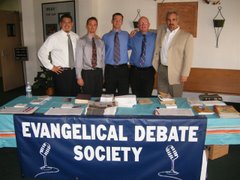
Evangelical Debate Society of
Southern California
"But examine everything carefully, hold fast to the truth."
(1 Thessalonians 5:21)
In recent days, I have received a number of questions, comments and requests regarding my views on the subject of Preterism. Because of the enormous response regarding this subject, I will be posting weekly on my theological blog regarding this subject. I have been also asked to debate on the subject of Preterism, an event which could transpire in the near future.
Preterism-
A Christian system of eschatological thought popular in various forms of Postmillenial and Amillennial theology that postulates that all of the end-times events mentioned in the Bible are believed to have been already fulfilled. These events were fulfilled in the past, particularly before 70 AD. during the Roman-Jewish war, wherein the Roman army led by General Titus, destroyed the Jewish Temple and dispersed the inhabitants of Jerusalem.
The term preterism is derived from the word preterite, or past perfect tense; it also has its roots in the Latin word præter, meaning "past." Adherents of Preterism are known as Preterists. See: en.wikipedia.org/wiki/Preterism
Adherents of "Partial Preterism" maintain that many aspects of Biblical eschatology were fulfilled in 70 AD but not all.
In recent years, the subject of Preterism and Partial Preterism has become a very popular discussion in educated Evangelical circles. The popularity of the Preterism issue has been brought upon due to many Evangelicals dissatisfaction and disillusionment with the popularization of Pretribulational and Dispensationalist views in such books as "The Left Behind Series" and due to the writings of partial Preterist theological writers RC Sproul and Hank Hanegraaf who authored the books "The Last Days According to Jesus" and "The Last Disciple" in recent years.
Due to my robust Augustinian soteriological convictions, many people over the years, have simply assumed that I must be Amillennialst or Postmillennalist, with Partial Preterist sympathies. However, this could not be further from the truth. For the record, I want to state publically, that I am a Premillennialist and Pretribulationalist and have been for twenty years.
For years I sat under Dr. David L. Hocking and John MacArthur, dispenationalist Bible teachers and I was educated at Moody Bible Institute, Biola University and the Master's Seminary, traditional bastions of Premillenial eschatological belief. Furthermore, I believe in the distinction between Israel and the Christian Church and that God has a future hope for the national of Israel. If I could be classified in a theological camp, I would most closely adhere to what is known as "Progressive Dispensationalism" made popular by Professor Dr. Robert L. Saucy of Talbot School of Theology and Darrel Boch of Dallas Theological Seminary and Craig Blaising, formerly of Dallas Seminary and Southern Baptist Seminary in KY, now research professor at Southwestern Baptist Theological Seminary in Fort Worth Texas.
While, I have many friends in various Evangelical camps of eschatological conviction and do not make ones views on the end times a litmus test for Evangelical Orthodoxy, I have become exceedingly concerned about the rise of Preterism and Partial Preterism in many Evangelical circles and am constantly being asked questions about the subject and have been asked by some to debate on the subject of Preterism.
One thing that has personally bothered me in recent years about the attack against Premillennialism and Pretribulationalism, is the constant negative mention of John Nelson Darby and the Plymouth Brethern as the founders of the Pretribulationalist view, as though mentioning Darby and the Plymouth Brethern somehow taints the entire Pretribulational argument.
Those who attack Pretribulationalism and Dispensationalist Premillennialism on the grounds that it was founded by Darby and the P.B. are guilty of the logical fallacy of
Ad Hominem. Translated from Latin to English, "Ad Hominem" means "against the man" or "against the person." as the nizkor project has rightly stated:
An Ad Hominem is a general category of fallacies in which a claim or argument is rejected on the basis of some irrelevant fact about the author of or the person presenting the claim or argument. Typically, this fallacy involves two steps. First, an attack against the character of person making the claim, her circumstances, or her actions is made (or the character, circumstances, or actions of the person reporting the claim). Second, this attack is taken to be evidence against the claim or argument the person in question is making (or presenting). This type of "argument" has the following form:
Person A makes claim X.
Person B makes an attack on person A.
Therefore A's claim is false.
The reason why an Ad Hominem (of any kind) is a fallacy is that the character, circumstances, or actions of a person do not (in most cases) have a bearing on the truth or falsity of the claim being made (or the quality of the argument being made).
I have done a tremendous amount of study on the history of John Nelson Darby and the Plymouth Brethern and can demonstrate conclusively that Darby and the Plymouth Brethren were theologically orthodox and Evangelical. Many Amillennial and Postmillenial opponents of the Pretribulationalist view might be suprised to discover that John Nelson Darby was a devout Calvinist who once separated from D.L. Moody over the Chicago Evangelist's alleged Arminian views. Hence, those Preterist and Partial Preterist advocated and opponents of Pretribulationalism need to stick to the arguments without resorting to personal attacks against Darby and the Plymouth Brethern.
Next time: I will explore the Preterist and Partial Preterist postions in depth.
by Lee Edward Enochs,
Evangelical Debate Society of
Southern California
"But examine everything carefully, hold fast to the truth."
(1 Thessalonians 5:21)
In recent days, I have received a number of questions, comments and requests regarding my views on the subject of Preterism. Because of the enormous response regarding this subject, I will be posting weekly on my theological blog regarding this subject. I have been also asked to debate on the subject of Preterism, an event which could transpire in the near future.
Preterism-
A Christian system of eschatological thought popular in various forms of Postmillenial and Amillennial theology that postulates that all of the end-times events mentioned in the Bible are believed to have been already fulfilled. These events were fulfilled in the past, particularly before 70 AD. during the Roman-Jewish war, wherein the Roman army led by General Titus, destroyed the Jewish Temple and dispersed the inhabitants of Jerusalem.
The term preterism is derived from the word preterite, or past perfect tense; it also has its roots in the Latin word præter, meaning "past." Adherents of Preterism are known as Preterists. See: en.wikipedia.org/wiki/Preterism
Adherents of "Partial Preterism" maintain that many aspects of Biblical eschatology were fulfilled in 70 AD but not all.
In recent years, the subject of Preterism and Partial Preterism has become a very popular discussion in educated Evangelical circles. The popularity of the Preterism issue has been brought upon due to many Evangelicals dissatisfaction and disillusionment with the popularization of Pretribulational and Dispensationalist views in such books as "The Left Behind Series" and due to the writings of partial Preterist theological writers RC Sproul and Hank Hanegraaf who authored the books "The Last Days According to Jesus" and "The Last Disciple" in recent years.
Due to my robust Augustinian soteriological convictions, many people over the years, have simply assumed that I must be Amillennialst or Postmillennalist, with Partial Preterist sympathies. However, this could not be further from the truth. For the record, I want to state publically, that I am a Premillennialist and Pretribulationalist and have been for twenty years.
For years I sat under Dr. David L. Hocking and John MacArthur, dispenationalist Bible teachers and I was educated at Moody Bible Institute, Biola University and the Master's Seminary, traditional bastions of Premillenial eschatological belief. Furthermore, I believe in the distinction between Israel and the Christian Church and that God has a future hope for the national of Israel. If I could be classified in a theological camp, I would most closely adhere to what is known as "Progressive Dispensationalism" made popular by Professor Dr. Robert L. Saucy of Talbot School of Theology and Darrel Boch of Dallas Theological Seminary and Craig Blaising, formerly of Dallas Seminary and Southern Baptist Seminary in KY, now research professor at Southwestern Baptist Theological Seminary in Fort Worth Texas.
While, I have many friends in various Evangelical camps of eschatological conviction and do not make ones views on the end times a litmus test for Evangelical Orthodoxy, I have become exceedingly concerned about the rise of Preterism and Partial Preterism in many Evangelical circles and am constantly being asked questions about the subject and have been asked by some to debate on the subject of Preterism.
One thing that has personally bothered me in recent years about the attack against Premillennialism and Pretribulationalism, is the constant negative mention of John Nelson Darby and the Plymouth Brethern as the founders of the Pretribulationalist view, as though mentioning Darby and the Plymouth Brethern somehow taints the entire Pretribulational argument.
Those who attack Pretribulationalism and Dispensationalist Premillennialism on the grounds that it was founded by Darby and the P.B. are guilty of the logical fallacy of
Ad Hominem. Translated from Latin to English, "Ad Hominem" means "against the man" or "against the person." as the nizkor project has rightly stated:
An Ad Hominem is a general category of fallacies in which a claim or argument is rejected on the basis of some irrelevant fact about the author of or the person presenting the claim or argument. Typically, this fallacy involves two steps. First, an attack against the character of person making the claim, her circumstances, or her actions is made (or the character, circumstances, or actions of the person reporting the claim). Second, this attack is taken to be evidence against the claim or argument the person in question is making (or presenting). This type of "argument" has the following form:
Person A makes claim X.
Person B makes an attack on person A.
Therefore A's claim is false.
The reason why an Ad Hominem (of any kind) is a fallacy is that the character, circumstances, or actions of a person do not (in most cases) have a bearing on the truth or falsity of the claim being made (or the quality of the argument being made).
I have done a tremendous amount of study on the history of John Nelson Darby and the Plymouth Brethern and can demonstrate conclusively that Darby and the Plymouth Brethren were theologically orthodox and Evangelical. Many Amillennial and Postmillenial opponents of the Pretribulationalist view might be suprised to discover that John Nelson Darby was a devout Calvinist who once separated from D.L. Moody over the Chicago Evangelist's alleged Arminian views. Hence, those Preterist and Partial Preterist advocated and opponents of Pretribulationalism need to stick to the arguments without resorting to personal attacks against Darby and the Plymouth Brethern.
Next time: I will explore the Preterist and Partial Preterist postions in depth.
Thursday, February 23, 2006
Romans Bible Study Every Wednesday Night!
You Are Invited to Our Bible Study Wednesday Nights
Romans 10:17
I hope you are doing well. Hey, I wanted to let you know, we started the in depth Romans Bible study back up at my place in Costa Mesa and I want to invite you and all your friends. I am totally revamping the study and making it more of an in depth Seminary type class.
You and all of your friends are invited to come, it's at 7:00pm at my apartment on Wednesday Nights.
My address is:
Romans Bible Study
343 E. 21st Street
Costa Mesa California # C
92627
(714) 514-8339
Hope all is well and hope to see you there!
Sincerely in Christ!
Ed
Romans 10:17
I hope you are doing well. Hey, I wanted to let you know, we started the in depth Romans Bible study back up at my place in Costa Mesa and I want to invite you and all your friends. I am totally revamping the study and making it more of an in depth Seminary type class.
You and all of your friends are invited to come, it's at 7:00pm at my apartment on Wednesday Nights.
My address is:
Romans Bible Study
343 E. 21st Street
Costa Mesa California # C
92627
(714) 514-8339
Hope all is well and hope to see you there!
Sincerely in Christ!
Ed
Wednesday, February 22, 2006
Los Angeles Time Article on DNA and the Book of Mormon
Last Friday, the Los Angeles Times featured a major front page article (two page article) on the DNA Controversy that is rocking the Mormon Church at it's very foundations.
In recent decades the Mormon Church has made many converts throughout Central and South America largerly through the LDS claim that the the inhabitants of Central and South America are direct decendants of the Lamanites who came from Israel and populated the southern part of the North American hemisphere according to the Book of Mormon.
In fact, this claim of the Mormon Church has helped convert 4 million Central and South Americans to the Mormon Church, roughly one third of the total Mormon population world wide. Many South and Central Americans have taken great pride that they are mentioned in the Book of Mormon and the LDS Church has been incredibly successful with this Evangelistic strategy in that part of the world.
However, through the percise science of DNA research which is 99.5% accurate, is has been conclusively demonstrated that there is no possibility that the inhabitants of South and Central America are related to the semetic Israelites, rather DNA evidence demonstrated that the current inhabitants of South and Central America descended from the Asian hemisphere and not Israel as the Book of Mormon falsely alleges.
The current firestorm in the Mormon Church regarding DNA is rocking the LDS Church to its very core and many people are leaving the Mormon Church.
I want to encourage everyone concerned about the claims of the Mormon Church to watch the video called "DNA vs. the Book of Mormon" which can be purchased at:
http://www.lhvm.org/dna.htm
Sincerely in Christ,
Ed Enochs
In recent decades the Mormon Church has made many converts throughout Central and South America largerly through the LDS claim that the the inhabitants of Central and South America are direct decendants of the Lamanites who came from Israel and populated the southern part of the North American hemisphere according to the Book of Mormon.
In fact, this claim of the Mormon Church has helped convert 4 million Central and South Americans to the Mormon Church, roughly one third of the total Mormon population world wide. Many South and Central Americans have taken great pride that they are mentioned in the Book of Mormon and the LDS Church has been incredibly successful with this Evangelistic strategy in that part of the world.
However, through the percise science of DNA research which is 99.5% accurate, is has been conclusively demonstrated that there is no possibility that the inhabitants of South and Central America are related to the semetic Israelites, rather DNA evidence demonstrated that the current inhabitants of South and Central America descended from the Asian hemisphere and not Israel as the Book of Mormon falsely alleges.
The current firestorm in the Mormon Church regarding DNA is rocking the LDS Church to its very core and many people are leaving the Mormon Church.
I want to encourage everyone concerned about the claims of the Mormon Church to watch the video called "DNA vs. the Book of Mormon" which can be purchased at:
http://www.lhvm.org/dna.htm
Sincerely in Christ,
Ed Enochs
Tuesday, February 21, 2006
Debates Coming this Year!
So then, faith comes by hearing and hearing by the Word of God"
(Romans 10:17)
Dear Family and Friends,
Hi Everyone!
I just wanted to tell you that I am in the process of organizing more theological debates similar to the one on the Trinity I was involved in a couple of months ago in Riverside California.
It is in my heart to organize theological debates with various non Evangelical groups active in the Orange County area such as Muslims, Buddhists, Hindu's, Mormons, Jehovah's Witnesses and other such groups.
I would appreciate your prayers for these debates as they are very time consuming in preparation, organization and study.
I love you all and want to hear from you!
Drop me an e-mail soon and let me know what topics you want to hear about.
Sincerely in Jesus Christ,
Ed Enochs
(Romans 10:17)
Dear Family and Friends,
Hi Everyone!
I just wanted to tell you that I am in the process of organizing more theological debates similar to the one on the Trinity I was involved in a couple of months ago in Riverside California.
It is in my heart to organize theological debates with various non Evangelical groups active in the Orange County area such as Muslims, Buddhists, Hindu's, Mormons, Jehovah's Witnesses and other such groups.
I would appreciate your prayers for these debates as they are very time consuming in preparation, organization and study.
I love you all and want to hear from you!
Drop me an e-mail soon and let me know what topics you want to hear about.
Sincerely in Jesus Christ,
Ed Enochs
Sunday, February 05, 2006
Concerning Mormon Authority
Authority: The power to enforce laws, exact obedience, command, determine, or judge.
Galatians 1:6-8
After spending a few weeks in Utah around a multitude of Mormons, the question of where Evangelicals get their authority becomes an essential issue. Mormons, as we know , believe that they are the restored Church and that they alone possess the authority of Jesus Christ to baptize, administer the Lord's supper and function as a true Church.
The LDS Church makes the audacious claim that Joseph Smith was God's annointed prophet of this dispensation and the power and authority of Christ rests in Joseph Smith and his apostles. The Mormons believe in the doctrine of Apostolic Authority that has similarites with that of offical Roman Catholicism in that they believe that the authority of Christ given to the Apostle Peter in Matthew 16:18-19, after falling way from the earth upon the death of the Apostle John around 100 A.D. was fully restored by Christ and bestowed upon Joseph Smith and his apostolic sucessors; namely the Presidents of the Mormon Church that followed him after his death in 1844. Joseph Smith wrote,
"My object in going to inquire of the Lord was to know which of all the sects was right, that I might know which to join. No sooner, therefore, did I get possession of myself, so as to be able to speak, than I asked the Personages who stood above me in the light, which of all the sects was right (for at this time it had never entered into my heart that all were wrong)—and which I should join. I was answered that I must join none of them, for they were all wrong and the Personage who addressed me said that all their creeds were an abomination in his sight; that those professors were all corrupt that: “they draw near to me with their lips, but their hearts are far from me, they teach for doctrines the commandments of men, having a form of godliness, but they deny the power thereof.”
History of the Church, Vol. 1, Chapters 1-5
"By searching the Scriptures I found that mankind did not come unto the Lord but that they had apostatized from the true and living faith and there was no society or denomination that built upon the Gospel of Jesus Christ as recorded in the New Testament"
(Personal Writings, p. 5).
Mormons believe the church fell away and was restored by Joseph Smith in 1830. Mormons believe in the reality of ongoing and continous revelation and that God has decreed that there be apostles of the Church today. The LDS believe that the supreme authority of Jesus Christ rests in the chief apostle, president and revelator Gorden B. Hinckley.
However, just the mere assertion that the Mormon Church is the true church of Jesus Christ and that God's annointed prophet and president of the Church is Gorden B. Hinckley does not make it the truth.
There is absolutely no evidence that the true Church of Christ fell away as the Mormons claim.
Galatians 1:6-8
After spending a few weeks in Utah around a multitude of Mormons, the question of where Evangelicals get their authority becomes an essential issue. Mormons, as we know , believe that they are the restored Church and that they alone possess the authority of Jesus Christ to baptize, administer the Lord's supper and function as a true Church.
The LDS Church makes the audacious claim that Joseph Smith was God's annointed prophet of this dispensation and the power and authority of Christ rests in Joseph Smith and his apostles. The Mormons believe in the doctrine of Apostolic Authority that has similarites with that of offical Roman Catholicism in that they believe that the authority of Christ given to the Apostle Peter in Matthew 16:18-19, after falling way from the earth upon the death of the Apostle John around 100 A.D. was fully restored by Christ and bestowed upon Joseph Smith and his apostolic sucessors; namely the Presidents of the Mormon Church that followed him after his death in 1844. Joseph Smith wrote,
"My object in going to inquire of the Lord was to know which of all the sects was right, that I might know which to join. No sooner, therefore, did I get possession of myself, so as to be able to speak, than I asked the Personages who stood above me in the light, which of all the sects was right (for at this time it had never entered into my heart that all were wrong)—and which I should join. I was answered that I must join none of them, for they were all wrong and the Personage who addressed me said that all their creeds were an abomination in his sight; that those professors were all corrupt that: “they draw near to me with their lips, but their hearts are far from me, they teach for doctrines the commandments of men, having a form of godliness, but they deny the power thereof.”
History of the Church, Vol. 1, Chapters 1-5
"By searching the Scriptures I found that mankind did not come unto the Lord but that they had apostatized from the true and living faith and there was no society or denomination that built upon the Gospel of Jesus Christ as recorded in the New Testament"
(Personal Writings, p. 5).
Mormons believe the church fell away and was restored by Joseph Smith in 1830. Mormons believe in the reality of ongoing and continous revelation and that God has decreed that there be apostles of the Church today. The LDS believe that the supreme authority of Jesus Christ rests in the chief apostle, president and revelator Gorden B. Hinckley.
However, just the mere assertion that the Mormon Church is the true church of Jesus Christ and that God's annointed prophet and president of the Church is Gorden B. Hinckley does not make it the truth.
There is absolutely no evidence that the true Church of Christ fell away as the Mormons claim.
Thursday, February 02, 2006
God's Law Demonstrates the Origin and Reality of Sin
by Lee Edward Enochs
"Therefore, just as sin entered the world through one man, and death through sin, and in this way death came to all men, because all sinned" (Romans 5:12).
"For all have sinned and fallen short of the glory of God" (Romans 3:23).
"For there is not a just person on the earth that does not sin" (Ecclesiastes 7:20).
In recent years, evangelists Kirk Cameron and Ray Comfort have done much positive ministerial work in proclaiming that the righteous standard of God's Law must be preached in any effective presentation of the Gospel of Jesus Christ. Cameron and Comfort have demonstrated from the Bible, that for a person to be saved, they must first acknowledge that they are sinful transgressors of God's Law as revealed in the Ten Commandments (Exodus 20).
In a postmodern and inherently anti-Christian civilization such as contemporary North America, questions pertaining to the Law and origin and nature of sin are deemed irrelevant, obstructionist and obscenely obsolete by most people functioning inside and outside of the historic Christian Church.
However, those who deny the existence, reality and perpetuity of sin are guilty of self contradiction and by self denial, they at once simultaneously affirm the Bible's teaching on the exceedingly sinfulness of sin and humanities enslavement and blindness due to their inherent sinful nature inherited through Adam (Romans 5:1-18).
For to deny the existence and ongoing reality of sin, one needs to give an account of why there is evil and suffering in the world. If sin does not exist as many rebellious Americans postulate, then, where does all the pain and misery originate from?
If there are no such things as sin and absolute evil as our secularist friends postulate, than why is there a universally transcendent feeling amongst all people groups of the world, that things are not as they should be on this earth and that men and women, at times do things they ought not. That people trust that some people in their given society will at times do evil things is demonstrated in the fact that almost all people have locks on their doors or other means of protecting their goods from being the victims of their respective neighbors thievery.
FACT: It is universally self evident that all people at times do wrong things. To say otherwise is to be dishonest and self-deceived. Any honest person, must acknowledge that he or she does things that are not right.
If it is a given that we all do wrong things at a given time, then we must affirm that there is an objective standard and absolute ethical criterion of good and evil by which we can conclusively deem something inherently virtuous or not.
The fact is, that we all have this objective standard of right and wrong inherent within ourselves. These moral sentiments are innate within us.
According to God's exclusively inspired, inerrant, infallible and authoritative Word, all men know there is such thing as sin; Romans 2:12-16 says,
All who sin apart from the law will also perish apart from the law, and all who sin under the law will be judged by the law. For it is not those who hear the law who are righteous in God's sight, but it is those who obey the law who will be declared righteous. (Indeed, when Gentiles, who do not have the law, do by nature things required by the law, they are a law for themselves, even though they do not have the law, since they show that the requirements of the law are written on their hearts, their consciences also bearing witness, and their thoughts now accusing, now even defending them.) This will take place on the day when God will judge men's secrets through Jesus Christ, as my gospel declares."
All men and women know they are sinners and they have sinned against God's righteous standard, those who say otherwise suppress the truth in unrighteousness and stand under the condemnation of God's Law.
The Ten Commandments, when preached effectively to non-Christians, demonstrates to them their sinfulness and need of a remedy for their predicament of condemnation; namely, the saving grace of God as found in the cross of Jesus Christ.
In short, all men and women know deep within that God exists and that we are transgressors of God's law, those who say otherwise are guilty of self denial and self deception (Romans 1:18-32).
Ray Comfort and Kirk Cameron's approach to Evangelism, uses the Law of God effectively, showing men and women they they must realize that they are sinners to understand and appreciate what they are being saved from. Such a message is of absolute necessity in the exceedingly dark world that has become American civilization.
We have all sinned and fallen short of God's glory and need to trust in the saving Gospel of God's grace through the person and cross of Jesus Christ to be saved from the wrath of God.
"But these have been written, that you might believe that Jesus is the Christ, the Son of God and that by believing, you might have life in His name" (John 20:31).
"Therefore, just as sin entered the world through one man, and death through sin, and in this way death came to all men, because all sinned" (Romans 5:12).
"For all have sinned and fallen short of the glory of God" (Romans 3:23).
"For there is not a just person on the earth that does not sin" (Ecclesiastes 7:20).
In recent years, evangelists Kirk Cameron and Ray Comfort have done much positive ministerial work in proclaiming that the righteous standard of God's Law must be preached in any effective presentation of the Gospel of Jesus Christ. Cameron and Comfort have demonstrated from the Bible, that for a person to be saved, they must first acknowledge that they are sinful transgressors of God's Law as revealed in the Ten Commandments (Exodus 20).
In a postmodern and inherently anti-Christian civilization such as contemporary North America, questions pertaining to the Law and origin and nature of sin are deemed irrelevant, obstructionist and obscenely obsolete by most people functioning inside and outside of the historic Christian Church.
However, those who deny the existence, reality and perpetuity of sin are guilty of self contradiction and by self denial, they at once simultaneously affirm the Bible's teaching on the exceedingly sinfulness of sin and humanities enslavement and blindness due to their inherent sinful nature inherited through Adam (Romans 5:1-18).
For to deny the existence and ongoing reality of sin, one needs to give an account of why there is evil and suffering in the world. If sin does not exist as many rebellious Americans postulate, then, where does all the pain and misery originate from?
If there are no such things as sin and absolute evil as our secularist friends postulate, than why is there a universally transcendent feeling amongst all people groups of the world, that things are not as they should be on this earth and that men and women, at times do things they ought not. That people trust that some people in their given society will at times do evil things is demonstrated in the fact that almost all people have locks on their doors or other means of protecting their goods from being the victims of their respective neighbors thievery.
FACT: It is universally self evident that all people at times do wrong things. To say otherwise is to be dishonest and self-deceived. Any honest person, must acknowledge that he or she does things that are not right.
If it is a given that we all do wrong things at a given time, then we must affirm that there is an objective standard and absolute ethical criterion of good and evil by which we can conclusively deem something inherently virtuous or not.
The fact is, that we all have this objective standard of right and wrong inherent within ourselves. These moral sentiments are innate within us.
According to God's exclusively inspired, inerrant, infallible and authoritative Word, all men know there is such thing as sin; Romans 2:12-16 says,
All who sin apart from the law will also perish apart from the law, and all who sin under the law will be judged by the law. For it is not those who hear the law who are righteous in God's sight, but it is those who obey the law who will be declared righteous. (Indeed, when Gentiles, who do not have the law, do by nature things required by the law, they are a law for themselves, even though they do not have the law, since they show that the requirements of the law are written on their hearts, their consciences also bearing witness, and their thoughts now accusing, now even defending them.) This will take place on the day when God will judge men's secrets through Jesus Christ, as my gospel declares."
All men and women know they are sinners and they have sinned against God's righteous standard, those who say otherwise suppress the truth in unrighteousness and stand under the condemnation of God's Law.
The Ten Commandments, when preached effectively to non-Christians, demonstrates to them their sinfulness and need of a remedy for their predicament of condemnation; namely, the saving grace of God as found in the cross of Jesus Christ.
In short, all men and women know deep within that God exists and that we are transgressors of God's law, those who say otherwise are guilty of self denial and self deception (Romans 1:18-32).
Ray Comfort and Kirk Cameron's approach to Evangelism, uses the Law of God effectively, showing men and women they they must realize that they are sinners to understand and appreciate what they are being saved from. Such a message is of absolute necessity in the exceedingly dark world that has become American civilization.
We have all sinned and fallen short of God's glory and need to trust in the saving Gospel of God's grace through the person and cross of Jesus Christ to be saved from the wrath of God.
"But these have been written, that you might believe that Jesus is the Christ, the Son of God and that by believing, you might have life in His name" (John 20:31).
Tuesday, January 31, 2006
Cardinal John Henry Newman: From Anglican Tractarian Leader to Roman Catholic Bishop
Cardinal John Henry Newman: From Anglican Tractarian Leader to Roman Catholic Bishop
some books by Newman: Relevancy: must see Newman's arguments for apostolic authority
On the inspiration of Scripture;
Newman, John Henry,
BS 480 N42
General
Two essays on Scriptural miracles and on ecclesi
Newman, John Henry,
BS 2545 M5 N4
General
The private devotions of Lancelot Andrewes.
Andrewes, Lancelot,
BV 4830 A655
General
Miscellanies from the Oxford sermons and other w
Newman, John Henry,
BX 1756 N4
General
Parochial and plain sermons v.2,
Newman, John Henry,
BX 5133 N4 P3 v.2
General
Parochial and plain sermons v.3,
Newman, John Henry,
BX 5133 N4 P3 v.3
General
Apologia pro vita sua; an authoritative text of
Newman, John Henry,
BX 4705 N5 A3
General
Parochial and plain sermons v.4,
Newman, John Henry,
BX 5133 N4 P3 v.4
General
Parochial and plain sermons v.1,
Newman, John Henry,
BX 5133 N4 P3 v.1
General
Parochial and plain sermons v.5,
Newman, John Henry,
BX 5133 N4 P3 v.5
Genera
some books by Newman: Relevancy: must see Newman's arguments for apostolic authority
On the inspiration of Scripture;
Newman, John Henry,
BS 480 N42
General
Two essays on Scriptural miracles and on ecclesi
Newman, John Henry,
BS 2545 M5 N4
General
The private devotions of Lancelot Andrewes.
Andrewes, Lancelot,
BV 4830 A655
General
Miscellanies from the Oxford sermons and other w
Newman, John Henry,
BX 1756 N4
General
Parochial and plain sermons v.2,
Newman, John Henry,
BX 5133 N4 P3 v.2
General
Parochial and plain sermons v.3,
Newman, John Henry,
BX 5133 N4 P3 v.3
General
Apologia pro vita sua; an authoritative text of
Newman, John Henry,
BX 4705 N5 A3
General
Parochial and plain sermons v.4,
Newman, John Henry,
BX 5133 N4 P3 v.4
General
Parochial and plain sermons v.1,
Newman, John Henry,
BX 5133 N4 P3 v.1
General
Parochial and plain sermons v.5,
Newman, John Henry,
BX 5133 N4 P3 v.5
Genera
Paul Weiss: Father of Theological Presuppostionalism
Paul Weiss: Philosopher.
From Yale Bulletin: August 30, 2002
(Relevancy: John Warwick Montgomery, in his "Where is History Going" argues that Godon Clark's presuppostionalism is similar to Paul Weiss' philosophy)
Paul Weiss, a preeminent philosopher known particularly for his work in metaphysics, died on July 5 at his home in Washington, D.C.
He was 101.
Professor Weiss taught at Yale from 1946 until his retirement in 1969 as Sterling Professor of Philosophy.
In his more than 30 books, Professor Weiss addressed such topics as metaphysics, cosmology and theology. He had a special interest in the way people related to each other through symbols, language, intonation, art and music. His books include "Being and Other Realities," "Creative Ventures" and, most recently, "Emphatics." A new work, "Surrogates," which explores the way that things stand for one another in nature and human experience, will be published next year. In addition, Professor Weiss co-edited a six-volume collection of the papers of philosopher Charles Sanders Peirce and wrote influential works on the philosophy of the arts, religion, sports, logic and politics.
Professor Weiss was the founder of the Metaphysical Society of America in 1947 and of its academic journal, Review of Metaphysics. He served as the journal's editor until 1964.
He was elected to the Library of Living Philosophers, which published "The Philosophy of Paul Weiss" in 1995 as part of a series of volumes devoted to influential philosophers.
In the book, Professor Weiss explained that he showed signs of a philosophical mind in early childhood. "When I was in the first grade," he recalled, "my teacher said that all the words in the English language were composed of the 26 letters we had so painfully learned. I was dumbfounded.
I spent a good deal of the day going over my vocabulary, searching for a word not made up of some combination of those letters. I then exhibited some of the marks of the philosopher: a refusal to accept the word of authority, a struggle with a problem beyond my powers to resolve, and the use of an unsatisfactory method, followed by a belated discovery that the problem had been misconstrued ..." He also credited his being hit twice by horse-drawn carts during childhood -- and his speculation about the role of chance in such incidents -- as another experience that influenced his interest in philosophical thought.
Paul Weiss was born in Manhattan on May 19, 1901, to working-class Jewish parents. He graduated from City College with a degree in philosophy and then studied with noted philosopher Alfred North Whitehead at Harvard University, where he earned his Ph.D. in 1929. He lectured for a year at Harvard and Radcliffe and then taught at Bryn Mawr before coming to Yale.
At Yale, he was known as an animated ,and passionate teacher who was a mentor to many students of philosophy, as well as to such noted alumni as writer William F. Buckley and entertainer Dick Cavett. Professor Weiss was the subject of documentary films and was interviewed by popular television hosts, including Jack Paar.
After his retirement from Yale, Professor Weiss gained notoriety for challenging age discrimination. When offered a prestigious chair at Fordham University that was later rescinded because of his age (he was 69) Professor Weiss filed an age discrimination suit against the university in 1971. He lost the much publicized $1 million suit.
Later, after teaching for many years as the Heffer Visiting Professor of Philosophy of Catholic University in Washington, Professor Weiss challenged that University's refusal to renew his contract, and an investigation by the Equal Opportunity Commission confirmed age discrimination as the reason. Catholic University reinstated Professor Weiss for two more years, after which he retired.
Professor Weiss is survived by his son, Jonathan A. Weiss of New York City, and a daughter, Judith E. Weiss of Las Vegas. His wife, Victoria, died in 1953.
From Yale Bulletin: August 30, 2002
(Relevancy: John Warwick Montgomery, in his "Where is History Going" argues that Godon Clark's presuppostionalism is similar to Paul Weiss' philosophy)
Paul Weiss, a preeminent philosopher known particularly for his work in metaphysics, died on July 5 at his home in Washington, D.C.
He was 101.
Professor Weiss taught at Yale from 1946 until his retirement in 1969 as Sterling Professor of Philosophy.
In his more than 30 books, Professor Weiss addressed such topics as metaphysics, cosmology and theology. He had a special interest in the way people related to each other through symbols, language, intonation, art and music. His books include "Being and Other Realities," "Creative Ventures" and, most recently, "Emphatics." A new work, "Surrogates," which explores the way that things stand for one another in nature and human experience, will be published next year. In addition, Professor Weiss co-edited a six-volume collection of the papers of philosopher Charles Sanders Peirce and wrote influential works on the philosophy of the arts, religion, sports, logic and politics.
Professor Weiss was the founder of the Metaphysical Society of America in 1947 and of its academic journal, Review of Metaphysics. He served as the journal's editor until 1964.
He was elected to the Library of Living Philosophers, which published "The Philosophy of Paul Weiss" in 1995 as part of a series of volumes devoted to influential philosophers.
In the book, Professor Weiss explained that he showed signs of a philosophical mind in early childhood. "When I was in the first grade," he recalled, "my teacher said that all the words in the English language were composed of the 26 letters we had so painfully learned. I was dumbfounded.
I spent a good deal of the day going over my vocabulary, searching for a word not made up of some combination of those letters. I then exhibited some of the marks of the philosopher: a refusal to accept the word of authority, a struggle with a problem beyond my powers to resolve, and the use of an unsatisfactory method, followed by a belated discovery that the problem had been misconstrued ..." He also credited his being hit twice by horse-drawn carts during childhood -- and his speculation about the role of chance in such incidents -- as another experience that influenced his interest in philosophical thought.
Paul Weiss was born in Manhattan on May 19, 1901, to working-class Jewish parents. He graduated from City College with a degree in philosophy and then studied with noted philosopher Alfred North Whitehead at Harvard University, where he earned his Ph.D. in 1929. He lectured for a year at Harvard and Radcliffe and then taught at Bryn Mawr before coming to Yale.
At Yale, he was known as an animated ,and passionate teacher who was a mentor to many students of philosophy, as well as to such noted alumni as writer William F. Buckley and entertainer Dick Cavett. Professor Weiss was the subject of documentary films and was interviewed by popular television hosts, including Jack Paar.
After his retirement from Yale, Professor Weiss gained notoriety for challenging age discrimination. When offered a prestigious chair at Fordham University that was later rescinded because of his age (he was 69) Professor Weiss filed an age discrimination suit against the university in 1971. He lost the much publicized $1 million suit.
Later, after teaching for many years as the Heffer Visiting Professor of Philosophy of Catholic University in Washington, Professor Weiss challenged that University's refusal to renew his contract, and an investigation by the Equal Opportunity Commission confirmed age discrimination as the reason. Catholic University reinstated Professor Weiss for two more years, after which he retired.
Professor Weiss is survived by his son, Jonathan A. Weiss of New York City, and a daughter, Judith E. Weiss of Las Vegas. His wife, Victoria, died in 1953.
Where Do Evangelicals Get Their Authority? (Similarities Between Mormon and Catholic Views of Apostolic Authority)
"And I say to you, that you are Peter, and upon this Rock, I will build my church, and the gates of hell, will not prevail against it"
Matthew 16:18
After being in Utah for a few weeks, I see that there are similarities in the way Mormons and Catholic Apologists view Authority.
The Catholic Church believes in the concept of Successio Personarum, or a continual succession of Popes stemming all the way back to the Apostle Peter, whom the Catholic Church believes was the first pope. Roman Catholicism argues that Christ bestowed His authority upon Peter and His papal successors and that this authority gives the Catholic Church the unique capacity to interpret the Bible for the Christian Church.
Similarly, the Mormon Church argues that it alone (vested in the President and Apostles of the LDS Church) possesses the authority of Jesus Christ since the Church in their view, was restored through the calling of Joseph Smith. The LDS believe that their church alone has the authority to interpret the Bible and administer the sacraments of communion and baptism.
However, the Protestant Church rejects this concept of Successio Personarum. or contemporary apostolic authority and argues for Successio Doctrinare, that is that the true Evangelical and Biblical doctrine has been passed down throughout the ages since the time of the apostles without fail or interruption.
Matthew 16:18
After being in Utah for a few weeks, I see that there are similarities in the way Mormons and Catholic Apologists view Authority.
The Catholic Church believes in the concept of Successio Personarum, or a continual succession of Popes stemming all the way back to the Apostle Peter, whom the Catholic Church believes was the first pope. Roman Catholicism argues that Christ bestowed His authority upon Peter and His papal successors and that this authority gives the Catholic Church the unique capacity to interpret the Bible for the Christian Church.
Similarly, the Mormon Church argues that it alone (vested in the President and Apostles of the LDS Church) possesses the authority of Jesus Christ since the Church in their view, was restored through the calling of Joseph Smith. The LDS believe that their church alone has the authority to interpret the Bible and administer the sacraments of communion and baptism.
However, the Protestant Church rejects this concept of Successio Personarum. or contemporary apostolic authority and argues for Successio Doctrinare, that is that the true Evangelical and Biblical doctrine has been passed down throughout the ages since the time of the apostles without fail or interruption.
With Alito in It's Time to End Abortion in this Country
I am very glad Judge Alito made it to the supreme court. Maybe now, abortion will end and the senseless slaughter of so many unborn babies will finally, finally cease!
Thursday, January 05, 2006
Romans Bible Study Will Continue Throughout Month
The Monday Night Romans study will continue, throughout January even though I will be in Mormon Utah, for more info please e-mail Abraham at:
abraham@abrahampolanco.com
abraham@abrahampolanco.com
Tuesday, January 03, 2006
In Utah for the Month of January
Romans 5:8
I will be in Logan Utah for the entire month of January 2006. Please pray for me, that I will be a good testimony amongst the Mormon Church this month.
I will be in Logan Utah for the entire month of January 2006. Please pray for me, that I will be a good testimony amongst the Mormon Church this month.
Romans Bible Study Every Monday Night!
"So then, faith comes by hearing and hearing by the Word of God"
(Romans 10:17)
Do you have a desire to grow in your knowledge of theology, apologetics and the teachings of the Bible? If so, we would like to invite you out to study the Book of Romans with us each Monday night in Brea California, for more information, please e-mail Bible Study leader Ed Enochs at: edenochs@yahoo.com
(Romans 10:17)
Do you have a desire to grow in your knowledge of theology, apologetics and the teachings of the Bible? If so, we would like to invite you out to study the Book of Romans with us each Monday night in Brea California, for more information, please e-mail Bible Study leader Ed Enochs at: edenochs@yahoo.com
Justification is by Grace through Faith in Christ Alone (Part I)
by Lee Edward Enochs,
A Sinner Saved by Grace Alone
"Being justified as a gift by His grace through the redemption which is in Christ Jesus; whom God displayed publicly as a propitiation in His blood through faith This was to demonstrate His righteousness, because in the forbearance of God He passed over the sins previously committed; for the demonstration, I say, of His righteousness at the present time, so that He would be just and the justifier of the one who has faith in Jesus" (Romans 3:24-26).
"Therefore, having been justified by faith, we have peace with God through our Lord Jesus Christ" (Romans 5:1)."For those whom He foreknew, He also predestined to become conformed to the image of His Son, so that He would be the firstborn among many brethren; and these whom He predestined, He also called; and these whom He called, He also justified; and these whom He justified, He also glorified" (Romans 8:28-29)."Nevertheless knowing that a man is not justified by the works of the Law but through faith in Christ Jesus, even we have believed in Christ Jesus, so that we may be justified by faith in Christ and not by the works of the Law; since by the works of the Law no flesh will be justified" (Galatians 2:16)."Being justified freely by his grace . . . being now justified by His blood . . . being now justified by faith"—Romans 3:24; 5:9; 5:1."The Evangelical doctrine of justification is the article by which the Church stands or falls" (Martin Luther).“Justification is a judicial act of God, in which He declares, on the basis of the righteousness of Jesus Christ, that all the claims of the law are satisfied with respect to the sinner”(L. Berkhof, Systematic Theology, p. 513)."Now, what is the meaning of justification? Divines will puzzle you, if you ask them. I must try the best I can to make justification plain and simple, even to the comprehension of a child. There is not such a thing as justification to be had on earth for mortal men, except in one way.
Justification, you know, is a forensic term: it is employed always in a legal sense. A prisoner is brought to the bar of justice to be tried. There is only one way whereby that prisoner can be justified, that is, he must be found not guilty. And if he is found not guilty, then he is justified, that is, he is proved to be a just man.If you find that man guilty, you cannot justify him. The Queen may pardon him, but she cannot justify him. The deed is not a justifiable one, if he were guilty concerning it, and he cannot be justified on account of it. He may be pardoned, but not royalty itself can ever wash that man's character. He is as much a real criminal when he is pardoned as before. There is no means among men of justifying a man of an accusation which is laid against him, except by his being proved not guilty. Now, the wonder of wonders is, that we are proved guilty, and yet we are justified: the verdict has been brought in against us—guilty—and yet notwithstanding, we are justified. Can any earthly tribunal do that? No, it remained for the ransom of Christ to effect that which is an impossibility to any tribunal upon earth. We are all guilty. Read the 23rd verse, immediately preceding the text: “For all have sinned, and come short of the glory of God.” There the verdict of guilty is brought in, and yet we are immediately afterwards said to be justified freely by his grace."C. H. Spurgeon (1834-1892)"Justification Made Plain"IntroductionIt has been almost twenty long years since my doctor friend Bruce Thomas first shared the good news of Jesus Christ with me on the campus of the University of Michigan. I want to state clearly that I believe in the "Sola's of the Protestant Reformation which are,SOLA SCRIPTURA (Scripture Alone)The inerrant Scripture is the sole source of written divine revelation,which alone can bind the conscience. The Bible alone teaches all that is necessary for our salvation from sin and is the standard by which all Christian behavior must be measured.We deny that any creed, council or individual may bind a Christian's conscience, that the Holy Spirit speaks independently of or contrary to what is set forth in the Bible, or that personal spiritual experience can ever be a vehicle of revelation.SOLA GRATIA (Grace Alone)In salvation we are rescued from God's wrath by His grace alone. It is the supernatural work of the Holy Spirit that brings us to Christ by releasing us from our to sin and raising us from spiritual death to spiritual life.We deny that salvation is in any sense a human work. Human methods, techniques or strategies by themselves cannot accomplish this transformation. Faith is not produced by our unregenerated human nature.SOLA FIDE (Faith Alone)Justification is by grace alone through faith alone because of Christ alone. In justification Christ's righteousness is imputed to us as the only possible satisfaction of God's perfect justice.We deny that justification rests on any merit to be found in us, or upon the grounds of an infusion of Christ's righteousness in us, or that an institution claiming to be a church that denies or condemns sola fide can be recognized as a legitimate church.SOLUS CHRISTUS (Christ Alone)Salvation is accomplished by the mediatorial work of the historical Christ alone. His sinless life and substitutionary atonement alone are sufficient for our justification and reconciliation to the Father.We deny that the gospel is preached if Christ's substitutionary work is not declared and faith in Christ and his work is not solicited.SOLI DEO GLORIA (Glory Of God Alone)Salvation is of God and has been accomplished by God, it is for God's glory and that we must glorify Him always.
We must live our entire lives before the face of God, under the authority of God and for his glory alone.Since the time I recieved Christ back in 1986, I have seen many people and theological movements come and go, but I have never seen so many people fall away from the true Christian faith like now.I have seen Christian friends of mine completely depart from the Evangelical faith into false religions such as Roman Catholicism and Eastern Orthodoxy and it greatly pains me, because on a careful study of these religious systems views of salvation, I have found that they are diametrically opposed to the Bible's teaching on salvation.I am writing this because I have seen so many of my friends abandon the Evangelical Christian faith for Roman Catholicism, Eastern Orthodoxy and cults that teach a person is justified before God through a combination of their own works and human effort and the grace of God.The Biblical doctrine of salvation is known as soteriology and a crucial issue in the Bible that all people should study carefully and with the utmost seriousness for it concerns where we will spend eternity. According to the Bible, we will either spend eternity with God or eternity separated from God in the lake of fire. Our eternal salvation is contigent upon whether or not we have truly been justified by God's grace through our faith in Jesus Christ alone.A. W. Pink (1889-1952), wrote in his work, "The Instrument of Justification";"God has not selected faith to be the instrument of justification because there is some peculiar virtue in faith, but rather because there is no merit in it: faith is self-emptying—“Therefore it is of faith that it might be by grace” (Rom 4:16). A gift is seen to be a gift when nothing is required or accepted of the recipient, but simply that he receive it. Whatever other properties faith may possess, it is simply as receiving Christ that it justifies. Were we said to be justified by repentance, by love, or by any other spiritual grace, it would convey the idea of something good in us being the consideration on which the blessing was bestowed; but justification by faith (correctly understood) conveys no such idea.“For how does true faith justify unless by uniting us to Christ, so that being made one with him, we may be admitted to a participation in his righteousness?” (John Calvin, Institutes of the Christian Religion, III, xvii, 11). Justifying faith is a looking away from self, a renouncing of my own righteousness, a laying hold of Christ. Justifying faith consists, first, of a knowledge and belief of the truth revealed in Scripture thereon; second, in an abandonment of all pretense, claim or confidence in our own righteousness; third, in a trust in and reliance upon the righteousness of Christ, laying hold of the blessing which He purchased for us. It is the heart's approval and a p probation of the method of justification proposed in the Gospel: by Christ alone, proceeding from the pure grace of God, and excluding all human merits. “In the Lord have I righteousness and strength” (Isa 45:24).None will experimentally appreciate the righteousness of Christ until they have been experimentally stripped by the Spirit. Not until the Lord puts us in the fire and burns off our filthy rags, and makes us stand before Him, trembling from head to foot as we view the sword of His justice suspended over our heads, will any truly value “the best robe.”
Not until the condemning sentence of the law has been applied by the Spirit to the conscience does the guilty soul cry, “Lost, lost!” (Rom 7:9, 10). Not until there is a personal apprehension of the requirements of God's Law, a feeling sense of our total inability to perform its righteous demands, and an honest realization that God would be just in banishing us from His presence forever, is the necessity for a precious Christ perceived by the soul."This human effort plus the grace of God idea of justification is contrary to the express teachings of the Bible and is known as synergism (Greek: synergia; 'working together') as opposed to the Biblical conception of justification also known as monergism (Greek: Mono; one) which conveys that men and women and boys and s of all ages can be saved through the grace of God apart from human effort.I love my Greek Orthodox, Roman Catholic, Mormon and Jehovah's Witness friends, but I must now stand for the Biblical Gospel of the Grace of God that teaches that we are justified by grace alone through our faith alone in Jesus Christ alone based on the authority of the Bible alone.I have seen that all the religions of the world except for Biblical and Evangelical Christianity teach that a person must earn their salvation by human effort doing good works.Throughout the annals of Church History, the all important Biblical truth of the Gospel of grace through faith in Jesus Christ alone has been attacked and undermined by false teachers who desire to put true Christians under a yoke of via different man made systems of works based righteousness.These false teachers seek to prevent unbelievers from hearing the good news of the saving Gospel of Jesus Christ and say that God requires that a person must perform good works in order to be saved.Yet, it is clear from the explicit teaching of the Bible that men and women, boys and s can be forgiven from their sins and be justified before God (declared righteous) exclusively on the basis of God's grace alone through our faith in the person and redemptive work of Jesus Christ alone.This paper has been written in a simple form for the believer in Christ and the non believer alike, in order to stand for the Gospel of Grace alone.Today, contrary to the false teachings of the Roman Catholic Church, Eastern Orthodox Church and other false religions, I will set forth the historic Evangelical and Protestant doctrine that salvation is all of grace.I will argue that a person is saved before God on the basis of God's grace alone through our faith in Jesus Christ alone. I will argue here that God demands absolute righteousness from us as the requirement for obtaining our eternal salvation. Because of our inherent and incessant sinfulness we need a perfect, alien righteousness, completely outside of ourselves in order to be justifed and declared righteous in the sight of Almighty God. This perfect alien righteousness is found completely outside of ourselves in the absolute perfect righteousness of the Lord Jesus Christ. This perfect righteousness is imputed to our account exclusively through God's sovereign grace through our faith in Jesus Christ and His perfect work of atonement upon the cross of Calvary alone.Theologian Charles Hodge wrote,"The nature of justification is determined by its ground. This indeed is an anticipation of another part of the subject, but it is in point here. If the Bible teaches that the ground of justification, the reason why God remits to us the penalty of the Law and accepts us as righteous in his sight, is something out of ourselves, something done for us and not what we do or experience, then it of necessity follows that justification is not subjective. It does not consist in the infusion of righteousness or in making the person justified personally holy. If the “formal cause” of our justification be our goodness, then we are justified for what we are. The Bible, however, teaches that no man living can be justified for what he is. He is condemned for what he is and for what he does. He is justified for what Christ has done for him."Martin Luther also wrote,"There is no such thing as merit; but all who are justified are justified for nothing (gratis), and this is credited to no onebut to the grace of God . . .For Christ alone it is proper to help and save others with His merits and works."The Apostle Paul wrote," For by grace you have been saved through faith; and that not of yourselves, it is the gift of God; not as a result of works, so that no one may boast. For we are His workmanship, created in Christ Jesus for good works, which God prepared beforehand so that we would walk in them" (Ephesians 2:8-10)." (God) saved us, not on the basis of deeds which we have done in righteousness, but according to His mercy, by the washing of regeneration and renewing by the Holy Spirit" (Titus 3:5).According to the Bible, salvation is all of grace.
There is nothing a person has to do to earn God's favor or merit his or her salvation. Jesus Christ died on the cross and rose again from the dead to give eternal life to all who would sincerely repent of their sins and place their faith in Jesus alone.Good works do not save a person but are the proof that that person has been saved by grace. Meaning this, that a person does not have to perform good works in order to earn their salvation, yet once a person is saved by God's grace alone, he or she will naturally bear good fruit as demonstrated by their good works before God.Good works do not save a person from the wrath of God, but are the natural by-product of true saving faith. If a person does not have good works flowing from their faith in Jesus Christ, they had better examine themselves in order to see if they are truly born again.
The Apostle Paul wrote;"Examine yourselves, prove yourselves, do you not know that Jesus Christ is in you unless you have failed the test" (2 Corinthians 13:5).The Apostle Peter wrote:"Therefore, brethren, be all the more diligent to make certain about His calling and choosing you; for as long as you practice these things, you will never stumble" (2 Peter 1:10).As I have quoted above in Ephesians 2:8-10 the Apostle Paul says that we are saved by grace through faith in Jesus Christ alone and that good works will naturally follow true conversion.If Christians are justified by grace through faith in Jesus Christ alone, why then do we still sin?Evangelicals believe that we are justified by God's grace through faith in Jesus Christ alone and that good works and fruits of repentance are the natural by-product of true saving faith. Yet because we still have a fallen human body effected by Adam's sin, we still have a propensity to sin and do sin all the time (Romans 7:13-25 and 1 John 1:6-9).
We do not believe that our justiifcation or being declared righteous before God eradicates sin entirely from our lives, hence we will struggle with various sins until we receive our glorified bodies upon our death or via the rapture.According to the teachings of the Bible we are justified once and for all by the propitiation of Christ's righteousness upon our behalf, so our legal standing before God has been decalred righteous yet, we still in these mortal bodies are not free from sin. This notion of being justified yet still sinful is what the great Protestant Reformer Martin Luther entitled in Latin: "Simul Iustus Et Peccator" or "Simultaneously Sinful and Righteous."Because of the imputation of Adam's sin to our account we are born in sin and acting sinfuly in the only thing we can do in our initial fallen state. Upon being justified before God, our sins are forgiven, the wrath of God is appeased and we are regenerated by the Holy Spirit. Thus as Christians we now have the ability to resist temptation and obey God. In our glorifed state in the future we will have only not to sin since we would have received our glorfied bodies.In justification we are saved by God from God and His sovereign wrath and declared in a foresnic or legal standing, "righteous" before God.While our justification is a once and for all instantaneous salvation event wherein the righteousness of Christ is imputed to us once and for all, sanctifcation (being set apart by God) is an ongoing process wherein God moment by moment conforms us into the image of Christ. The process of sanctification is a lifetime process where we are being conformed to Christ's image, but our justification is a once and for all instantaneous event were we are declared righteous before God.Many opponents of the Evangelical Doctrine of Justification by grace through faith in Jesus Christ alone falsely charge us Evangelicals with "Antinomianism" the heretical doctrine that Christians who are saved under grace do not have to adhere to any moral standards and can live anyway they want.Evangelicalism has definitely never taught that Christians who have been justifed by grace through faith in Christ alone can go out and sin as often as they want, those who live in such a sinful state should examine whether or not they have been saved by grace in the first place because the Bible is clear that those who practice sinful acts will not inherit the Kingdom of God (1 Corinthians 6:9-10 and 1 John 3:1-10).
Justification does not cause a person to be free from sin entirely, the true believer will always have an ongoing struggle with sin, but, the frequency of the sin should decrease as we are conformed more and more into the very image of Jesus Christ our glorious Lord.Likewise, Evangelicals believe that in God's justification of a sinner, a believer in Christ is eternally secure and cannot lose his or her salvation if they have been saved by grace (John 10:28-30, Romans 8:38-39, Philippians 1:6 and Jude 24). Biblical Evangelicalism teaches that a true believer in Christ is justified by grace alone through faith alone in Christ alone based on the authority of the Bible alone and that all true Christians will endure in their faith until the end and cannot lose their standing before God and their eternal salvation.On the other hand, those individuals who say they are Christians but practice sin should be warned to reconsider if they have truly been justified, for true Christians according to the Bible, will not live in a lifestyle of unbroken and unrepentant sin.Martin Luther wrote in his sermon the "Methods and Fruits of Justification,"Again, nothing is necessary in order to accomplish good works but justification; and he that hath attained it performs good works."
Do the Biblical Unitarians Have a Coherent and Objective Hermenutical Criterion?
by L. Edward Enochs
An Open Letter and Theological Salvo to Anthony Buzzard and the Biblical Unitarian Movement
"Test all things, hold fast to the truth"
(1 Thessalonians 5:21).
Dear Unitarians, Dr. Buzzard, Dan Mages and Danny Dixon,
By now you probably know that the word is out about the recent Riverside debate and the general consensus across Southern California is that the Trinitarians in the recent debate presented a more cogent and coherent presentation in defense of the Trinity
Recently, as many of us watched a video that was produced on the debate, a common response being made is that the Unitarian presentation was disjointed and squattered.
As a defender of historic Evangelical Orthodoxy on the Trinity I am willing to continue this debate in writing and in on going public debates like the one held in Riverside this past week, however, one thing has become a consensus amongst the Orthodox Evangelicals is that Unitarians must produce a far more cogent and systematic presentation of their anti-trinitarianism and a better hermenutical articulation of their position, providing some semblance of an objective standard of interpretation.
As a participant in this recent debate, I was greatly perplexed as to what methodology of hermeneutics you were using and seen some major inherent incongruousness in your interpretive grid from which you exegete Scripture. I myself was left scratching my head and wondering from what criterion do you objectively interpret Scripture. Is your hermeneutic taken from the subjectivistic postmodern standard of the Emergent Church Movement, philosophical rationalism, Historical-Grammaticalism or some other interpretive method of understanding Holy Scripture.
It will be interesting to see if you will regroup and redouble your efforts to produce such a hermeneutic or run the risk of being deemed incoherent by your Trinitarian opponents such as I.
In any event, I am looking forward to seeing you rally to muster a better hermeneutic.
I look forward to sparring with you on the Trinity in the days ahead.
In Defense of the Historic Trinity,
Lee Edward Enochs
Evangelical Apologist,
Southern California
An Open Letter and Theological Salvo to Anthony Buzzard and the Biblical Unitarian Movement
"Test all things, hold fast to the truth"
(1 Thessalonians 5:21).
Dear Unitarians, Dr. Buzzard, Dan Mages and Danny Dixon,
By now you probably know that the word is out about the recent Riverside debate and the general consensus across Southern California is that the Trinitarians in the recent debate presented a more cogent and coherent presentation in defense of the Trinity
Recently, as many of us watched a video that was produced on the debate, a common response being made is that the Unitarian presentation was disjointed and squattered.
As a defender of historic Evangelical Orthodoxy on the Trinity I am willing to continue this debate in writing and in on going public debates like the one held in Riverside this past week, however, one thing has become a consensus amongst the Orthodox Evangelicals is that Unitarians must produce a far more cogent and systematic presentation of their anti-trinitarianism and a better hermenutical articulation of their position, providing some semblance of an objective standard of interpretation.
As a participant in this recent debate, I was greatly perplexed as to what methodology of hermeneutics you were using and seen some major inherent incongruousness in your interpretive grid from which you exegete Scripture. I myself was left scratching my head and wondering from what criterion do you objectively interpret Scripture. Is your hermeneutic taken from the subjectivistic postmodern standard of the Emergent Church Movement, philosophical rationalism, Historical-Grammaticalism or some other interpretive method of understanding Holy Scripture.
It will be interesting to see if you will regroup and redouble your efforts to produce such a hermeneutic or run the risk of being deemed incoherent by your Trinitarian opponents such as I.
In any event, I am looking forward to seeing you rally to muster a better hermeneutic.
I look forward to sparring with you on the Trinity in the days ahead.
In Defense of the Historic Trinity,
Lee Edward Enochs
Evangelical Apologist,
Southern California
Saturday, December 31, 2005
Defense of the Eternal Preexistence of Jesus Christ Throughout church history, the Christian Church has always maintained faith in the Doctrine of the Triune nature of Almighty God, affirming the essential Biblical truth that within the one true and living God exists three distinct persons: the Father, the Son and the Holy Spirit and that Jesus Christ preexisted before His incarnation.
One of the egregious errors of the Unitarian position regarding the Trinity pertains to the Preexistence and deity of Jesus Christ.
By Pre-existence we mean, that the body of Jesus Christ, began with it's conception in the Womb, however, the mind and soul of Jesus existed before the conception of His earthly body. Jesus is unique in that He alone possesses a soul that pre-existed His conception in the womb of His mother. Whereas, all other humans begin to exist at conception, the Son of God pre-existed His entrance into the World. The Deity of Christ and eternal preexistence is openly denied by the Unitarians.
The Unitarians believe that God is only one person and that Jesus Christ is not God, the second person of the Trinity who is co-equal with the Father and deny the personhood and deity of the Holy Spirit as well. They argue that Christ did not actually physically exist as a person before the incarnation, rather he existed in the foreknowledge and plan of God. Anthony Buzzard, one of the leading modern Unitarian scholars argues in his book says that the Prexistence statements in the NT really have to do with predestination and foreordination and not that Christ pre-existed in eternity past.
On Page 176 of this same work, Buzzard writes, the view of Jesus as uncreated" is not derived from scripture; rather, it has been handed down through post-biblical tradition."
Again, on Page 181 and 182 Buzzard writes,
"Talk of Jesus preexistence [in Scripture] ought probably in most, perhaps in all cases, to be understood, on the analogy of the preexistence of the Torah, to indicate the eternal divine purpose being achieved through him rather than preexistence of a fully personal kind. " On Page 184 Buzzard quotes James Dunn in stating,
"Outside of John's gospel, there is no doctrine of a literal preexistence."However, this Unitarian denial of the eternal pre-existence of the Lord Jesus Christ is easily refuted by Holy Scripture. The Bible is very clear that Jesus Christ is God and that he personally existed in eternity past before His Incarnation via the virgin Birth. It must be noted that the entire Unitarian line of argumentation against the doctrine of the Trinity and its denial of the deity and pre-existence of Christ can be demonstrated to be in absolute error if it can be shown from Scripture and the original languages of the Bible, that Jesus Christ personally existed at least one day before His incarnation. The following Scriptures clearly demonstrate that Jesus Christ did personally pre-exist before His incarnation and easily refute the heretical errors of Unitarianism argued for by own opponents in this debate. Micah 5:2 2"But as for you, Bethlehem Ephrathah, Too little to be among the clans of Judah, From you One will go forth for Me to be ruler in Israel His goings forth are from long ago, From the days of eternity." German Old Testament scholars Kiel & Delitzsch in their 10 volume commentary on the OT clearly demonstrate that this passage, a prophecy concerning the Messiah refers to Jesus Christ’s pre-existence when they write, that: “the future Ruler of Israel, whose goings forth reach back into eternity, is to bring forth from the insignificant Bethlehem, like his ancestor David. The descent of David from Bethlehem forms the substratum not only for the prophetic announcement of the fact that the Messiah would come forth this small town, but also for the divine appointment that Christ was born in Bethlehem, the city of David.” Dr. Thomas McComiskey, esteemed professor of OT & Semitic languages at Trinity Evangelical Divinity school states in the Expositor’s Bible commentary that the Hebrew grammar & syntax of Micah 5:2, in the terms “Old (qedem) & (yeme olam) denote great antiquity as well as eternity in the strictest sense. He argues that, Christ pre-existed in eternity past & only in Jesus Christ does this prophecy find fulfillment. (p427). Dr. Pocock, the highly respected English Arabic & Hebrew scholar, who occupied both the chairs of Arabic & Hebrew at Oxford argued that the term “of old, from everlasting” signals a description of Christ’s eternal generation, or His going forth as the Son of God, begotten of His father before all worlds” John 1:1-3 we find these Words,
In the beginning was the Word, & the Word was with God, & the Word was God. He was in the beginning with God. All things came into being through Him, & apart from Him nothing came into being that has come into being.
This is a VERY simple statement of pure-and-simple plurality-in-unity.
John 1:14 the Apostle John writes, “& the Word became flesh & dwelt amongst us & we beheld His glory as the only begotten of the Father, full of grace & truth”
I am well aware of the fact that Buzzard & the Unitarians argue that the Logos mentioned here by the Apostle John is not referring to a person, however, taken in context, when you view John 1:1-14 as a literary unit, the Logos can only refer to Jesus Christ who had a pre-existence & ultimately became flesh.
If these verses do not refer to Jesus Christ who became flesh, what in the World does He mean when He says, “The Word became flesh & dwelt amongst us & we beheld His glory, the glory as the only begotten of the Father” who then, if not Jesus, is the Only begotten of the Father? The context of these passages conclusively demonstrate that:
1. The Logos existed from the beginning with God.
2. The Logos is Himself God. The lit. Greek renders it ‘& God was the Word”
3. The Logos had preexistence as God.
4. All things came into being through the Logos.
5. The Logos became flesh.
6. The Logos is Himself Jesus Christ as evidenced by the fact that the Logos becomes flesh & is called the only begotten of the Father.
It is clear from the writings of the Apostle John that the only begotten of the Father refers to Jesus.
John the Baptist argues for Christ’s preexistence when he says in John 1:15 “This was He of whom I said, ‘He who comes after me is preferred before me, for He was before me.” He even says it again in 1:27
John wasn’t influenced so much by the Greek philosophers as our opponents might think, he was well schooled in the Targums of which we saw taught that the Meemra’, THE WORD was YHWH.
John 8:58, Jesus Christ once again exerts His pre-existence when he stated, “Before Abraham was, I am” conclusively demonstrating that Jesus believed that He existed before Abraham.”
Dr. AT Robertson, the most renowned Greek scholar & Grammarian of the 20th century makes some interesting points here:
1. Greek is clearly saying that "before Abraham came into existence or was born"
2. Jesus is undoubtedly claiming, “eternal existence with the absolute phrase used of God.” ego eimi
3. The contrast between genesthai, which is Abraham’s entrance into existence & eimi (Jesus as a timeless being) is complete.
Did they not want to stone him because he was claiming to be deity? Well The "I am" phrase is how the OT Septuagint translators render the Hebrew "I AM" of Ex 3:14. This "I am" statement of Jesus is immediately understood by the Jews, who pick up stones to execute the proper sentence for blasphemy (Lev 24.16).
John 17:5, another devastating verse against the Unitarian argument against the Pre-existence of Christ, Jesus said,
5"Now, Father, glorify Me together with Yourself, with the glory which I had with You before the world was.
Hey here is a question for you, how can Jesus have glory with the Father before the world began if he didn’t pre-exist?
It is clear from that Jesus pre-existed before His incarnation & claimed that He enjoyed fellowship with the Father before the foundation of the world.
Again Dr. A.T. Robertson writing on the Greek Grammatical construction writes,
“Jesus prays for full restoration to the pre-incarnate glory & fellowship (cf. Mat 1:1) enjoyed before the Incarnation (John 1:14). This is not just ideal pre-existence, but actual & conscious existence at the Father's side…It is small wonder that those who deny or reject the deity of Jesus Christ have trouble with the Johannine authorship of this book & with the genuineness of these words. But even Harnack admits that the words here and in verse John 24 are "undoubtedly the reflection of the certainty with which Jesus himself spoke" (What Is Christianity, Engl. Tr., p. 132). But Paul, as clearly as John, believes in the actual pre-existence and deity of Jesus Christ (Phil 2:5-11).
The Apostle Paul in Colossians 1:15-16 also clearly argues for the Pre-existence of Jesus Christ, when he writes,
15He is the image of the invisible God, the firstborn of all creation. For by Him all things were created, both in the heavens & on earth, visible & invisible, whether thrones or dominions or rulers or authorities--all things have been created through Him & for Him. 17He is before all things, & in Him all things hold together.
When looking at the prepositions used in the Greek en-in; dia-through, & eis, scholars point out that these not only prove supreme deity but also his preexistence. It is absolutely obvious & inescapable from that Jesus Christ is God & that He preexisted before the world, evidenced by the fact Paul says here that Christ is before all things & in Him all things are held together.
No amount of Iesegesis & grammatical gymnastics can allow the Unitarians to escape from the obvious fact that Paul believed Jesus Christ pre-existed before His virgin Birth, to say otherwise is to go against the grammatical construction of the text & to lapse into a Presuppositional bias against Christ’s pre-existence based on previously held views against the Deity of Christ & the Trinity.
Lastly Hebrews 1:1-3 clearly demonstrates that Jesus has preexistence before His physical birth in this world, when the author of Hebrews states;
1God, after He spoke long ago to the fathers in the prophets in many portions & in many ways, 2in these last days has spoken to us in His Son, whom He appointed heir of all things, through whom also He made the world. 3And He is the radiance of His glory and the exact representation of His nature, and upholds all things by the word of His power When He had made purification of sins, He sat down at the right hand of the Majesty on high.
Verse two clearly states that God the Father made the world through Jesus Christ.
A.T. Robertson writes,
“Through whom The Son as Heir is also the Intermediate Agent (dia) in the work of creation as we have it in Col 1:16; John 1:3….the Scriptural evidence for the Pre-existence of Jesus Christ, conclusively demonstrating His deity is abundant, to argue otherwise is to go against the context of these verses, to lapse into esiegeis and a Presuppositional bias against the Trinity, not because the Scriptures actually teach your Unitarian position.”
In verse 3 the literal Greek reads that the Son is the exact character & nature of God. The word for character or representation when used in extra biblical literature refers to an exact copy, like an impression in clay or a stamping on a coin. Jesus nature is an exact copy of the nature of the Father.
But this is what Trinitarians expect…and what Unitarians have problems with.
One of the egregious errors of the Unitarian position regarding the Trinity pertains to the Preexistence and deity of Jesus Christ.
By Pre-existence we mean, that the body of Jesus Christ, began with it's conception in the Womb, however, the mind and soul of Jesus existed before the conception of His earthly body. Jesus is unique in that He alone possesses a soul that pre-existed His conception in the womb of His mother. Whereas, all other humans begin to exist at conception, the Son of God pre-existed His entrance into the World. The Deity of Christ and eternal preexistence is openly denied by the Unitarians.
The Unitarians believe that God is only one person and that Jesus Christ is not God, the second person of the Trinity who is co-equal with the Father and deny the personhood and deity of the Holy Spirit as well. They argue that Christ did not actually physically exist as a person before the incarnation, rather he existed in the foreknowledge and plan of God. Anthony Buzzard, one of the leading modern Unitarian scholars argues in his book says that the Prexistence statements in the NT really have to do with predestination and foreordination and not that Christ pre-existed in eternity past.
On Page 176 of this same work, Buzzard writes, the view of Jesus as uncreated" is not derived from scripture; rather, it has been handed down through post-biblical tradition."
Again, on Page 181 and 182 Buzzard writes,
"Talk of Jesus preexistence [in Scripture] ought probably in most, perhaps in all cases, to be understood, on the analogy of the preexistence of the Torah, to indicate the eternal divine purpose being achieved through him rather than preexistence of a fully personal kind. " On Page 184 Buzzard quotes James Dunn in stating,
"Outside of John's gospel, there is no doctrine of a literal preexistence."However, this Unitarian denial of the eternal pre-existence of the Lord Jesus Christ is easily refuted by Holy Scripture. The Bible is very clear that Jesus Christ is God and that he personally existed in eternity past before His Incarnation via the virgin Birth. It must be noted that the entire Unitarian line of argumentation against the doctrine of the Trinity and its denial of the deity and pre-existence of Christ can be demonstrated to be in absolute error if it can be shown from Scripture and the original languages of the Bible, that Jesus Christ personally existed at least one day before His incarnation. The following Scriptures clearly demonstrate that Jesus Christ did personally pre-exist before His incarnation and easily refute the heretical errors of Unitarianism argued for by own opponents in this debate. Micah 5:2 2"But as for you, Bethlehem Ephrathah, Too little to be among the clans of Judah, From you One will go forth for Me to be ruler in Israel His goings forth are from long ago, From the days of eternity." German Old Testament scholars Kiel & Delitzsch in their 10 volume commentary on the OT clearly demonstrate that this passage, a prophecy concerning the Messiah refers to Jesus Christ’s pre-existence when they write, that: “the future Ruler of Israel, whose goings forth reach back into eternity, is to bring forth from the insignificant Bethlehem, like his ancestor David. The descent of David from Bethlehem forms the substratum not only for the prophetic announcement of the fact that the Messiah would come forth this small town, but also for the divine appointment that Christ was born in Bethlehem, the city of David.” Dr. Thomas McComiskey, esteemed professor of OT & Semitic languages at Trinity Evangelical Divinity school states in the Expositor’s Bible commentary that the Hebrew grammar & syntax of Micah 5:2, in the terms “Old (qedem) & (yeme olam) denote great antiquity as well as eternity in the strictest sense. He argues that, Christ pre-existed in eternity past & only in Jesus Christ does this prophecy find fulfillment. (p427). Dr. Pocock, the highly respected English Arabic & Hebrew scholar, who occupied both the chairs of Arabic & Hebrew at Oxford argued that the term “of old, from everlasting” signals a description of Christ’s eternal generation, or His going forth as the Son of God, begotten of His father before all worlds” John 1:1-3 we find these Words,
In the beginning was the Word, & the Word was with God, & the Word was God. He was in the beginning with God. All things came into being through Him, & apart from Him nothing came into being that has come into being.
This is a VERY simple statement of pure-and-simple plurality-in-unity.
John 1:14 the Apostle John writes, “& the Word became flesh & dwelt amongst us & we beheld His glory as the only begotten of the Father, full of grace & truth”
I am well aware of the fact that Buzzard & the Unitarians argue that the Logos mentioned here by the Apostle John is not referring to a person, however, taken in context, when you view John 1:1-14 as a literary unit, the Logos can only refer to Jesus Christ who had a pre-existence & ultimately became flesh.
If these verses do not refer to Jesus Christ who became flesh, what in the World does He mean when He says, “The Word became flesh & dwelt amongst us & we beheld His glory, the glory as the only begotten of the Father” who then, if not Jesus, is the Only begotten of the Father? The context of these passages conclusively demonstrate that:
1. The Logos existed from the beginning with God.
2. The Logos is Himself God. The lit. Greek renders it ‘& God was the Word”
3. The Logos had preexistence as God.
4. All things came into being through the Logos.
5. The Logos became flesh.
6. The Logos is Himself Jesus Christ as evidenced by the fact that the Logos becomes flesh & is called the only begotten of the Father.
It is clear from the writings of the Apostle John that the only begotten of the Father refers to Jesus.
John the Baptist argues for Christ’s preexistence when he says in John 1:15 “This was He of whom I said, ‘He who comes after me is preferred before me, for He was before me.” He even says it again in 1:27
John wasn’t influenced so much by the Greek philosophers as our opponents might think, he was well schooled in the Targums of which we saw taught that the Meemra’, THE WORD was YHWH.
John 8:58, Jesus Christ once again exerts His pre-existence when he stated, “Before Abraham was, I am” conclusively demonstrating that Jesus believed that He existed before Abraham.”
Dr. AT Robertson, the most renowned Greek scholar & Grammarian of the 20th century makes some interesting points here:
1. Greek is clearly saying that "before Abraham came into existence or was born"
2. Jesus is undoubtedly claiming, “eternal existence with the absolute phrase used of God.” ego eimi
3. The contrast between genesthai, which is Abraham’s entrance into existence & eimi (Jesus as a timeless being) is complete.
Did they not want to stone him because he was claiming to be deity? Well The "I am" phrase is how the OT Septuagint translators render the Hebrew "I AM" of Ex 3:14. This "I am" statement of Jesus is immediately understood by the Jews, who pick up stones to execute the proper sentence for blasphemy (Lev 24.16).
John 17:5, another devastating verse against the Unitarian argument against the Pre-existence of Christ, Jesus said,
5"Now, Father, glorify Me together with Yourself, with the glory which I had with You before the world was.
Hey here is a question for you, how can Jesus have glory with the Father before the world began if he didn’t pre-exist?
It is clear from that Jesus pre-existed before His incarnation & claimed that He enjoyed fellowship with the Father before the foundation of the world.
Again Dr. A.T. Robertson writing on the Greek Grammatical construction writes,
“Jesus prays for full restoration to the pre-incarnate glory & fellowship (cf. Mat 1:1) enjoyed before the Incarnation (John 1:14). This is not just ideal pre-existence, but actual & conscious existence at the Father's side…It is small wonder that those who deny or reject the deity of Jesus Christ have trouble with the Johannine authorship of this book & with the genuineness of these words. But even Harnack admits that the words here and in verse John 24 are "undoubtedly the reflection of the certainty with which Jesus himself spoke" (What Is Christianity, Engl. Tr., p. 132). But Paul, as clearly as John, believes in the actual pre-existence and deity of Jesus Christ (Phil 2:5-11).
The Apostle Paul in Colossians 1:15-16 also clearly argues for the Pre-existence of Jesus Christ, when he writes,
15He is the image of the invisible God, the firstborn of all creation. For by Him all things were created, both in the heavens & on earth, visible & invisible, whether thrones or dominions or rulers or authorities--all things have been created through Him & for Him. 17He is before all things, & in Him all things hold together.
When looking at the prepositions used in the Greek en-in; dia-through, & eis, scholars point out that these not only prove supreme deity but also his preexistence. It is absolutely obvious & inescapable from that Jesus Christ is God & that He preexisted before the world, evidenced by the fact Paul says here that Christ is before all things & in Him all things are held together.
No amount of Iesegesis & grammatical gymnastics can allow the Unitarians to escape from the obvious fact that Paul believed Jesus Christ pre-existed before His virgin Birth, to say otherwise is to go against the grammatical construction of the text & to lapse into a Presuppositional bias against Christ’s pre-existence based on previously held views against the Deity of Christ & the Trinity.
Lastly Hebrews 1:1-3 clearly demonstrates that Jesus has preexistence before His physical birth in this world, when the author of Hebrews states;
1God, after He spoke long ago to the fathers in the prophets in many portions & in many ways, 2in these last days has spoken to us in His Son, whom He appointed heir of all things, through whom also He made the world. 3And He is the radiance of His glory and the exact representation of His nature, and upholds all things by the word of His power When He had made purification of sins, He sat down at the right hand of the Majesty on high.
Verse two clearly states that God the Father made the world through Jesus Christ.
A.T. Robertson writes,
“Through whom The Son as Heir is also the Intermediate Agent (dia) in the work of creation as we have it in Col 1:16; John 1:3….the Scriptural evidence for the Pre-existence of Jesus Christ, conclusively demonstrating His deity is abundant, to argue otherwise is to go against the context of these verses, to lapse into esiegeis and a Presuppositional bias against the Trinity, not because the Scriptures actually teach your Unitarian position.”
In verse 3 the literal Greek reads that the Son is the exact character & nature of God. The word for character or representation when used in extra biblical literature refers to an exact copy, like an impression in clay or a stamping on a coin. Jesus nature is an exact copy of the nature of the Father.
But this is what Trinitarians expect…and what Unitarians have problems with.
Subscribe to:
Posts (Atom)